FCP_FMG_AD-7.6 Exam Details
-
Exam Code
:FCP_FMG_AD-7.6 -
Exam Name
:FortiManager 7.6 Administrator -
Certification
:Fortinet Certifications -
Vendor
:Fortinet -
Total Questions
:109 Q&As -
Last Updated
:May 30, 2026
Fortinet FCP_FMG_AD-7.6 Online Questions & Answers
-
Question 91:
Refer to the exhibit.
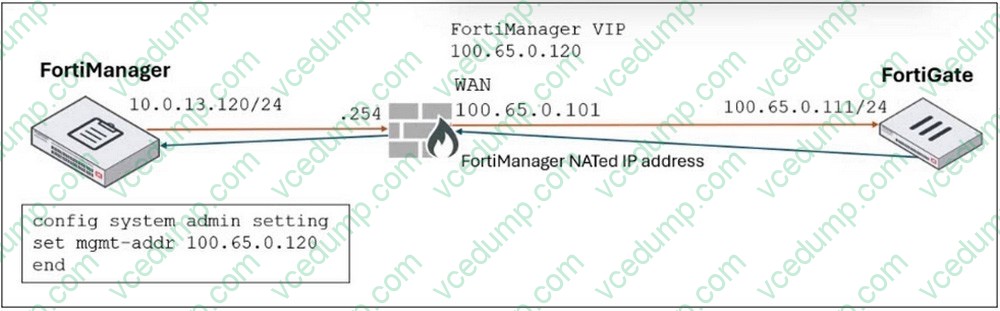
FortiManager is operating behind a network address translation (NAT) device, and the administrator configured the FortiManager NATed IP address under the FortiManager system administration settings.
What is the expected result during discovery?
A. FortiManager sets both the 100.65.0.120 IP address and 10.0.13.120 IP address on FortiGate.
B. FortiManager sets both the 100.65.0.120 IP address and 100.65.0.101 IP address on FortiGate.
C. FortiManager sets the 100.65.0.101 IP address on FortiGate.
D. FortiManager sets the 100.65.0.120 IP address on FortiGate. -
Question 92:
Refer to the exhibit.
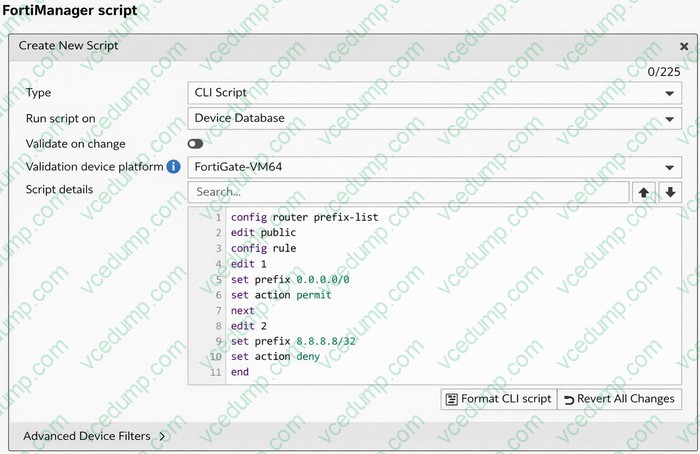
Which two results occur if you run the script using theDevice Databaseoption? (Choose two.)
A. The device Config Status is tagged as Modified.
B. The script history shows the successful installation of the script on the remote FortiGate.
C. The successful execution of a script on the Device Database creates a new revision history.
D. The administrator must install these changes on a managed device using the Install Wizard. -
Question 93:
Refer to the exhibit.
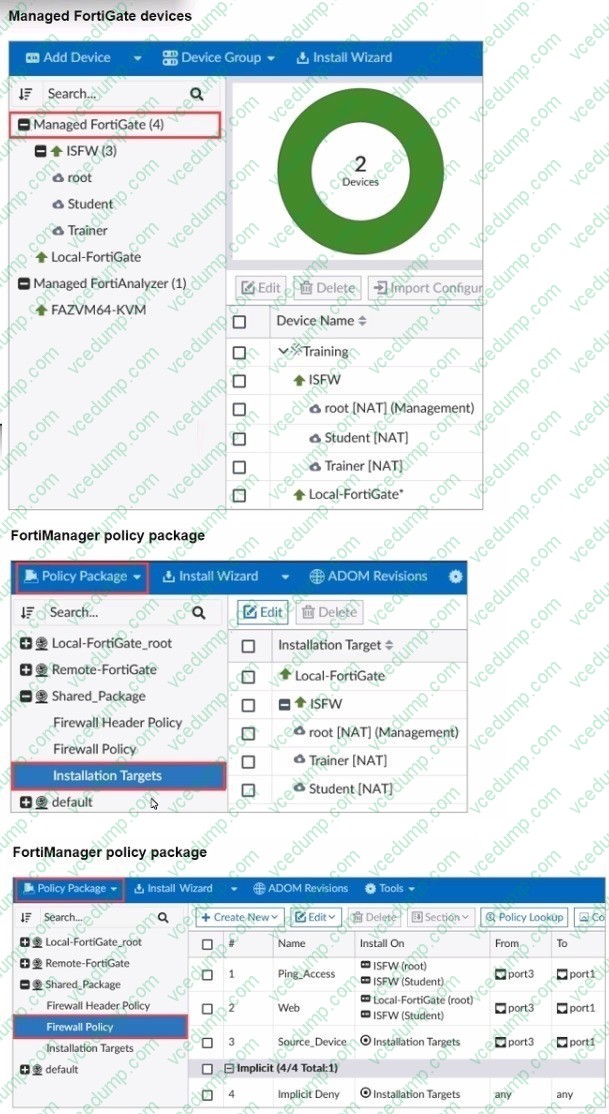
Given the configuration shown in the exhibit, which two conclusions can you draw from the installation targets in the Install On column? (Choose two.)
A. Policy seq.# 3 will be installed on all managed devices and VDOMs that are listed under Installation Targets.
B. Policy seq.# 3 will be skipped because no installation targets are specified.
C. Policy seq.# 2 will not be installed on the Local-FortiGate root VDOM because there is no root VDOM in the Installation Target
D. Policy seq.# 1 will be installed on the ISFW device root[NAT] and Student[NAT] VDOMs only. -
Question 94:
Which configuration setting for FortiGate is part o an ADOM-level database on FortiManager?
A. NSX-T Service Template
B. Routing
C. SNMP
D. Security profiles -
Question 95:
Refer to the exhibit.
Start to import config from device(Remote-FortiGate) vdom(root) to adom(root), package(Remote- FortiGate_root)
"firewall address", SKIPPED, "(name=all, oid=2309, DUPLICATE)"
"firewall address", FAIL, "(name=REMOTE_SUBNET, oid=2311, reason=interface((firewall address:REMOTE_SUBNET) any<-port6) binding fail)"
"firewall policy", FAIL, "(name=1, oid=3070, reason=interface(interface binding contradiction. detail:
(firewall address:REMOTE_SUBNET) any<-port6) binding fail)"
What can you conclude from the downloaded import report?
A. FortiManager does not support per-device mapping for firewall addresses.
B. The administrator will see a new policy package named Remote-FortiGate_root in the FortiManager ADOM database.
C. FortiManager will change the configuration of REMOTE_SUBNET to match the interface mapping coming in from Remote-FortiGate.
D. As a result of this policy import process, FortiManager will create a new firewall address called REMOTE_SUBNET in the ADOM database. -
Question 96:
Refer to the exhibit.
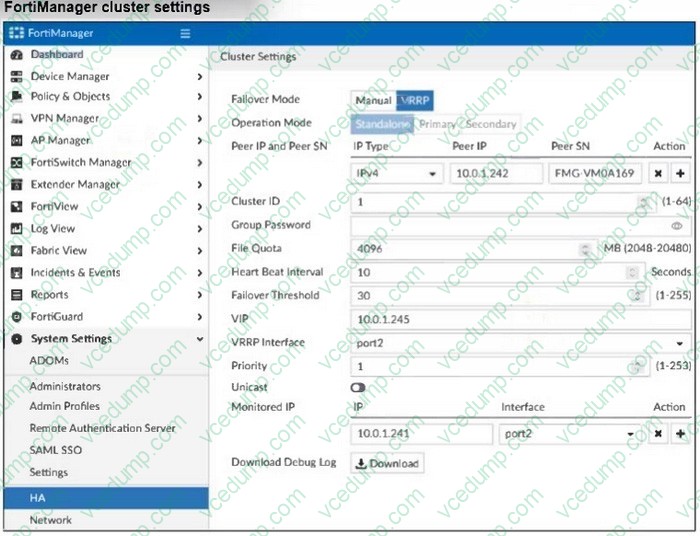
If the monitored interface for the primary FortiManager device fails, what must you do to maintain high availability (HA)?
A. The FortiManager HAfailover is transparent to administrators and does not require any additional action.
B. Manually promote one of the working secondary devices to the primary role: and reboot the original primary device to remove the peer IP address of the failed device.
C. Reconfigure the primary device to remove the peer IP address of the failed device from its configuration.
D. Check the integrity database of the primary device to force a secondary device to become the new primary with all active interfaces. -
Question 97:
An administrator created a new ADOM named Training for FortiGate devices only, and added the root FortiGate device of a Security Fabric group to the Training ADOM.
Given the administrator's actions, which statement correctly describes the expected result for the downstream devices in the Security Fabric?
A. The downstream devices show as unauthorized in the Training ADOM
B. The downstream devices are automatically authorized.
C. The downstream devices will appear in the root ADOM.
D. The downstream devices must be added using the Add Device wizard. -
Question 98:
Refer to the exhibit.
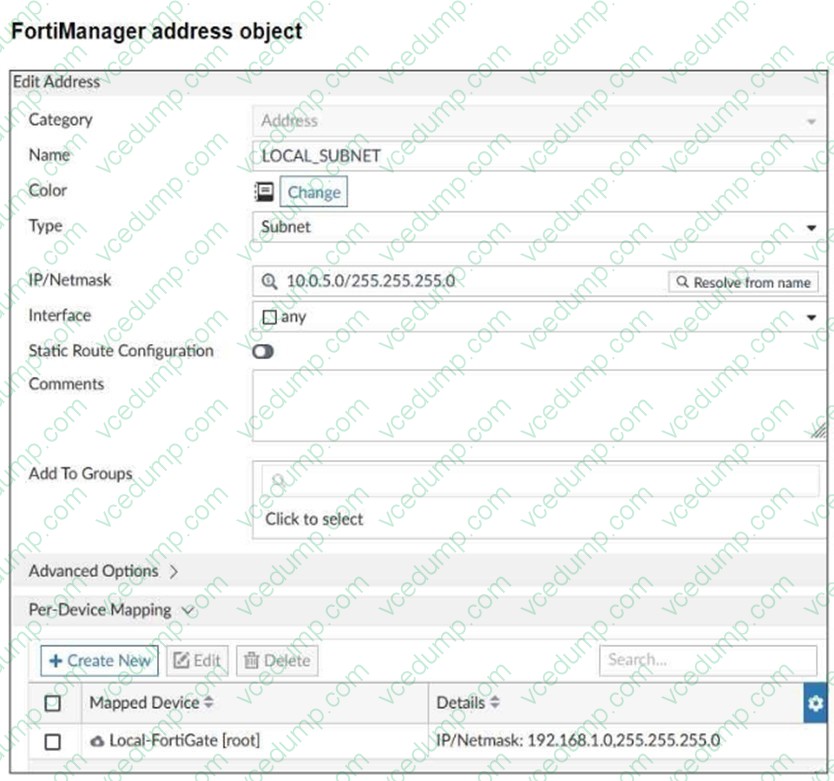
An administrator has created a firewall address object that is used in multiple policy packages for multiple FortiGate devices in an ADOM.
After the installation operation is performed, which IP/netmask will be installed on Local-FortiGate for theLOCAL_SUBNETfirewall address object?
A. 192.168.1.0/24
B. Local-FortiGate automatically chooses an IP/netmask based on its network interface settings.
C. It will create two firewall address objects on Local-FortiGate with 192.168.1.0/24 and 10.0.5.0/24 values.
D. 10.0.5.0/24 -
Question 99:
Refer to the exhibits.
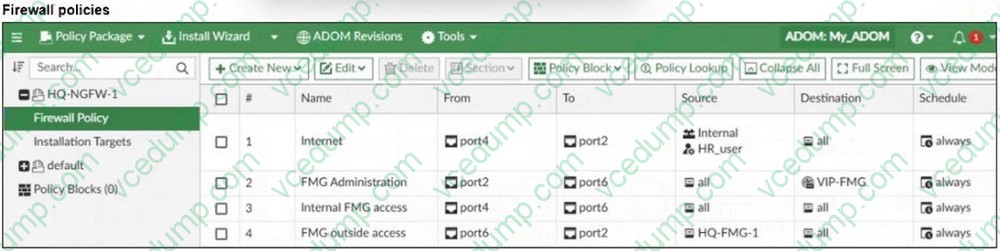

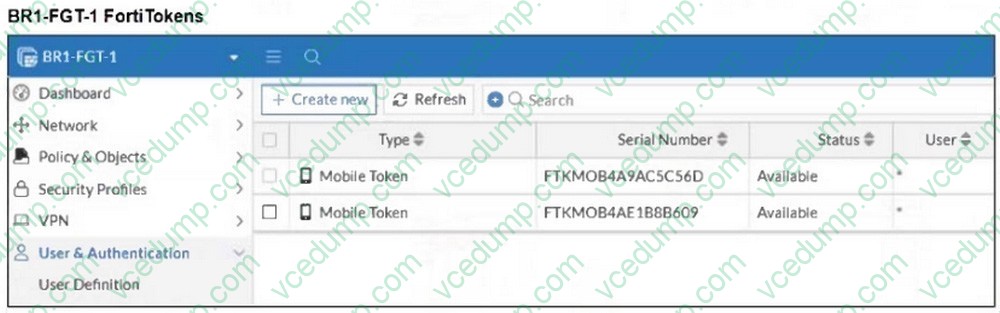
An administrator needs to push a FortiToken Mobile to assign it to HR_user in the HQ-NGFW-1.
However, when installing the policy package, they receive the following error message:
Copy device global objects
Vdom copy failed:
error -999 -
Copy objects for vdom root
"firewall policy", "1", id=5532, COMMIT FAIL - invalid value - prop[user fortitoken]:
Mobile FortiToken FTKM0B4A9AC5C56D used by user local HR_user could not be found at device
"user local", "FTKM0B4A9AC5C56D", id=5586, COMMIT FAIL - invalid value - prop[user fortitoken]: Mobile FortiToken FTKM0B4A9AC5C56D used by user local HR_user could not be found at device
Why is the administrator not able to install the FortiToken on the HQ-NGFW-1 firewall?
A. The administrator must use a user local meta field to assign FortiToken.
B. The administrator must use a valid FortiToken that exists on HQ-NGFW-1.
C. The administrator must use a metadata variable to assign the same FortiToken to multiple users in FortiManager.
D. The administrator must use per-device mapping to assign the FortiToken to HQ-NGFW-1. -
Question 100:
Which FortiManager function allows exporting system templates between ADOMs?
A. ADOM revision export
B. CLI script execution
C. fmprofile export-profile
D. Policy package clone
Related Exams:
-
EMEA-ADVANCED-SUPPORT
Fortinet EMEA Advanced Support -
FCP_FAC_AD-6.5
FCP - FortiAuthenticator 6.5 Administrator -
FCP_FAZ_AD-7.4
FCP - FortiAnalyzer 7.4 Administrator -
FCP_FAZ_AN-7.4
FCP - FortiAnalyzer 7.4 Analyst -
FCP_FAZ_AN-7.6
Fortinet NSE 5 - FortiAnalyzer 7.6 Analyst -
FCP_FCT_AD-7.2
FCP - Forti Client EMS 7.2 Administrator -
FCP_FCT_AD-7.4
Fortinet NSE 6 - FortiClient EMS 7.4 Administrator -
FCP_FGT_AD-7.4
FCP - FortiGate 7.4 Administrator -
FCP_FGT_AD-7.6
FortiGate 7.6 Administrator FCP_FGT_AD-7.6 -
FCP_FMG_AD-7.4
FCP - FortiManager 7.4 Administrator
Tips on How to Prepare for the Exams
Nowadays, the certification exams become more and more important and required by more and more enterprises when applying for a job. But how to prepare for the exam effectively? How to prepare for the exam in a short time with less efforts? How to get a ideal result and how to find the most reliable resources? Here on Vcedump.com, you will find all the answers. Vcedump.com provide not only Fortinet exam questions, answers and explanations but also complete assistance on your exam preparation and certification application. If you are confused on your FCP_FMG_AD-7.6 exam preparations and Fortinet certification application, do not hesitate to visit our Vcedump.com to find your solutions here.