DVA-C02 Exam Details
-
Exam Code
:DVA-C02 -
Exam Name
:AWS Certified Developer - Associate (DVA-C02) -
Certification
:Amazon Certifications -
Vendor
:Amazon -
Total Questions
:574 Q&As -
Last Updated
:May 27, 2026
Amazon DVA-C02 Online Questions & Answers
-
Question 361:
A social media application uses the AWS SDK for JavaScript on the frontend to get user credentials from AWS Security Token Service (AWS STS). The application stores its assets in an Amazon S3 bucket. The application serves its content
by using an Amazon CloudFront distribution with the origin set to the S3 bucket.
The credentials for the role that the application assumes to make the SDK calls are stored in plaintext in a JSON file within the application code. The developer needs to implement a solution that will allow the application to get user credentials
without having any credentials hardcoded in the application code.
Which solution will meet these requirements?
A. Add a Lambda@Edge function to the distribution. Invoke the function on viewer request. Add permissions to the function's execution role to allow the function to access AWS STS. Move all SDK calls from the frontend into the function.
B. Add a CloudFront function to the distribution. Invoke the function on viewer request. Add permissions to the function's execution role to allow the function to access AWS STS. Move all SDK calls from the frontend into the function.
C. Add a Lambda@Edge function to the distribution. Invoke the function on viewer request. Move the credentials from the JSON file into the function. Move all SDK calls from the frontend into the function.
D. Add a CloudFront function to the distribution. Invoke the function on viewer request. Move the credentials from the JSON file into the function. Move all SDK calls from the frontend into the function. -
Question 362:
A developer needs to migrate an online retail application to AWS to handle an anticipated increase in traffic. The application currently runs on two servers: one server for the web application and another server for the database. The web server renders webpages and manages session state in memory. The database server hosts a MySQL database that contains order details. When traffic to the application is heavy, the memory usage for the web server approaches 100% and the application slows down considerably.
The developer has found that most of the memory increase and performance decrease is related to the load of managing additional user sessions. For the web server migration, the developer will use Amazon EC2 instances with an Auto Scaling group behind an Application Load Balancer.
Which additional set of changes should the developer make to the application to improve the application's performance?
A. Use an EC2 instance to host the MySQL database. Store the session data and the application data in the MySQL database.
B. Use Amazon ElastiCache for Memcached to store and manage the session data. Use an Amazon RDS for MySQL DB instance to store the application data.
C. Use Amazon ElastiCache for Memcached to store and manage the session data and the application data.
D. Use the EC2 instance store to manage the session data. Use an Amazon RDS for MySQL DB instance to store the application data. -
Question 363:
A developer is building a three-tier web application that should be able to handle a minimum of 5000 requests per minute. Requirements state that the web tier should be completely stateless while the application maintains session state for the users.
How can session data be externalized, keeping latency at the LOWEST possible value?
A. Create an Amazon RDS instance, then implement session handling at the application level to leverage a database inside the RDS database instance for session data storage.
B. Implement a shared file system solution across the underlying Amazon EC2 instances, then implement session handling at the application level to leverage the shared file system for session data storage.
C. Create an Amazon ElastiCache (Memcached) cluster, then implement session handling at the application level to leverage the cluster for session data storage.
D. Create an Amazon DynamoDB table, then implement session handling at the application level to leverage the table for session data storage. -
Question 364:
A developer is creating an application that includes an Amazon API Gateway REST API in the us-east-2 Region. The developer wants to use Amazon CloudFront and a custom domain name for the API. The developer has acquired an SSL/ TLS certificate for the domain from a third-party provider.
How should the developer configure the custom domain for the application?
A. Import the SSL/TLS certificate into AWS Certificate Manager (ACM) in the same Region as the API. Create a DNS A record for the custom domain.
B. Import the SSL/TLS certificate into CloudFront. Create a DNS CNAME record for the custom domain.
C. Import the SSL/TLS certificate into AWS Certificate Manager (ACM) in the same Region as the API. Create a DNS CNAME record for the custom domain.
D. Import the SSL/TLS certificate into AWS Certificate Manager (ACM) in the us-east-1 Region. Create a DNS CNAME record for the custom domain. -
Question 365:
A developer is managing an application that uploads user files to an Amazon S3 bucket named companybucket. The company wants to maintain copies of all the files uploaded by users for compliance purposes, while ensuring users still have access to the data through the application.
Which IAM permissions should be applied to users to ensure they can create but not remove files from the bucket?
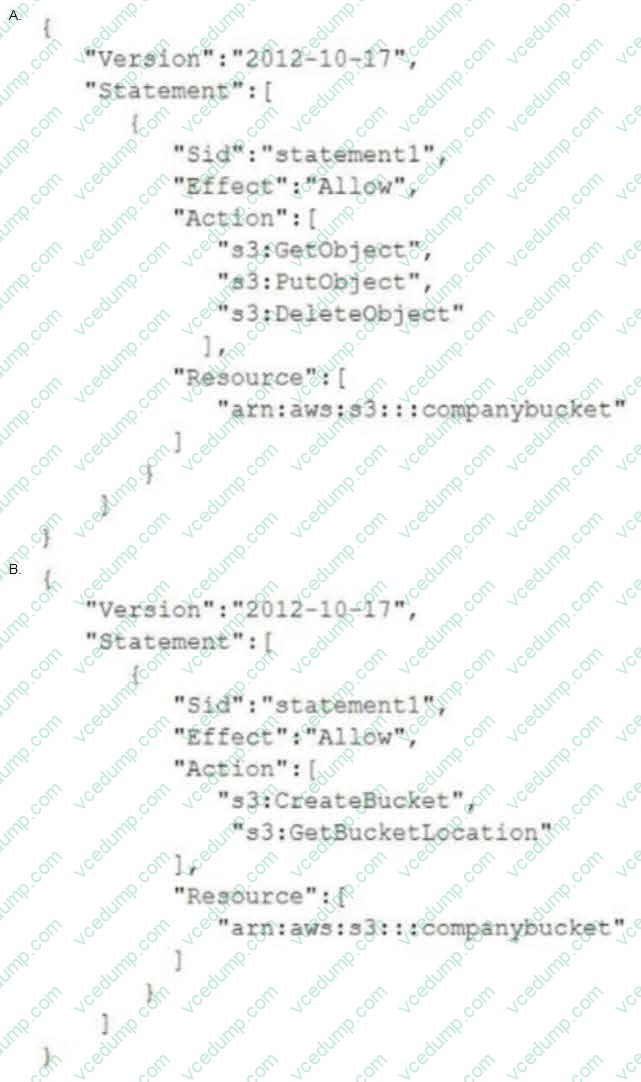
A. Option A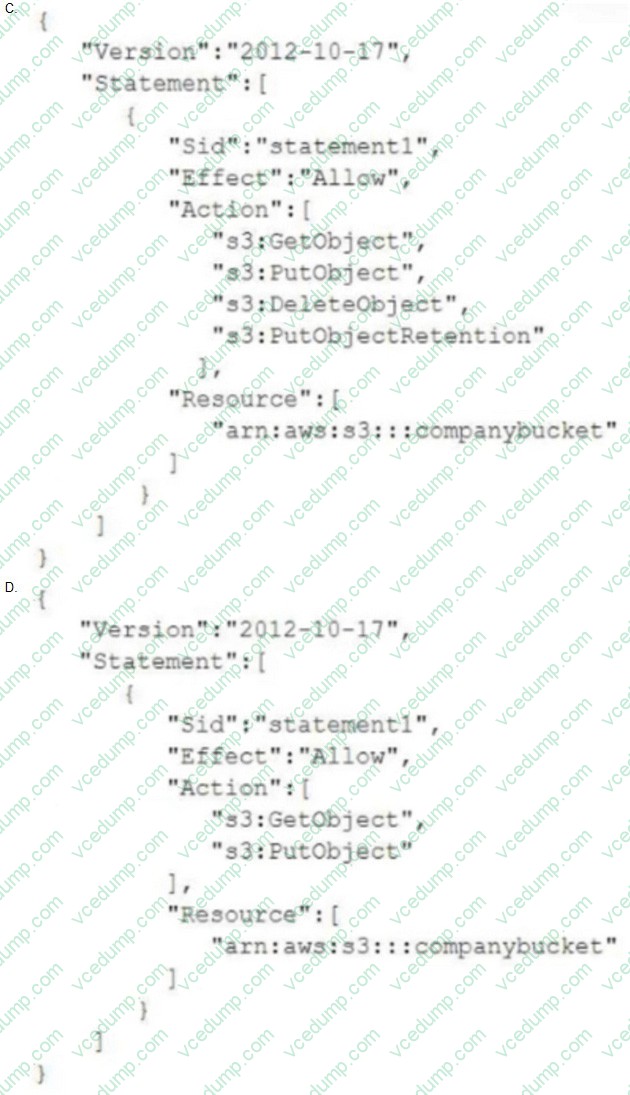
B. Option B
C. Option C
D. Option D -
Question 366:
A company is working on a new serverless application. A developer needs to find an automated way to deploy AWS Lambda functions and the dependent infrastructure with minimum coding effort. The application also needs to be reliable. Which method will meet these requirements with the LEAST operational overhead?
A. Build the application by using shell scripts to create .zip files for each Lambda function. Manually upload the .zip files to the AWS Management Console.
B. Build the application by using the AWS Serverless Application Model (AWS SAM). Use a continuous integration and continuous delivery (CI/CD) pipeline and the SAM CLI to deploy the Lambda functions.
C. Build the application by using shell scripts to create .zip files for each Lambda function. Upload the .zip files. Deploy the .zip files as Lambda functions by using the AWS CLI in a continuous integration and continuous delivery (CI/CD) pipeline.
D. Build a container for each Lambda function. Store the container images in AWS CodeArtifact. Deploy the containers as Lambda functions by using the AWS CLI in a continuous integration and continuous delivery (CI/CD) pipeline. -
Question 367:
A developer is troubleshooting a three-tier application, which is deployed on Amazon EC2 instances. There is a connectivity problem between the application servers and the database servers. Which AWS services or tools should be used to identify the faulty component? (Select TWO.)
A. AWS CloudTrail
B. AWS Trusted Advisor
C. Amazon VPC Flow Logs
D. Network access control lists
E. AWS Config rules -
Question 368:
A company had an Amazon RDS for MySQL DB instance that was named mysql-db. The DB instance was deleted within the past 90 days.
A developer needs to find which IAM user or role deleted the DB instance in the AWS environment.
Which solution will provide this information?
A. Retrieve the AWS CloudTrail events for the resource mysql-db where the event name is DeleteDBInstance. Inspect each event.
B. Retrieve the Amazon CloudWatch log events from the most recent log stream within the rds/mysql-db log group. Inspect the log events.
C. Retrieve the AWS X-Ray trace summaries. Filter by services with the name mysql-db. Inspect the ErrorRootCauses values within each summary.
D. Retrieve the AWS Systems Manager deletions inventory. Filter the inventory by deletions that have a TypeName value of RDS. Inspect the deletion details. -
Question 369:
A company hosts a monolithic application on Amazon EC2 instances. The company starts converting some features of the application to a serverless architecture by using Amazon API Gateway and AWS Lambda. After the migration, some users report problems with payment processing.
Upon inspection, a developer discovers that the Lambda function that calls the external payment API is taking longer than expected. Therefore, the API Gateway requests are timing out. What should the developer do to resolve this issue in the serverless architecture?
A. Use the EC2 instances to make the API calls to the payment API.
B. Use Amazon Simple Queue Service (Amazon SQS) with API Gateway and the Lambda function to asynchronously call the payment API.
C. Increase the API Gateway timeout duration to match the payment API time.
D. Increase the Lambda function's memory to increase the network bandwidth and increase the speed of the payment API calls. -
Question 370:
A company runs its APIs using Amazon API Gateway in front of AWS Lambda functions. The company wants to add logging at the API level. Each API must have production and development environments. The developer wants to enable different logging levels in both environments.
How can these requirements be met?
A. Set up a stage for each environment. In each stage, point to different Lambda functions that implement the logging logic in the code. Access the logs in Amazon CloudWatch Logs.
B. Set up a stage for each environment. In each stage, define a different logging level according to the logging requirements. Access the logs in Amazon CloudWatch Logs.
C. Set up a stage and use the same Lambda functions. In Amazon CloudWatch Logs, set up a filter based on the log level according to the logging requirements.
D. Set up a stage for each environment. In each stage, define a variable for the log level. Set the value according to the logging requirements.
Related Exams:
-
AIF-C01
Amazon AWS Certified AI Practitioner (AIF-C01) -
AIP-C01
AWS Certified Generative AI Developer - Professional -
ANS-C00
AWS Certified Advanced Networking - Specialty (ANS-C00) -
ANS-C01
AWS Certified Advanced Networking - Specialty (ANS-C01) -
AXS-C01
AWS Certified Alexa Skill Builder - Specialty (AXS-C01) -
BDS-C00
AWS Certified Big Data - Speciality (BDS-C00) -
CLF-C02
AWS Certified Cloud Practitioner (CLF-C02) -
DAS-C01
AWS Certified Data Analytics - Specialty (DAS-C01) -
DATA-ENGINEER-ASSOCIATE
AWS Certified Data Engineer - Associate (DEA-C01) -
DBS-C01
AWS Certified Database - Specialty (DBS-C01)
Tips on How to Prepare for the Exams
Nowadays, the certification exams become more and more important and required by more and more enterprises when applying for a job. But how to prepare for the exam effectively? How to prepare for the exam in a short time with less efforts? How to get a ideal result and how to find the most reliable resources? Here on Vcedump.com, you will find all the answers. Vcedump.com provide not only Amazon exam questions, answers and explanations but also complete assistance on your exam preparation and certification application. If you are confused on your DVA-C02 exam preparations and Amazon certification application, do not hesitate to visit our Vcedump.com to find your solutions here.