DP-100 Exam Details
-
Exam Code
:DP-100 -
Exam Name
:Designing and Implementing a Data Science Solution on Azure -
Certification
:Microsoft Certifications -
Vendor
:Microsoft -
Total Questions
:617 Q&As -
Last Updated
:Jul 17, 2026
Microsoft DP-100 Online Questions & Answers
-
Question 351:
Note: This question is part of a series of questions that present the same scenario. Each question in the series contains a unique solution that might meet the stated goals. Some question sets might have more than one correct solution, while others might not have a correct solution.
After you answer a question in this section, you will NOT be able to return to it. As a result, these questions will not appear in the review screen.
An IT department creates the following Azure resource groups and resources:
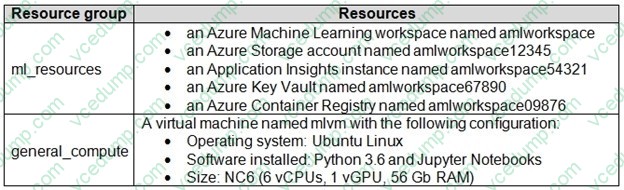
The IT department creates an Azure Kubernetes Service (AKS)-based inference compute target named aks-cluster in the Azure Machine Learning workspace.
You have a Microsoft Surface Book computer with a GPU. Python 3.6 and Visual Studio Code are installed.
You need to run a script that trains a deep neural network (DNN) model and logs the loss and accuracy metrics.
Solution: Attach the mlvm virtual machine as a compute target in the Azure Machine Learning workspace. Install the Azure ML SDK on the Surface Book and run Python code to connect to the workspace. Run the training script as an experiment on the mlvm remote compute resource.
Does the solution meet the goal?
A. Yes
B. No -
Question 352:
DRAG DROP
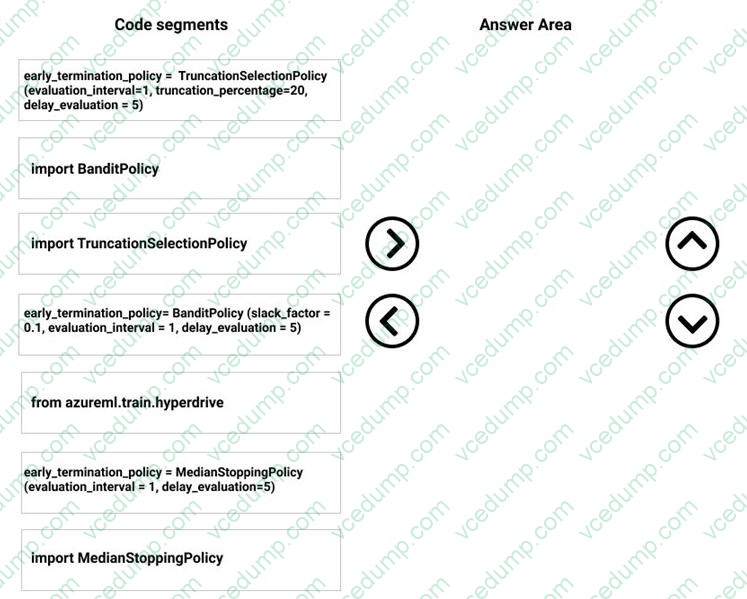
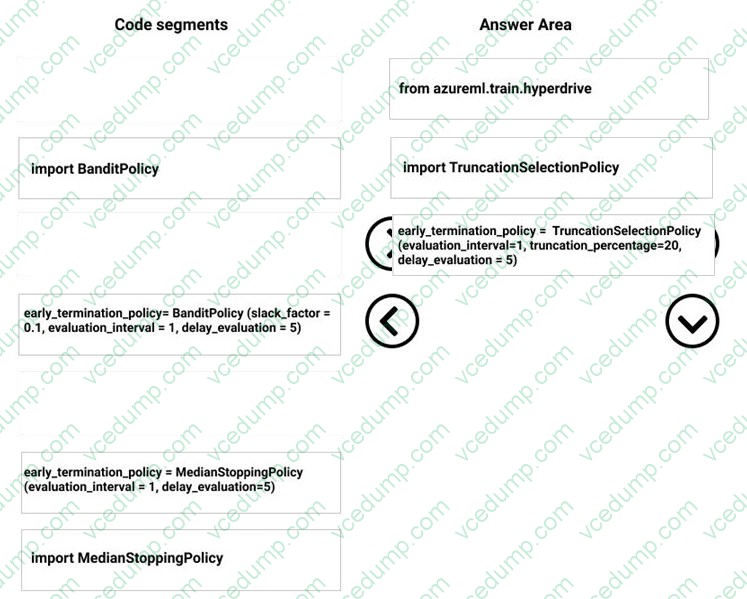
You need to implement early stopping criteria as stated in the model training requirements.
Which three code segments should you use to develop the solution? To answer, move the appropriate code segments from the list of code segments to the answer area and arrange them in the correct order.
NOTE: More than one order of answer choices is correct. You will receive the credit for any of the correct orders you select.
Select and Place:
-
Question 353:
You manage an Azure Machine Learning workspace. You have an environment for training jobs which uses an existing Docker image. A new version of the Docker image is available.
You need to use the latest version of the Docker image for the environment configuration by using the Azure Machine Learning SDK v2-What should you do?
A. Modify the conda.file to specify the new version of the Docker image.
B. Use the Environment class to create a new version of the environment.
C. Use the create.or.update method to change the tag of the image.
D. Change the description parameter of the environment configuration. -
Question 354:
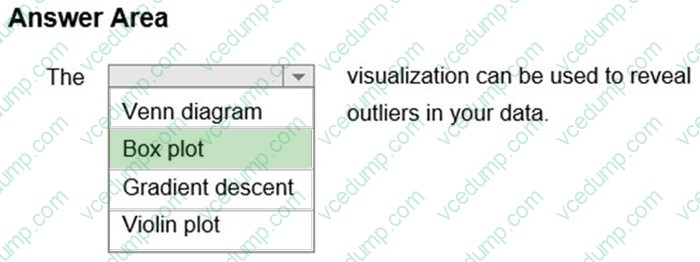
HOTSPOT
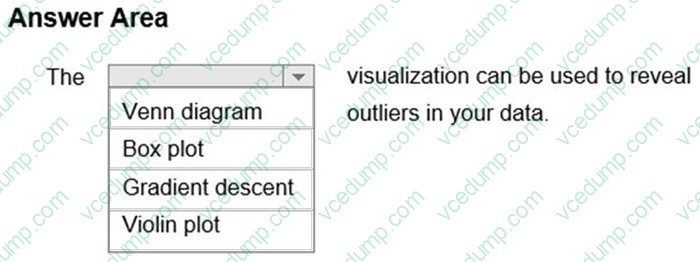
You need to consider the underlined segment to establish whether it is accurate.
-
Question 355:
You plan to provision an Azure Machine Learning Basic edition workspace for a data science project.
You need to identify the tasks you will be able to perform in the workspace.
Which three tasks will you be able to perform? Each correct answer presents a complete solution.
NOTE: Each correct selection is worth one point.
A. Create a Compute Instance and use it to run code in Jupyter notebooks.
B. Create an Azure Kubernetes Service (AKS) inference cluster.
C. Use the designer to train a model by dragging and dropping pre-defined modules.
D. Create a tabular dataset that supports versioning.
E. Use the Automated Machine Learning user interface to train a model. -
Question 356:
Note: This question is part of a series of questions that present the same scenario. Each question in the series contains a unique solution that might meet the stated goals. Some question sets might have more than one correct solution, while others might not have a correct solution.
After you answer a question in this section, you will NOT be able to return to it. As a result, these questions will not appear in the review screen.
You train and register a machine learning model.
You plan to deploy the model as a real-time web service. Applications must use key-based authentication to use the model.
You need to deploy the web service.
Solution:
Create an AciWebservice instance.
Set the value of the auth_enabled property to False.
Set the value of the token_auth_enabled property to True.
Deploy the model to the service.
Does the solution meet the goal?
A. Yes
B. No -
Question 357:
HOTSPOT
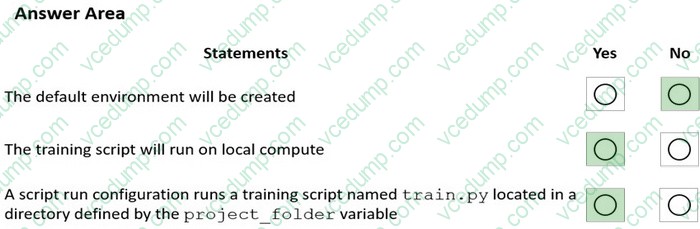
You use an Azure Machine Learning workspace.
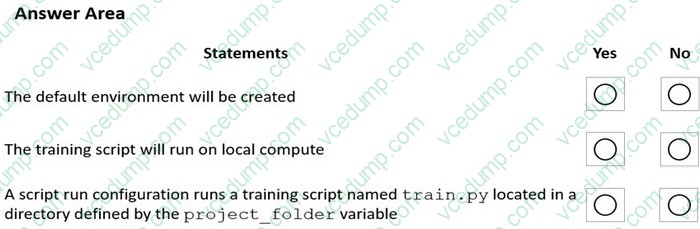
You create the following Python code:

For each of the following statements, select Yes if the statement is true. Otherwise, select No.
NOTE: Each correct selection is worth one point.
-
Question 358:
You create a multi-class image classification deep learning model that uses the PyTorch deep learning framework.
You must configure Azure Machine Learning Hyperdrive to optimize the hyperparameters for the classification model.
You need to define a primary metric to determine the hyperparameter values that result in the model with the best accuracy score.
Which three actions must you perform? Each correct answer presents part of the solution.
NOTE: Each correct selection is worth one point.
A. Set the primary_metric_goal of the estimator used to run the bird_classifier_train.py script to maximize.
B. Add code to the bird_classifier_train.py script to calculate the validation loss of the model and log it as a float value with the key loss.
C. Set the primary_metric_goal of the estimator used to run the bird_classifier_train.py script to minimize.
D. Set the primary_metric_name of the estimator used to run the bird_classifier_train.py script to accuracy.
E. Set the primary_metric_name of the estimator used to run the bird_classifier_train.py script to loss.
F. Add code to the bird_classifier_train.py script to calculate the validation accuracy of the model and log it as a float value with the key accuracy. -
Question 359:
DRAG DROP
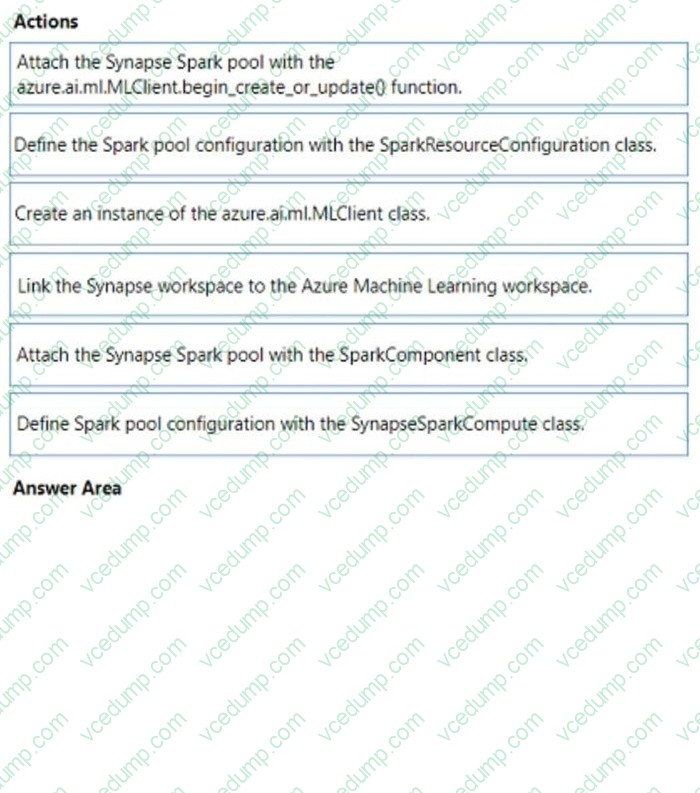
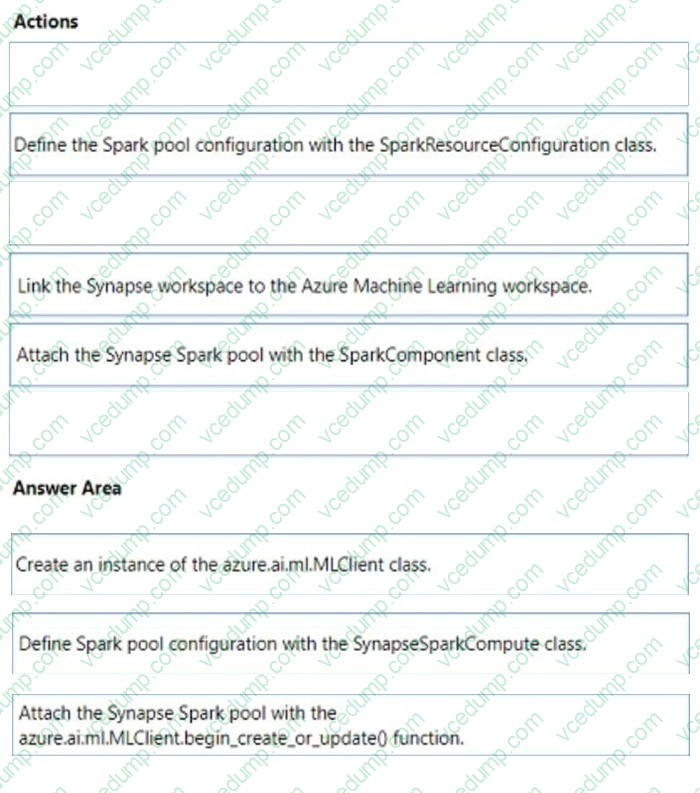
You create an Azure Machine Learning workspace and an Azure Synapse Analytics workspace with a Spark pool. The workspaces are contained within the same Azure subscription.
You must manage the Synapse Spark pool from the Azure Machine Learning workspace.
You need to attach the Synapse Spark pool in Azure Machine Learning by using the Python SDK v2.
Which three actions should you perform in sequence? To answer, move the appropriate actions from the list of actions to the answer area and arrange them in the correct order.
Select and Place:
-
Question 360:
You have an Azure Machine Learning workspace.
You plan to use automated machine learning to train a natural language processing model for multi-class classification.
You need to provide a dataset for training the model.
How should you format the data?
A. Exactly one text column and one or more label columns
B. One or more text columns and exactly one label column
C. One or more text columns and one or more label columns
D. Exactly one text column and exactly one label column
Related Exams:
-
62-193
Technology Literacy for Educators -
70-243
Administering and Deploying System Center 2012 Configuration Manager -
70-355
Universal Windows Platform – App Data, Services, and Coding Patterns -
77-420
Excel 2013 -
77-427
Excel 2013 Expert Part One -
77-725
Word 2016 Core Document Creation, Collaboration and Communication -
77-726
Word 2016 Expert Creating Documents for Effective Communication -
77-727
Excel 2016 Core Data Analysis, Manipulation, and Presentation -
77-728
Excel 2016 Expert: Interpreting Data for Insights -
77-731
Outlook 2016 Core Communication, Collaboration and Email Skills
Tips on How to Prepare for the Exams
Nowadays, the certification exams become more and more important and required by more and more enterprises when applying for a job. But how to prepare for the exam effectively? How to prepare for the exam in a short time with less efforts? How to get a ideal result and how to find the most reliable resources? Here on Vcedump.com, you will find all the answers. Vcedump.com provide not only Microsoft exam questions, answers and explanations but also complete assistance on your exam preparation and certification application. If you are confused on your DP-100 exam preparations and Microsoft certification application, do not hesitate to visit our Vcedump.com to find your solutions here.