DOP-C02 Exam Details
-
Exam Code
:DOP-C02 -
Exam Name
:AWS Certified DevOps Engineer - Professional (DOP-C02) -
Certification
:Amazon Certifications -
Vendor
:Amazon -
Total Questions
:461 Q&As -
Last Updated
:Jul 11, 2026
Amazon DOP-C02 Online Questions & Answers
-
Question 411:
A DevOps engineer is implementing governance controls for a company that requires its infrastructure to be housed within the United States. The engineer must restrict which AWS Regions can be used, and ensure an alert is sent as soon as possible if any activity outside the governance policy takes place. The controls should be automatically enabled on any new Region outside the United States (US).
Which combination of actions will meet these requirements? (Choose two.)
A. Create an AWS Organizations SCP that denies access to all non-global services in non-US Regions. Attach the policy to the root of the organization.
B. Configure AWS CloudTrail to send logs to Amazon CloudWatch Logs and enable it for all Regions. Use a CloudWatch Logs metric filter to send an alert on any service activity in non-US Regions.
C. Use an AWS Lambda function that checks for AWS service activity and deploy it to all Regions. Write an Amazon EventBridge rule that runs the Lambda function every hour, sending an alert if activity is found in a non-US Region.
D. Use an AWS Lambda function to query Amazon Inspector to look for service activity in non-US Regions and send alerts if any activity is found.
E. Write an SCP using the aws:RequestedRegion condition key limiting access to US Regions. Apply the policy to all users, groups, and roles. -
Question 412:
A company's development team uses AWS CloudFormation to deploy its application resources. The team must use it for any changes to the environment. The team cannot use the AWS Management Console or the AWS CLI to make manual changes directly.
The team uses a developer IAM role to access the environment. The role is configured with the AdministratorAccess managed policy. The company has created a new CloudFormationDeployment IAM role that has the following policy.
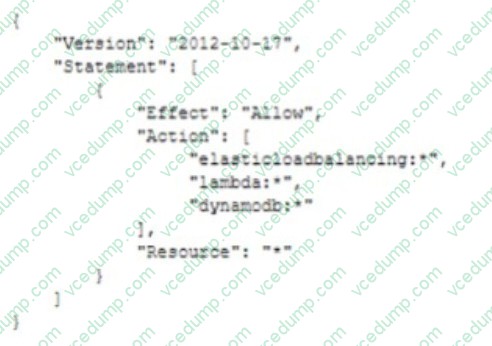
The company wants to ensure that only CloudFormation can use the new role. The development team cannot make any manual changes to the deployed resources.
Which combination of steps meets these requirements? (Select THREE.)
A. Remove the AdministratorAccess policy. Assign the ReadOnlyAccess managed IAM policy to the developer role. Instruct the developers to use the CloudFormationDeployment role as a CloudFormation service role when the developers deploy new stacks.
B. Update the trust policy of the CloudFormationDeployment role to allow the developer IAM role to assume the CloudFormationDeployment role.
C. Configure the IAM role to be able to get and pass the CloudFormationDeployment role for CloudFormation actions for resources.
D. Update the trust policy of the CloudFormationDeployment role to allow the cloudformation.amazonaws.com AWS principal to perform the iam:AssumeRole action.
E. Remove the AdministratorAccess policy. Assign the ReadOnlyAccess managed IAM policy to the developer role. Instruct the developers to assume the CloudFormationDeployment role when they deploy new stacks.
F. Add an IAM policy to the CloudFormationDeployment role to allow cloudformation:* on all resources.Add a policy that allows the iam:PassRole action for the ARN, if iam:PassedToService equals cloudformation.amazonaws.com. -
Question 413:
A developer is using the AWS Serverless Application Model (AWS SAM) to create a prototype for an AWS Lambda function. The AWS SAM template contains an AWS::Serverless::Function resource that has the CodeUri property that points to an Amazon S3 location. The developer wants to identify the correct commands for deployment before creating a CI/CD pipeline.
The developer creates an archive of the Lambda function code named package.zip. The developer uploads the .zip file archive to the S3 location specified in the CodeUri property. The developer runs the sam deploy command and deploys the Lambda function. The developer updates the Lambda function code and uses the same steps to deploy the new version of the Lambda function. The sam deploy command fails and returns an error of no changes to deploy.
Which solutions will deploy the new version? (Choose two.)
A. Use the aws cloudformation update-stack command instead of the sam deploy command.
B. Use the aws cloudformation update-stack-instances command instead of the sam deploy command.
C. Update the CodeUri property to reference the local application code folder. Use the sam deploy command.
D. Update the CodeUri property to reference the local application code folder. Use the aws cloudformation create-change-set command and the aws cloudformation execute-change-set command.
E. Update the CodeUri property to reference the local application code folder. Use the aws cloudformation package command and the aws cloudformation deploy command. -
Question 414:
A company recently deployed its web application on AWS. The company is preparing for a large-scale sales event and must ensure that the web application can scale to meet the demand.
The application's frontend infrastructure includes an Amazon CloudFront distribution that has an Amazon S3 bucket as an origin. The backend infrastructure includes an Amazon API Gateway API, several AWS Lambda functions, and an Amazon Aurora DB cluster.
The company's DevOps engineer conducts a load test and identifies that the Lambda functions can fulfil the peak number of requests. However, the DevOps engineer notices request latency during the initial burst of requests. Most of the requests to the Lambda functions produce queries to the database. A large portion of the invocation time is used to establish database connections.
Which combination of steps will provide the application with the required scalability? (Choose three.)
A. Configure a higher reserved concurrency for the Lambda functions.
B. Configure a higher provisioned concurrency for the Lambda functions.
C. Convert the DB cluster to an Aurora global database. Add additional Aurora Replicas in AWS Regions based on the locations of the company's customers.
D. Refactor the Lambda functions. Move the code blocks that initialize database connections into the function handlers.
E. Use Amazon RDS Proxy to create a proxy for the Aurora database. Update the Lambda functions to use the proxy endpoints for database connections. -
Question 415:
A DevOps engineer is working on a data archival project that requires the migration of on-premises data to an Amazon S3 bucket. The DevOps engineer develops a script that incrementally archives on-premises data that is older than 1 month to Amazon S3. Data that is transferred to Amazon S3 is deleted from the on-premises location The script uses the S3 PutObject operation.
During a code review the DevOps engineer notices that the script does not verity whether the data was successfully copied to Amazon S3. The DevOps engineer must update the script to ensure that data is not corrupted during transmission. The script must use MD5 checksums to verify data integrity before the on-premises data is deleted.
Which solutions for the script will meet these requirements'? (Select TWO.)
A. Check the returned response for the Versioned Compare the returned Versioned against the MD5 checksum.
B. Include the MD5 checksum within the Content-MD5 parameter. Check the operation call's return status to find out if an error was returned.
C. Include the checksum digest within the tagging parameter as a URL query parameter.
D. Check the returned response for the ETag. Compare the returned ETag against the MD5 checksum.
E. Include the checksum digest within the Metadata parameter as a name-value pair After upload use the S3 HeadObject operation to retrieve metadata from the object. -
Question 416:
A company runs hundreds of EC2 instances with new instances launched/terminated hourly. Security requires all running instances to have an instance profile attached. A default profile exists and must be attached automatically to any instance missing one.
Which solution meets this requirement?
A. EventBridge rule for RunInstances API calls, invoke Lambda to attach default profile.
B. AWS Config with ec2-instance-profile-attached managed rule, automatic remediation using Systems Manager Automation runbook to attach profile.
C. EventBridge rule for StartInstances API calls, invoke Systems Manager Automation runbook to attach profile.
D. AWS Config iam-role-managed-policy-check managed rule, automatic remediation with Lambda to attach profile. -
Question 417:
Some of your EC2 instances are configured to use a Proxy. Can you use Amazon Inspector for regular assessment of instances behind proxy?
A. Only Windows-based systems are supported as Linux-based systems use custom configurations that are not supported by AWS Agent in the current release.
B. Only Linux-based systems are supported, and AWS agent supports HTTPS proxy on these systems.
C. No, AWS Agent does NOT support proxy environments.
D. Yes, AWS Agent supports proxy environments on both Linux-based and Windows-based systems. -
Question 418:
A company has an application that runs on Amazon EC2 instances. The company uses an AWS CodePipeline pipeline to deploy the application into multiple AWS Regions. The pipeline is configured with a stage for each Region. Each stage contains an AWS CloudFormation action for each Region.
When the pipeline deploys the application to a Region, the company wants to confirm that the application is in a healthy state before the pipeline moves on to the next Region. Amazon Route 53 record sets are configured for the application in each Region. A DevOps engineer creates a Route 53 health check that is based on an Amazon CloudWatch alarm for each Region where the application is deployed.
What should the DevOps engineer do next to meet the requirements?
A. Create an AWS Step Functions workflow to check the state of the CloudWatch alarm. Configure the Step Functions workflow to exit with an error if the alarm is in the ALARM state. Create a new stage in the pipeline between each Region deployment stage. In each new stage, include an action to invoke the Step Functions workflow.
B. Configure an AWS CodeDeploy application to deploy a CloudFormation template with automatic rollback. Configure the CloudWatch alarm as the instance health check for the CodeDeploy application. Remove the CloudFormation actions from the pipeline. Create a CodeDeploy action in the pipeline stage for each Region.
C. Create a new pipeline stage for each Region where the application is deployed. Configure a CloudWatch alarm action for the new stage to check the state of the CloudWatch alarm and to exit with an error if the alarm is in the ALARM state
D. Configure the CloudWatch agent on the EC2 instances to report the application status to the Route 53 health check. Create a new pipeline stage for each Region where the application is deployed. Configure a CloudWatch alarm action to exit with an error if the CloudWatch alarm is in the ALARM state. -
Question 419:
Which services can be used as optional components of setting up a new Trail in CloudTrail?
A. KMS, SNS and SES
B. CloudWatch, S3 and SNS
C. KMS, Cloudwatch and SNS
D. KMS, S3 and CloudWatch -
Question 420:
Which of the following is an invalid variable name in Ansible?
A. host1st_ref
B. host-first-ref
C. Host1stRef
D. host_first_ref
Related Exams:
-
AIF-C01
Amazon AWS Certified AI Practitioner (AIF-C01) -
AIP-C01
AWS Certified Generative AI Developer - Professional -
ANS-C00
AWS Certified Advanced Networking - Specialty (ANS-C00) -
ANS-C01
AWS Certified Advanced Networking - Specialty (ANS-C01) -
AXS-C01
AWS Certified Alexa Skill Builder - Specialty (AXS-C01) -
BDS-C00
AWS Certified Big Data - Speciality (BDS-C00) -
CLF-C02
AWS Certified Cloud Practitioner (CLF-C02) -
DAS-C01
AWS Certified Data Analytics - Specialty (DAS-C01) -
DATA-ENGINEER-ASSOCIATE
AWS Certified Data Engineer - Associate (DEA-C01) -
DBS-C01
AWS Certified Database - Specialty (DBS-C01)
Tips on How to Prepare for the Exams
Nowadays, the certification exams become more and more important and required by more and more enterprises when applying for a job. But how to prepare for the exam effectively? How to prepare for the exam in a short time with less efforts? How to get a ideal result and how to find the most reliable resources? Here on Vcedump.com, you will find all the answers. Vcedump.com provide not only Amazon exam questions, answers and explanations but also complete assistance on your exam preparation and certification application. If you are confused on your DOP-C02 exam preparations and Amazon certification application, do not hesitate to visit our Vcedump.com to find your solutions here.