DEA-C01 Exam Details
-
Exam Code
:DEA-C01 -
Exam Name
:SnowPro Advanced: Data Engineer Certification (DEA-C01) -
Certification
:Snowflake Certifications -
Vendor
:Snowflake -
Total Questions
:65 Q&As -
Last Updated
:Sep 03, 2025
Snowflake DEA-C01 Online Questions & Answers
-
Question 21:
How can the following relational data be transformed into semi-structured data using the LEAST amount of operational overhead?
A. Use the to_json function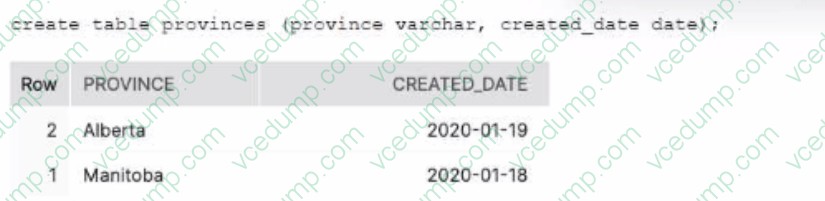
B. Use the PAESE_JSON function to produce a variant value
C. Use the OBJECT_CONSTRUCT function to return a Snowflake object
D. Use the TO_VARIANT function to convert each of the relational columns to VARIANT. -
Question 22:
Which Snowflake objects does the Snowflake Kafka connector use? (Select THREE).
A. Pipe
B. Serverless task
C. Internal user stage
D. Internal table stage
E. Internal named stage
F. Storage integration -
Question 23:
A Data Engineer would like to define a file structure for loading and unloading data
Where can the file structure be defined? (Select THREE)
A. copy command
B. MERGE command
C. FILE FORMAT Object
D. pipe object
E. stage object
F. INSERT command -
Question 24:
A Data Engineer is evaluating the performance of a query in a development environment. Based on the Query Profile what are some performance tuning options the Engineer can use? (Select TWO)
A. Add a LIMIT to the ORDER BY If possible
B. Use a multi-cluster virtual warehouse with the scaling policy set to standard
C. Move the query to a larger virtual warehouse
D. Create indexes to ensure sorted access to data
E. Increase the max cluster count -
Question 25:
A CSV file around 1 TB in size is generated daily on an on-premise server A corresponding table. Internal stage, and file format have already been created in Snowflake to facilitate the data loading process How can the process of bringing the CSV file into Snowflake be automated using the LEAST amount of operational overhead?
A. Create a task in Snowflake that executes once a day and runs a copy into statement that references the internal stage The internal stage will read the files directly from the on-premise server and copy the newest file into the table from the on-premise server to the Snowflake table
B. On the on-premise server schedule a SQL file to run using SnowSQL that executes a PUT to push a specific file to the internal stage Create a task that executes once a day m Snowflake and runs a OOPY WTO statement that references the internal stage Schedule the task to start after the file lands in the internal stage
C. On the on-premise server schedule a SQL file to run using SnowSQL that executes a PUT to push a specific file to the internal stage. Create a pipe that runs a copy into statement that references the internal stage Snowpipe auto-ingest will automatically load the file from the internal stage when the new file lands in the internal stage.
D. On the on premise server schedule a Python file that uses the Snowpark Python library. The Python script will read the CSV data into a DataFrame and generate an insert into statement that will directly load into the table The script will bypass the need to move a file into an internal stage -
Question 26:
A Data Engineer ran a stored procedure containing various transactions During the execution, the session abruptly disconnected preventing one transactionfrom committing or rolling hark.The transaction was left in a detached state and created a lock on resources ...must the Engineer take to immediately run a new transaction?
A. Call the system function SYSTEM$ABORT_TRANSACTION.
B. Call the system function SYSTEM$CANCEL_TRANSACTION.
C. Set the LOCK_TIMEOUTto FALSE in the stored procedure
D. Set the transaction abort on error to true in the stored procedure. -
Question 27:
A Data Engineer is implementing a near real-time ingestionpipeline to toad data into Snowflake using the Snowflake Kafka connector. There will be three Kafka topics created.
......snowflake objects are created automatically when the Kafka connector starts? (Select THREE)
A. Tables
B. Tasks
C. Pipes
D. internal stages
E. External stages
F. Materialized views -
Question 28:
Company A and Company B both have Snowflake accounts. Company A's account is hosted on a different cloud provider and region than Company B's account Companies A and B are not in the same Snowflake organization.
How can Company A share data with Company B? (Select TWO).
A. Create a share within Company A's account and add Company B's account as a recipient of that share
B. Create a share within Company A's account, and create a reader account that is a recipient of the share Grant Company B access to the reader account
C. Use database replication to replicate Company A's data into Company B's account Create a share within Company B's account and grant users within Company B's account access to the share
D. Create a new account within Company A's organization in the same cloud provider and region as Company B's account Use database replication to replicate Company A's data to the new account Create a share within the new account and add Company B's account as a recipient of that share
E. Create a separate database within Company A's account to contain only those data sets they wish to share with Company B Create a share within Company A's account and add all the objects within this separate database to the share Add Company B's account as a recipient of the share -
Question 29:
Which system role is recommended for a custom role hierarchy to be ultimately assigned to?
A. ACCOUNTADMIN
B. SECURITYADMIN
C. SYSTEMADMIN
D. USERADMIN -
Question 30:
A secure function returns data coming through an inbound share
What will happen if a Data Engineer tries to assign usage privileges on this function to an outbound share?
A. An error will be returned because the Engineer cannot share data that has already been shared
B. An error will be returned because only views and secure stored procedures can be shared
C. An error will be returned because only secure functions can be shared with inbound shares
D. The Engineer will be able to share the secure function with other accounts
Related Exams:
-
ADA-C01
SnowPro Advanced: Administrator Certification (ADA-C01) -
ARA-C01
SnowPro Advanced: Architect Certification (ARA-C01) -
COF-C02
SnowPro Core Certification (COF-C02) -
COF-R02
SnowPro Core Recertification (COF-R02) -
DAA-C01
SnowPro Advanced: Data Analyst (DAA-C01) -
DSA-C02
SnowPro Advanced: Data Scientist Certification (DSA-C02) -
SOL-C01
SnowPro Associate: Platform Certification
Tips on How to Prepare for the Exams
Nowadays, the certification exams become more and more important and required by more and more enterprises when applying for a job. But how to prepare for the exam effectively? How to prepare for the exam in a short time with less efforts? How to get a ideal result and how to find the most reliable resources? Here on Vcedump.com, you will find all the answers. Vcedump.com provide not only Snowflake exam questions, answers and explanations but also complete assistance on your exam preparation and certification application. If you are confused on your DEA-C01 exam preparations and Snowflake certification application, do not hesitate to visit our Vcedump.com to find your solutions here.