DATABRICKS-CERTIFIED-GENERATIVE-AI-ENGINEER-ASSOCIATE Exam Details
-
Exam Code
:DATABRICKS-CERTIFIED-GENERATIVE-AI-ENGINEER-ASSOCIATE -
Exam Name
:Databricks Certified Generative AI Engineer Associate -
Certification
:Databricks Certifications -
Vendor
:Databricks -
Total Questions
:82 Q&As -
Last Updated
:Jul 11, 2026
Databricks DATABRICKS-CERTIFIED-GENERATIVE-AI-ENGINEER-ASSOCIATE Online Questions & Answers
-
Question 31:
A Generative Al Engineer is tasked with developing an application that is based on an open source large language model (LLM). They need a foundation LLM with a large context window. Which model fits this need?
A. DistilBERT
B. MPT-30B
C. Llama2-70B
D. DBRX -
Question 32:
What is an effective method to preprocess prompts using custom code before sending them to an LLM?
A. Directly modify the LLM's internal architecture to include preprocessing steps
B. It is better not to introduce custom code to preprocess prompts as the LLM has not been trained with examples of the preprocessed prompts
C. Rather than preprocessing prompts, it's more effective to postprocess the LLM outputs to align the outputs to desired outcomes
D. Write a MLflow PyFunc model that has a separate function to process the prompts -
Question 33:
A small and cost-conscious startup in the cancer research field wants to build a RAG application using Foundation Model APIs.
Which strategy would allow the startup to build a good-quality RAG application while being cost-conscious and able to cater to customer needs?
A. Limit the number of relevant documents available for the RAG application to retrieve from
B. Pick a smaller LLM that is domain-specific
C. Limit the number of queries a customer can send per day
D. Use the largest LLM possible because that gives the best performance for any general queries -
Question 34:
A Generative AI Engineer is testing a simple prompt template in LangChain using the code below, but is getting an error.
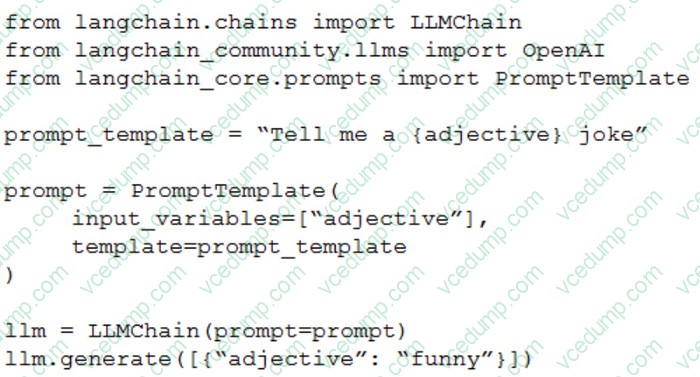
Assuming the API key was properly defined, what change does the Generative AI Engineer need to make to fix their chain?
A. Option A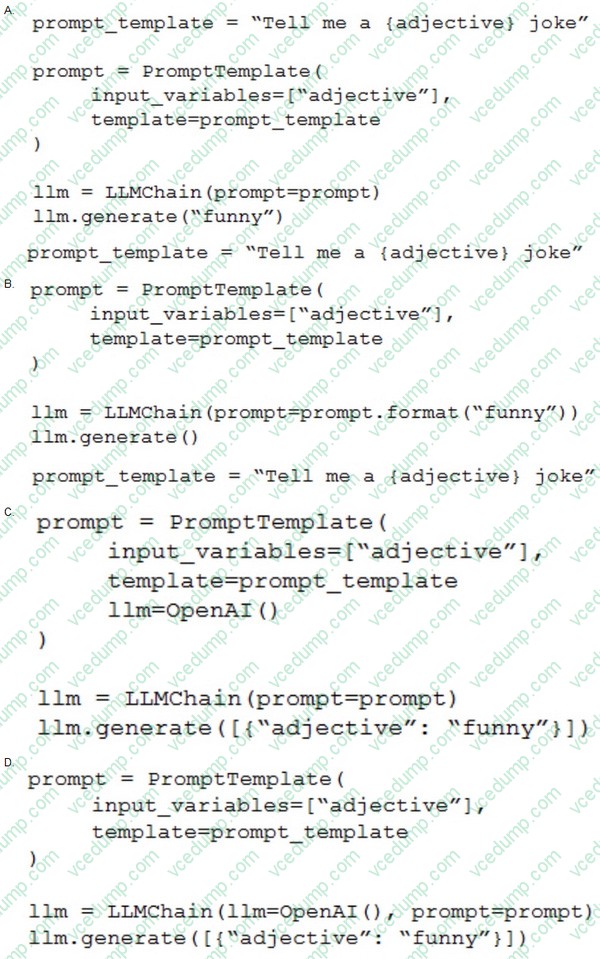
B. Option B
C. Option C
D. Option D -
Question 35:
A Generative AI Engineer is designing a chatbot for a gaming company that aims to engage users on its platform while its users play online video games.
Which metric would help them increase user engagement and retention for their platform?
A. Randomness
B. Diversity of responses
C. Lack of relevance
D. Repetition of responses -
Question 36:
A Generative AI Engineer is creating an agent-based LLM system for their favorite monster truck team. The system can answer text based questions about the monster truck team, lookup event dates via an API call, or query tables on the team's latest standings.
How could the Generative AI Engineer best design these capabilities into their system?
A. Ingest PDF documents about the monster truck team into a vector store and query it in a RAG architecture.
B. Write a system prompt for the agent listing available tools and bundle it into an agent system that runs a number of calls to solve a query.
C. Instruct the LLM to respond with "RAG", "API", or "TABLE" depending on the query, then use text parsing and conditional statements to resolve the query.
D. Build a system prompt with all possible event dates and table information in the system prompt. Use a RAG architecture to lookup generic text questions and otherwise leverage the information in the system prompt. -
Question 37:
A Generative AI Engineer just deployed an LLM application at a digital marketing company that assists with answering customer service inquiries. Which metric should they monitor for their customer service LLM application in production?
A. Number of customer inquiries processed per unit of time
B. Energy usage per query
C. Final perplexity scores for the training of the model
D. HuggingFace Leaderboard values for the base LLM -
Question 38:
A Generative Al Engineer interfaces with an LLM with prompt/response behavior that has been trained on customer calls inquiring about product availability. The LLM is designed to output "In Stock" if the product is available or only the term "Out of Stock" if not.
Which prompt will work to allow the engineer to respond to call classification labels correctly?
A. Respond with "In Stock" if the customer asks for a product.
B. You will be given a customer call transcript where the customer asks about product availability. The outputs are either "In Stock" or "Out of Stock". Format the output in JSON, for example: {"call_id": "123", "label": "In Stock"}.
C. Respond with "Out of Stock" if the customer asks for a product.
D. You will be given a customer call transcript where the customer inquires about product availability. Respond with "In Stock" if the product is available or "Out of Stock" if not. -
Question 39:
A Generative AI Engineer is building an LLM to generate article summaries in the form of a type of poem, such as a haiku, given the article content. However, the initial output from the LLM does not match the desired tone or style. Which approach will NOT improve the LLM's response to achieve the desired response?
A. Provide the LLM with a prompt that explicitly instructs it to generate text in the desired tone and style
B. Use a neutralizer to normalize the tone and style of the underlying documents
C. Include few-shot examples in the prompt to the LLM
D. Fine-tune the LLM on a dataset of desired tone and style -
Question 40:
A Generative Al Engineer has successfully ingested unstructured documents and chunked them by document sections. They would like to store the chunks in a Vector Search index. The current format of the dataframe has two columns: (i) original document file name (ii) an array of text chunks for each document.
What is the most performant way to store this dataframe?
A. Split the data into train and test set, create a unique identifier for each document, then save to a Delta table
B. Flatten the dataframe to one chunk per row, create a unique identifier for each row, and save to a Delta table
C. First create a unique identifier for each document, then save to a Delta table
D. Store each chunk as an independent JSON file in Unity Catalog Volume. For each JSON file, the key is the document section name and the value is the array of text chunks for that section
Related Exams:
-
DATABRICKS-CERTIFIED-ASSOCIATE-DEVELOPER-FOR-APACHE-SPARK
Databricks Certified Associate Developer for Apache Spark 3.0 -
DATABRICKS-CERTIFIED-ASSOCIATE-DEVELOPER-FOR-APACHE-SPARK-35
Databricks Certified Associate Developer for Apache Spark 3.5 - Python -
DATABRICKS-CERTIFIED-DATA-ANALYST-ASSOCIATE
Databricks Certified Data Analyst Associate -
DATABRICKS-CERTIFIED-DATA-ENGINEER-ASSOCIATE
Databricks Certified Data Engineer Associate -
DATABRICKS-CERTIFIED-GENERATIVE-AI-ENGINEER-ASSOCIATE
Databricks Certified Generative AI Engineer Associate -
DATABRICKS-CERTIFIED-PROFESSIONAL-DATA-ENGINEER
Databricks Certified Data Engineer Professional -
DATABRICKS-CERTIFIED-PROFESSIONAL-DATA-SCIENTIST
Databricks Certified Professional Data Scientist -
DATABRICKS-MACHINE-LEARNING-ASSOCIATE
Databricks Certified Machine Learning Associate -
DATABRICKS-MACHINE-LEARNING-PROFESSIONAL
Databricks Certified Machine Learning Professional
Tips on How to Prepare for the Exams
Nowadays, the certification exams become more and more important and required by more and more enterprises when applying for a job. But how to prepare for the exam effectively? How to prepare for the exam in a short time with less efforts? How to get a ideal result and how to find the most reliable resources? Here on Vcedump.com, you will find all the answers. Vcedump.com provide not only Databricks exam questions, answers and explanations but also complete assistance on your exam preparation and certification application. If you are confused on your DATABRICKS-CERTIFIED-GENERATIVE-AI-ENGINEER-ASSOCIATE exam preparations and Databricks certification application, do not hesitate to visit our Vcedump.com to find your solutions here.