DATABRICKS-CERTIFIED-ASSOCIATE-DEVELOPER-FOR-APACHE-SPARK-35 Exam Details
-
Exam Code
:DATABRICKS-CERTIFIED-ASSOCIATE-DEVELOPER-FOR-APACHE-SPARK-35 -
Exam Name
:Databricks Certified Associate Developer for Apache Spark 3.5 - Python -
Certification
:Databricks Certifications -
Vendor
:Databricks -
Total Questions
:145 Q&As -
Last Updated
:Jul 14, 2026
Databricks DATABRICKS-CERTIFIED-ASSOCIATE-DEVELOPER-FOR-APACHE-SPARK-35 Online Questions & Answers
-
Question 1:
What is a feature of Spark Connect?
A. It supports DataStreamReader, DataStreamWriter, StreamingQuery, and Streaming APIs
B. Supports DataFrame, Functions, Column, SparkContext PySpark APIs
C. It supports only PySpark applications
D. It has built-in authentication -
Question 2:
What is the behavior for functiondate_sub(start, days)if a negative value is passed into thedaysparameter?
A. The same start date will be returned
B. An error message of an invalid parameter will be returned
C. The number of days specified will be added to the start date
D. The number of days specified will be removed from the start date -
Question 3:
A Spark engineer must select an appropriate deployment mode for the Spark jobs.
What is the benefit of using cluster mode in Apache SparkTM?
A. In cluster mode, resources are allocated from a resource manager on the cluster, enabling better performance and scalability for large jobs
B. In cluster mode, the driver is responsible for executing all tasks locally without distributing them across the worker nodes.
C. In cluster mode, the driver runs on the client machine, which can limit the application's ability to handle large datasets efficiently.
D. In cluster mode, the driver program runs on one of the worker nodes, allowing the application to fully utilize the distributed resources of the cluster. -
Question 4:
A developer initializes a SparkSession:
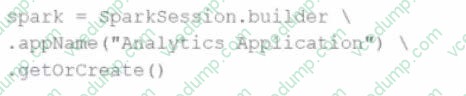
spark = SparkSession.builder \
.appName("Analytics Application") \
.getOrCreate()
Which statement describes thesparkSparkSession?
A. ThegetOrCreate()method explicitly destroys any existing SparkSession and creates a new one.
B. A SparkSession is unique for eachappName, and callinggetOrCreate()with the same name will return an existing SparkSession once it has been created.
C. If a SparkSession already exists, this code will return the existing session instead of creating a new one.
D. A new SparkSession is created every time thegetOrCreate()method is invoked. -
Question 5:
An MLOps engineer is building a Pandas UDF that applies a language model that translates English strings into Spanish. The initial code is loading the model on every call to the UDF, which is hurting the performance of the data pipeline. The initial code is:
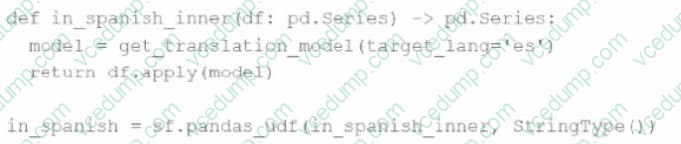
def in_spanish_inner(df: pd.Series) -> pd.Series:
model = get_translation_model(target_lang='es')
return df.apply(model)
in_spanish = sf.pandas_udf(in_spanish_inner, StringType())
How can the MLOps engineer change this code to reduce how many times the language model is loaded?
A. Convert the Pandas UDF to a PySpark UDF
B. Convert the Pandas UDF from a Series Series UDF to a Series Scalar UDF
C. Run thein_spanish_inner()function in amapInPandas()function call
D. Convert the Pandas UDF from a Series Series UDF to an Iterator[Series] Iterator[Series] UDF -
Question 6:
Given the schema:
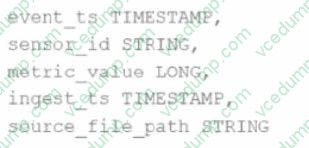
event_ts TIMESTAMP,
sensor_id STRING,
metric_value LONG,
ingest_ts TIMESTAMP,
source_file_path STRING
The goal is to deduplicate based on: event_ts, sensor_id, and metric_value.
A. dropDuplicates on all columns (wrong criteria)
B. dropDuplicates with no arguments (removes based on all columns)
C. groupBy without aggregation (invalid use)
D. dropDuplicates on the exact matching fields -
Question 7:
A data engineer wants to create an external table from a JSON file located at/data/input.jsonwith the following requirements: Create an external table namedusers Automatically infer schema Merge records with differing schemas Which code snippet should the engineer use?
A. CREATE TABLE users USING json OPTIONS (path '/data/input.json')
B. CREATE EXTERNAL TABLE users USING json OPTIONS (path '/data/input.json')
C. CREATE EXTERNAL TABLE users USING json OPTIONS (path '/data/input.json', mergeSchema 'true')
D. CREATE EXTERNAL TABLE users USING json OPTIONS (path '/data/input.json', schemaMerge 'true') -
Question 8:
A data engineer is asked to build an ingestion pipeline for a set of Parquet files delivered by an upstream team on a nightly basis. The data is stored in a directory structure with a base path of "/path/events/data". The upstream team drops daily data into the underlying subdirectories following the convention year/month/day.
A few examples of the directory structure are:
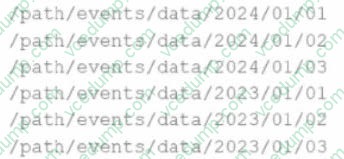
Which of the following code snippets will read all the data within the directory structure?
A. df = spark.read.option("inferSchema", "true").parquet("/path/events/data/")
B. df = spark.read.option("recursiveFileLookup", "true").parquet("/path/events/data/")
C. df = spark.read.parquet("/path/events/data/*")
D. df = spark.read.parquet("/path/events/data/") -
Question 9:
A data analyst wants to add a column date derived from a timestamp column.
A. dates_df.withColumn("date", f.unix_timestamp("timestamp")).show()
B. dates_df.withColumn("date", f.to_date("timestamp")).show()
C. dates_df.withColumn("date", f.date_format("timestamp", "yyyy-MM-dd")).show()
D. dates_df.withColumn("date", f.from_unixtime("timestamp")).show() -
Question 10:
A data engineer is building a Structured Streaming pipeline and wants the pipeline to recover from failures or intentional shutdowns by continuing where the pipeline left off. How can this be achieved?
A. By configuring the optioncheckpointLocationduringreadStream
B. By configuring the optionrecoveryLocationduring the SparkSession initialization
C. By configuring the optionrecoveryLocationduringwriteStream
D. By configuring the optioncheckpointLocationduringwriteStream
Related Exams:
-
DATABRICKS-CERTIFIED-ASSOCIATE-DEVELOPER-FOR-APACHE-SPARK
Databricks Certified Associate Developer for Apache Spark 3.0 -
DATABRICKS-CERTIFIED-ASSOCIATE-DEVELOPER-FOR-APACHE-SPARK-35
Databricks Certified Associate Developer for Apache Spark 3.5 - Python -
DATABRICKS-CERTIFIED-DATA-ANALYST-ASSOCIATE
Databricks Certified Data Analyst Associate -
DATABRICKS-CERTIFIED-DATA-ENGINEER-ASSOCIATE
Databricks Certified Data Engineer Associate -
DATABRICKS-CERTIFIED-GENERATIVE-AI-ENGINEER-ASSOCIATE
Databricks Certified Generative AI Engineer Associate -
DATABRICKS-CERTIFIED-PROFESSIONAL-DATA-ENGINEER
Databricks Certified Data Engineer Professional -
DATABRICKS-CERTIFIED-PROFESSIONAL-DATA-SCIENTIST
Databricks Certified Professional Data Scientist -
DATABRICKS-MACHINE-LEARNING-ASSOCIATE
Databricks Certified Machine Learning Associate -
DATABRICKS-MACHINE-LEARNING-PROFESSIONAL
Databricks Certified Machine Learning Professional
Tips on How to Prepare for the Exams
Nowadays, the certification exams become more and more important and required by more and more enterprises when applying for a job. But how to prepare for the exam effectively? How to prepare for the exam in a short time with less efforts? How to get a ideal result and how to find the most reliable resources? Here on Vcedump.com, you will find all the answers. Vcedump.com provide not only Databricks exam questions, answers and explanations but also complete assistance on your exam preparation and certification application. If you are confused on your DATABRICKS-CERTIFIED-ASSOCIATE-DEVELOPER-FOR-APACHE-SPARK-35 exam preparations and Databricks certification application, do not hesitate to visit our Vcedump.com to find your solutions here.