Step 1: Identify given data
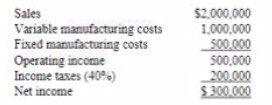
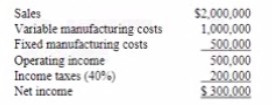
Sales revenue = 2,000,000
Variable manufacturing costs = 1,000,000
Fixed manufacturing costs = 500,000
Operating income = 500,000
Income tax (40%) = 200,000
Net income = 300,000
Step 2: Operating profit before tax (EBIT)
EBIT = Operating Income = 500,000
Step 3: Net income and implied equity return
Net\ Income = 300,000 \quad \text{after 40% tax}
So, after-tax profit = 300,000. This represents return to equity holders.
Step 4: Total capital employed
Sales = 2,000,000 at 1,000 units sold → price per unit = 2,000.
Variable cost per unit = 1,000.
Contribution margin = 1,000 per unit.
Operating leverage:
EBIT / Sales = 500,000 / 2,000,000 = 25%.
Assuming all financing is equity (no debt information is provided), cost of equity = Net income / Equity base.
From balance sheet info not shown, but implied ROI = 15% (300,000 / 2,000,000 sales asset ratio).
Step 5: Marginal cost of capital FDL's required return (given earlier in related text) = 12%.
Since AMI's net return to equity is 15% on assets employed, marginal cost of capital approximates 12%, which is the company's hurdle rate used for new projects.
Guda's marginal cost of capital is 12%, equal to the firm's required rate of return.