CIMA-P1 Exam Details
-
Exam Code
:CIMA-P1 -
Exam Name
:P1 - Management Accounting -
Certification
:CIMA Certifications -
Vendor
:CIMA -
Total Questions
:275 Q&As -
Last Updated
:Jul 15, 2026
CIMA CIMA-P1 Online Questions & Answers
-
Question 1:
The labour requirement for a special contract is 250 skilled labour hours paid at $10 per hour and 750 semi-skilled labour hours paid at $8 per hour.
At present, skilled labour is fully utilised on other contracts which generate a $12 contribution per hour, after charging labour costs. Additional skilled labour is unavailable in the short term.
There is a surplus of 1,200 semi-skilled hours over the period of the contract but the firm has a policy of no redundancies.
The relevant cost of labour for the special contract is:
A. $ 5,500
B. $ 3,000
C. $ 8,500
D. $ 11,500 -
Question 2:
Which of the following managers is most likely to be responsible for an favourable labour efficiency variance?
A. Production Manager
B. Purchasing Manager
C. Human Resources Manager
D. Marketing Manager -
Question 3:
CORRECT TEXT
A company makes two products, product X with a contribution per unit of $10 and product Y with a contribution per unit of $4. These products are sold in the mix 3:2 by volume and fixed costs are $38,000 per period.
The breakeven point for product Y, based on the expected sales mix is:
-
Question 4:
A healthcare company specializes in hip, knee and shoulder replacement operations, known as surgical procedures. As well as providing these surgical procedures the company offers pre operation and post operation in-patient care, in a fully equipped hospital, for those patients who will be undergoing the surgical procedures.
Surgeons are paid a fixed fee for each surgical procedure they perform and an additional amount for any follow-up consultations. Post procedure follow-up consultations are only undertaken if there are any complications in relation to the surgical procedure. There is no additional fee charged to patients for any follow up consultations. All other staff are paid annual salaries.
The company's existing costing system uses a single overhead rate, based on revenue, to charge the costs of support activities to the procedures. Concern has been raised about the inaccuracy of procedure costs and the company's accountant has initiated a project to implement an activity-based costing (ABC) system. The project team has collected the following data on each of the procedures.
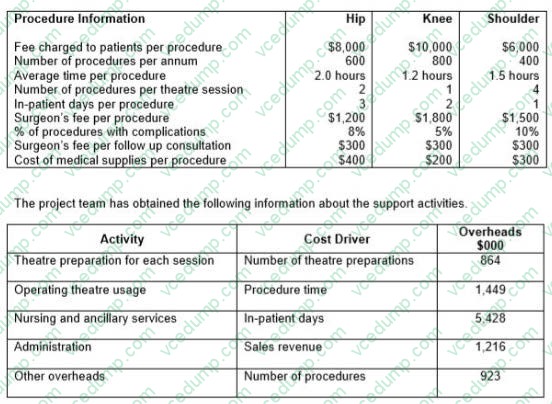
Calculate the profit per procedure for each of the three procedures using activity-based costing. What was the profit for the knee procedure, using ABC costing?
A. $2466
B. $781
C. $1808
D. $2305 -
Question 5:
XY can choose from four mutually exclusive projects. The projects will each last for one year and their net cash inflows will be determined by market conditions. The forecast net cash inflows for each of the possible outcomes are shown below.
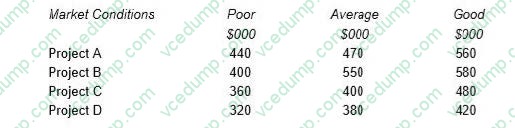
If the company applies the maximin criterion the project chosen would be:
A. Project A
B. Project B
C. Project C
D. Project D -
Question 6:
`Public sector organizations are often judged by their economy, efficiency and effectiveness. Consequently, they should use an approach to budgeting other than incremental budgeting.'
Required:
Explain ONE advantage and TWO disadvantages of public sector organizations using incremental budgeting.
Select all true statements.
A. An incremental; approach is not as easy and fast to implement than other forms of budgeting approaches e.g. zero based budgeting.
B. Public sector organizations tend to be fairly complex and in many cases outputs cannot be measured in monetary terms therefore the link between inputs and outputs is difficult to establish. An incremental approach can therefore provide a cost effective approach to budgeting.
C. Under an incremental approach to budgeting, existing operations and the current budgeted allowance for these existing activities are taken as the base level for preparing the budget.
D. The main advantage of incremental budgeting is that the cost of past activities becomes fixed and any inefficiencies or wastage is perpetuated.
E. The incremental approach means that budget holders in public sector organizations will be encouraged to use up this year's budget will be as high as possible.
F. The incremental approach encourages managers in public sector organizations to look at the efficiency and effectiveness of activities undertaken. -
Question 7:
TP makes wedding cakes that are sold to specialist retail outlets which decorate the cakes according to the customers' specific requirements. The standard cost per unit of its most popular cake is as follows:
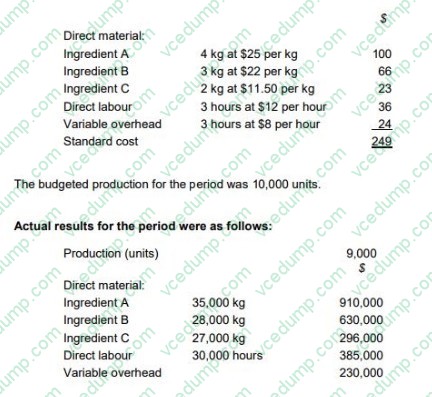
The general market prices at the time of purchase for Ingredient A and Ingredient B were $23 per kg and $20 per kg respectively. TP operates a JIT purchasing system for ingredients and a JIT production system; therefore, there was no inventory during the period.
What was the material price planning variance for ingredient B?
A. The material price planning variance - Ingredient B was $54 000 F
B. The material price planning variance - Ingredient B was $64 000 F
C. The material price planning variance - Ingredient B was $57 000 F
D. The material price planning variance - Ingredient B was $59 000 F -
Question 8:
A company operates a standard costing system.
The company combines two raw materials in a process in order to produce a finished product. During month 6 the direct material mix variance was favourable and the direct material yield variance was adverse.
Which of the following statements would explain both of the variances?
A. There was more wastage in the process than standard and a greater proportion of the cheaper of the two materials was input than standard.
B. Both of the materials were purchased at a lower price than standard and the lower quality increased wastage.
C. Higher skilled labour resulted in less wastage from the process than standard and a lower proportion of the more expensive of the two materials was input than standard.
D. The actual wastage from the process was equal to standard and a greater proportion of the cheaper of the two materials was input than standard. -
Question 9:
A company produces and sells more than one product.
All products are manufactured using the same facilities and incur common fixed costs.
Which of the following is used to calculate the break-even sales revenue for the business?
A. Total fixed costs / weighted average contribution to sales ratio
B. Total fixed costs / weighted average contribution per unit
C. Total fixed costs / contribution per unit
D. Total fixed costs / operating profit to sales ratio -
Question 10:
QR uses an activity based budgeting (ABB) system to budget product costs. It manufactures two products, product Q and product R. The budget details for these two products for the forthcoming period are as follows:
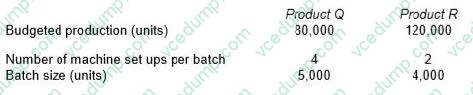
The total budgeted cost of setting up the machines is $74,400. What was the budgeted machine set up cost per unit of product Q?
A. $0.39 per unit
B. $0.56 per unit
C. $0.37 per unit
D. $0.48 per unit
Related Exams:
-
CIMA-BA1
BA1 - Fundamentals of Business Economics -
CIMA-BA2
BA2 - Fundamentals of Management Accounting -
CIMA-BA3
BA3 - Fundamentals of Financial Accounting -
CIMA-BA4
BA4 - Fundamentals of Ethics, Corporate Governance and Business Law -
CIMA-CS3
CS3 - Strategic Case Study 2021 -
CIMA-E1
E1 - Managing Finance in a Digital World -
CIMA-E2
E2 - Managing Performance -
CIMA-E3
E3 - Strategic Management -
CIMA-F1
F1 - Financial Reporting -
CIMA-F2
F2 - Advanced Financial Reporting
Tips on How to Prepare for the Exams
Nowadays, the certification exams become more and more important and required by more and more enterprises when applying for a job. But how to prepare for the exam effectively? How to prepare for the exam in a short time with less efforts? How to get a ideal result and how to find the most reliable resources? Here on Vcedump.com, you will find all the answers. Vcedump.com provide not only CIMA exam questions, answers and explanations but also complete assistance on your exam preparation and certification application. If you are confused on your CIMA-P1 exam preparations and CIMA certification application, do not hesitate to visit our Vcedump.com to find your solutions here.