CFA-LEVEL-1 Exam Details
-
Exam Code
:CFA-LEVEL-1 -
Exam Name
:CFA Level I - Chartered Financial Analyst -
Certification
:CFA Institute Certifications -
Vendor
:CFA Institute -
Total Questions
:3960 Q&As -
Last Updated
:May 27, 2026
CFA Institute CFA-LEVEL-1 Online Questions & Answers
-
Question 3601:
Milra Choudra is considering how to invest her $100,000 investment portfolio- Choudra's investment advisor has recommended that she invest 60% in the SandP 500 stock market index and 40% in the risk-free asset. The advisor has derived the following forecasts for the SandP 500:
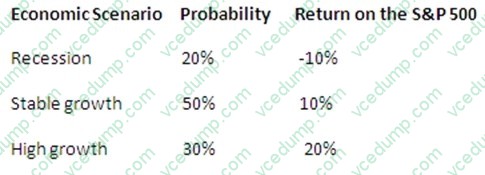
Assuming a risk-free rate of 5%, the expected return on Choudra's portfolio is closest to:
A. 6. 6%.
B. 7. 4%.
C. 9.0%. -
Question 3602:
You combine three assets (A, B, and C) into a portfolio. What is the expected return and standard deviation of the portfolio? You will put 25% of your funds into Asset A with an expected return of 5% and a standard deviation of zero, 50% of your funds into Asset B with an expected return of 10% and a standard deviation of 5%, and 25% of your funds into Asset C with an expected return of 5% with a standard deviation of zero.
A. .075 .025
B. .025 .05
C. .075 .075
D. .05 .10 -
Question 3603:
If you were asked to study the economy over the past five years, you would use the real GDP series rather than the nominal GDP series because
A. the nominal GDP series reflects changes in both output and prices, whereas the real GDP series, roughly speaking, merely reflects changes in output.
B. the nominal GDP series fails to account for transfer payments, whereas the real GDP series includes these payments.
C. the real GDP series accounts for imports, making it more precise than the nominal GDP series.
D. exports are excluded from the real GDP series, making it less complicated than the nominal GDP series. -
Question 3604:
Which of the following is/are true for a project which needs only an initial outlay and no further expenses?
I. The shorter the payback period, the greater the liquidity of the project.
II. The discounted payback period is always more than the simple payback period.
III.
The payback period rule considers all the cash flows involved in a project.
A. II and III
B. II only
C. I and II
D. III only
E. I and III
F. I only
G. I, II and III -
Question 3605:
A mutual fund has a load of 4 percent and a net asset value (NAV) of $20 per share. What must an investor pay to purchase 250 shares?
A. $5,200.
B. $4,800.
C. $5,013.
D. $5,208. -
Question 3606:
Omar Henry is a firm believer in capital market theory and the capita! asset pricing model. Henry has developed a model to select overpriced stocks as indicated by the security market line. The model identifies the overpriced securities and then executes a short position in the overpriced stocks. Which of the following practical conditions would prevent Henry from using his model to explain capital market behavior?
A. All investors use exactly the same two-stage dividend discount model to evaluate stocks.
B. All investors pay the same commission rate of $0.03/share on all equity trades.
C. All changes in Federal Reserve policy are perfectly anticipated by investors. -
Question 3607:
What is the name of this technical indicator?
(Number of advancing issues + 1/2 volume of issues unchanged) / total number of issues traded
A. Confidence Index.
B. CBOE Put/Call Ratio.
C. None of these answers is correct.
D. Block Uptick/Downtick Ratio.
E. Advance/Decline Line. -
Question 3608:
Most mutual funds compared to the (Dow Jones Industrial Average) DJIA _______.
A. are less risky
B. achieved lower net returns
C. show similar returns
D. achieved greater net returns -
Question 3609:
A market researcher with Churn Brothers Brokerage is attempting to estimate the earnings per share (EPS) for a broad market index, and has assimilated the following information:
Sales per share: $700
Next year's operating profit margin: 25%
Next year's depreciation per share: $80
Next year's interest expense: $45. 50
Next year's corporate tax rate: 35%
Using this information, what is the EPS figure for this stock market series?
A. $32. 17
B. $164. 18
C. The answer cannot be calculated from the information provided.
D. $46. 56
E. None of these answers is correct.
F. $112. 67 -
Question 3610:
Interstate Transport has a target capital structure of 50 percent debt and 50 percent common equity. The firm is considering a new independent project which has an IRR of 13 percent and which is not related to transportation. However, a pure play proxy firm has been identified that is exclusively engaged in the new line of business. The proxy firm has a beta of 1.38. Both firms have a marginal tax rate of 40 percent, and Interstate's before-tax cost of debt is 12 percent. The risk-free rate is 10 percent, and the market risk premium is 5 percent. The firm should
A. Be indifferent between accepting or rejecting; the firm's required rate of return on the project equals its expected return.
B. Accept the project; its IRR exceeds the risk-free rate and the before-tax cost of debt.
C. Accept the project; its IRR is greater than the firm's required rate of return on the project of 12. 05 percent.
D. Reject the project; its IRR is less than the firm's required rate of return on the project of 16. 9 percent.
E. Reject the project; its IRR is only 13 percent.

Tips on How to Prepare for the Exams
Nowadays, the certification exams become more and more important and required by more and more enterprises when applying for a job. But how to prepare for the exam effectively? How to prepare for the exam in a short time with less efforts? How to get a ideal result and how to find the most reliable resources? Here on Vcedump.com, you will find all the answers. Vcedump.com provide not only CFA Institute exam questions, answers and explanations but also complete assistance on your exam preparation and certification application. If you are confused on your CFA-LEVEL-1 exam preparations and CFA Institute certification application, do not hesitate to visit our Vcedump.com to find your solutions here.