CCRN-ADULT Exam Details
-
Exam Code
:CCRN-ADULT -
Exam Name
:CCRN (Adult) - Direct Care Eligibility Pathway -
Certification
:AACN Certifications -
Vendor
:AACN -
Total Questions
:150 Q&As -
Last Updated
:May 25, 2026
AACN CCRN-ADULT Online Questions & Answers
-
Question 41:
A patient who underwent bowel resection surgery due to small bowel rupture is tachycardic and hypotensive. A nurse calls the on-call surgical resident and reports the findings. No new orders are received. The nurse should continue to monitor the patient and
A. notify the charge nurse during nightly rounds.
B. inform the clinical manager in the morning.
C. initiate the rapid response team.
D. consult the nearest nursing colleague. -
Question 42:
An unconscious patient in hepatic failure secondary to alcoholism becomes acutely hypoglycemic. Glucagon administration is contraindicated for this patient because glucagon
A. interferes with lactulose (Cephulac) therapy.
B. produces additional sedative effects.
C. is ineffective when hepatocytes are damaged.
D. causes rebound hyperglycemia. -
Question 43:
A patient is intubated and receiving assist control mechanical ventilation and is on a norepinephrine drip following a head injury. Patient data are:
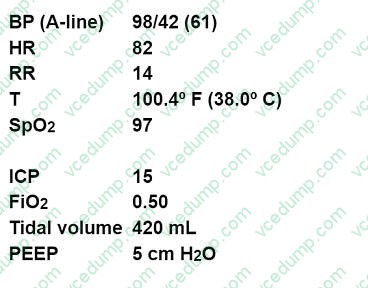
Which of the following interventions will improve cerebral perfusion?
A. increasing the norepinephrine rate
B. administering prescribed acetaminophen
C. requesting an ABG
D. suctioning the airway -
Question 44:
A unit council is requesting to change a documentation screen of the electronic health record (EHR) at a large health system. The change was not discussed with the department prior to the request and was denied by the EHR committee. Which of the following strategies will most likely lead to accomplishing the team's goals?
A. Have nursing leadership evaluate the proposal before resubmitting the request.
B. Discuss the proposed solution with stakeholders to determine buy in.
C. Work with key staff members to rewrite the request to present at the next meeting.
D. Attempt to change the process through another format. -
Question 45:
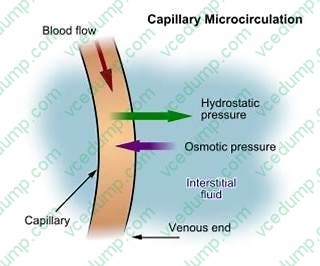
A patient is admitted with anaphylactic shock secondary to a blood transfusion. The patient's spouse asks the nurse to explain how blood can cause a low blood pressure. The nurse responds that with anaphylactic shock the
A. heart muscle weakens and is unable to pump effectively.
B. peripheral blood vessels dilate, and this creates a maldistribution of volume.
C. kidneys excrete large amounts of urine dropping the blood pressure.
D. autonomic nervous system is disrupted dropping blood pressure. -
Question 46:
An experienced nurse new to a unit believes the literature does not support current unit practice of a fixed-dose nitroglycerin IV (Tridil) infusion in all postoperative cardiac surgery patients for 24 hours. The nurse develops a proposal referencing peer-reviewed articles. Based on the proposal, unit leaders agree to remove the nitroglycerin IV (Tridil) infusion from the standard order set. The actions taken by the nurse are best described as
A. collaboration with a team.
B. a clinical research study.
C. a performance improvement project.
D. evidence-based practice. -
Question 47:
The family of a patient requests permission to administer traditional herbs to the patient. Which of the following should be the nurse's first action?
A. Inform the family that herbal therapy is not appropriate in the hospital.
B. Consult with the pharmacist on the effects of the specific herbs.
C. Allow the patient to take the herbs because they are natural.
D. Obtain an order for the herbs. -
Question 48:
A nurse is providing care to a patient diagnosed with abdominal compartment syndrome. The nurse should recognize the patient is most at risk for developing
A. increased urine output.
B. increased preload.
C. increased peak inspiratory pressure.
D. decreased intracranial pressure. -
Question 49:
Which of the following is a late finding in hypovolemic shock?
A. tachycardia
B. UO greater than 30 mL/hr
C. cool, dry skin
D. hypotension -
Question 50:
An oncology patient presents with hematuria and bleeding from previous injection sites. Which diagnostic test result should the nurse review first?
A. complete blood count
B. arterial blood gas
C. complete metabolic panel
D. coagulation panel
Tips on How to Prepare for the Exams
Nowadays, the certification exams become more and more important and required by more and more enterprises when applying for a job. But how to prepare for the exam effectively? How to prepare for the exam in a short time with less efforts? How to get a ideal result and how to find the most reliable resources? Here on Vcedump.com, you will find all the answers. Vcedump.com provide not only AACN exam questions, answers and explanations but also complete assistance on your exam preparation and certification application. If you are confused on your CCRN-ADULT exam preparations and AACN certification application, do not hesitate to visit our Vcedump.com to find your solutions here.