C_HANAIMP_17 Exam Details
-
Exam Code
:C_HANAIMP_17 -
Exam Name
:SAP Certified Application Associate - SAP HANA 2.0 (SPS05) -
Certification
:SAP Certifications -
Vendor
:SAP -
Total Questions
:80 Q&As -
Last Updated
:Jul 15, 2026
SAP C_HANAIMP_17 Online Questions & Answers
-
Question 61:
What can you identify using the Performance Analysis Mode?
Note: There are 2 correct answers to this question.
A. Usage statistics of the calculation view
B. Joins that are defined on calculated columns
C. If the data is in the hot or warm storage tier
D. Information about join cardinality -
Question 62:
Which of the following are usually no longer required in the architecture of SAPS/4HANA? Note: There are 2 correct answers to this question.
A. Aggregates
B. ABAP CDS
C. Synonyms
D. Indexes -
Question 63:
Which types of data are used to represent spatial information?
Note: There are 2correct answers to this question.
A. Column data
B. Vector data
C. Raster data
D. Graph data -
Question 64:
Which of the following are warm tier Solutions? Note: There are 3 correct answers.
A. Active / active read-enabled mode
B. Native Storage Extension
C. Extension Node
D. Dynamic Tiering
E. Persistent Memory -
Question 65:
Why does SAP issue warnings about the use of imperative or procedural SQL Script statements?
A. They can harm SQL optimization.
B. NOT all reporting tools can consume the results.
C. They introduce potential security risk.
D. They call multiple processing engines -
Question 66:
You have made changes to the design-time files of several calculation views in your DEV environment. These calculation views belong to the same project. Before deploying your calculation views to a PROD environment, which sequence of steps is required in the DEV environment?
A. Export the HDB module -> Export the project
B. Build the HDB module -> Build the project
C. Activate the project -> Build the HDB module
D. Build the project -> Build the HDB module -
Question 67:
Why do you use parameter mapping in a calculation view?
Note: There are 2 correct answers to this question.
A. To convert the data types of input parameters
B. To push down filters to the lowest level calculation views
C. To pass variable values to external value help views
D. To enable an input parameter in a calculation view -
Question 68:
You have a calculation view which includes nodes as shown in the graphic. You decide to select the "Ignore Multiple Output for Filters" check box on Projection Node 3. What might the effects of this be?
Note: There are 2 correct answers to this question.
A. The view will return the profit calculation for only the US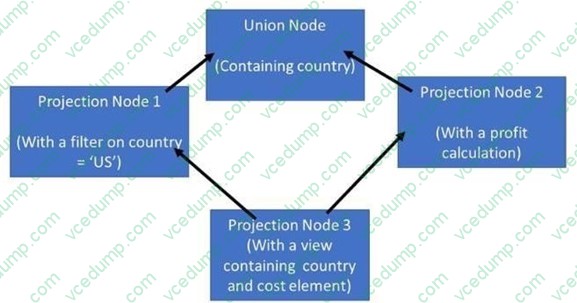
B. A change to the data that is returned by the view
C. Increased performance
D. Decreased performance -
Question 69:
Referring to the diagram, which privileges would a user require to view United States data when querying the CUBE Calculation view?
A. Analytic Privileges and SELECT privileges on the CUBE Calculation view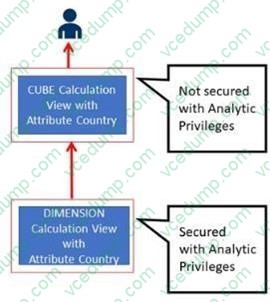
B. A SELECT privilege and an Analytic Privilege (Country = United States) on the DIMENSION Calculation view
C. A SELECT privilege on the CUBE and an Analytic Privilege (Country = United States) on the DIMENSION Calculation view
D. SELECT or Privileges and Analytic Privileges on both views -
Question 70:
You want to create a star schema using a calculation view. The measures are based on columns from two transaction tables. Dimension calculation views provide the attributes.
What is the correct approach?
A. Combine the transaction tables using a join node in a calculation view of type cube. Use the multi-join capability of the join node to connect the transactional tables with the dimension calculation views.
B. Combine the transaction tables using a star join node in a calculation view of type cube with star join. Use a join node to join the dimensions to the fact table.
C. Combine the transaction tables using an aggregation node in a calculation view of type cube with star join. Use a star join node to join the dimensions to the fact table.
D. Combine the transaction tables using a join node in a calculation view of type cube with star join. Use a star join node to join the dimensions to the fact table.
Related Exams:
-
C_ABAPD_2507
SAP Certified Associate - Back-End Developer - ABAP Cloud -
C_ACDET_2506
SAP Certified Associate - Configuring SAP Ariba Strategic Sourcing Suite -
C_ACT_2403
SAP Certified Associate - Project Manager - SAP Activate -
C_ACTIVATE05
SAP Certified Associate - SAP Activate Project Manager -
C_ACTIVATE12
SAP Certified Associate - SAP Activate Project Manager -
C_ACTIVATE13
SAP Certified Associate - SAP Activate Project Manager -
C_ACTIVATE22
SAP Certified Associate - SAP Activate Project Manager -
C_ADBTP_2601
Administrating SAP Business Technology Platform(C_ADBTP_2601) -
C_AIG_2412
SAP Certified Associate - SAP Generative AI Developer -
C_ARCIG_2404
SAP Certified Associate - Implementation Consultant - Managed Gateway for Spend Management and SAP Business Network
Tips on How to Prepare for the Exams
Nowadays, the certification exams become more and more important and required by more and more enterprises when applying for a job. But how to prepare for the exam effectively? How to prepare for the exam in a short time with less efforts? How to get a ideal result and how to find the most reliable resources? Here on Vcedump.com, you will find all the answers. Vcedump.com provide not only SAP exam questions, answers and explanations but also complete assistance on your exam preparation and certification application. If you are confused on your C_HANAIMP_17 exam preparations and SAP certification application, do not hesitate to visit our Vcedump.com to find your solutions here.