C9510-401 Exam Details
-
Exam Code
:C9510-401 -
Exam Name
:IBM WebSphere Application Server Network Deployment V8.5.5 and Liberty Profile System Administration -
Certification
:IBM Certifications -
Vendor
:IBM -
Total Questions
:73 Q&As -
Last Updated
:Jul 08, 2026
IBM C9510-401 Online Questions & Answers
-
Question 61:
A system administrator has been asked to uninstall an application from a cluster running in a WebSphere Application Server Network Deployment cell. This application was installed from the Integrated Solutions Console (ISC). The monitored directory for the cluster is
. What step(s) can the administrator perform to uninstall the application?
A. Delete the application file from .
B. Stop the running cluster.Delete the application file from .
C. Stop the running cluster.Copy the application file to .Delete the application file from .
D. Create a properties file to describe the deletion of the application file.Copy the properties file to . -
Question 62:
A developer created an enterprise application which contained data source and security role information. The developer asked a system administrator to install this application to an application server where global security is enabled using the Integrated Solutions Console (ISC). A new data source was configured at the server scope for the use of this application. While load testing the application, the developer noticed that the attributes configured on the new data source were ignored by the application server.
How can the administrator ensure that the attributes configured on the new data source are used by the application server?
A. Create the data source under cell scope instead of server scope.
B. Delete any data source of the same name defined under node, cluster or cell scope.
C. Reinstall the application and clear the Process embedded configuration check box.
D. Correct the component-managed and container-managed authentication aliases set on the data source. -
Question 63:
The administrator needs to identify any security role references and security constraints in a web application. How can the administrator identify these roles and constraints?
A. ibm-application-ext.xml file using a text editor.
B. ibmconfig folder in the application after using the EARExpander command.
C. Web deployment descriptor using IBM Assembly and Deploy Tools.
D. Security role to user/group mapping by using the Integrated Solutions Console (ISC). -
Question 64:
A system administrator needs to configure a JDBC provider and a data source for an application in a clustered environment. The administrator also needs to copy the JDBC drivers from the database server to the application server machines.
How can the administrator meet these requirements?
A. Create a JDBC provider and the data source in the cluster scope.Copy the driver to all nodes.Set the environment variable at the node level to the driver's path.
B. Create a JDBC provider in the server scope and the data source in the node scope.Copy the driver to all application servers.Set the environment variable at the node level to the driver's path.
C. Create a JDBC provider in the node scope and the data source in the cell scope.Copy the driver to the deployment manager.Set the environment variable at the server level to point to the deployment manager path.
D. Create a JDBC provider in the application scope and the data source in the server scope.Copy the driver to all application server directories.Set the environment variable in each JVM to the driver's path. -
Question 65:
A web application is hosted on an application server that receives HTTP requests from a third party application named myApp. The URIGroup mapping for this application is called default_host_myApp.
The development team asks a system administrator to configure the HTTP plug-in to prevent routing requests to any application server except server1.
The following exhibit shows the parts of the plugin-cfg.xml file that are relevant for myApp. The UriGroups for other applications are not shown in the exhibit.
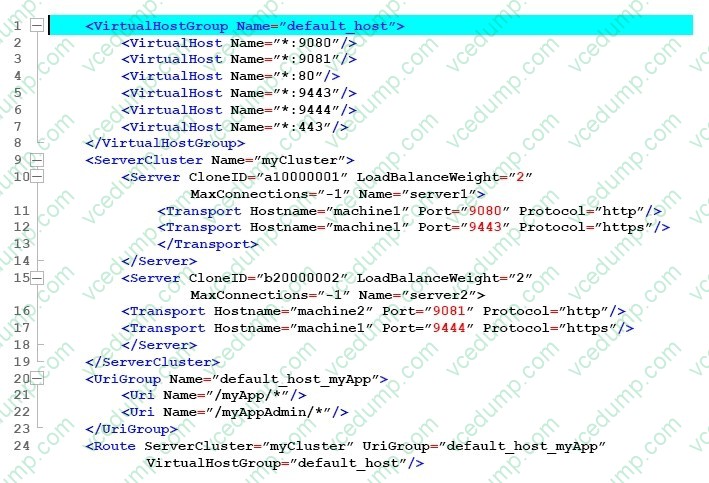
What should the administrator do to the plugin-cfg.xml file to ensure that requests for default_host_myApp URIGroup are routed only to machine1?
A. Delete the Server tag for CloneId="b20000002"Delete all of the tags within the Server tag
B. Delete the UriGroup tag for default_host_myAppDelete all of the tags within the UriGroup tag
C. Delete the VirtualHostGroup tag for default_hostDelete all of the tags within the VirtualHostGroup tag
D. Edit the LoadBalanceWeight for server1 to 20Edit the LoadBalanceWeight for server2 to -
Question 66:
A system administrator completed a WebSphere Application Server installation by using the Installation Manager. During installation, all defaults were selected for the installation root directories and the shared resources directory. Over time, the administrator has updated the installation with various interim fixes and fix packs. The administrator notices that the shared resources directory is very large in size and grows larger each time the Installation Manager is run.
How can the administrator decrease the size and remove some of the content from the shared resources directory?
A. Manually delete content from the directory.
B. During an update, create a new shared resources directory.
C. Clear the Delete Saved Files option for the Installation Manager.
D. Set the preserve Downloaded Artifacts preference to false. -
Question 67:
A web application was deployed on a WebSphere Application Server cluster. While users are using the application, one of the cluster servers fails and the users lose their working data. What can the system administrator configure to ensure users can continue to work if one of the cluster server fails?
A. An increased session timeout.
B. A cluster of external HTTP servers.
C. A load balancer to spread work between existing servers.
D. A WebSphere eXtreme Scale HTTP session management. -
Question 68:
A system administrator is configuring the security of a new environment. The administrator has been asked to configure one LDAP server that has different sub-trees for business users and administration users. What should the administrator do to implement the required security configuration?
A. Install and configure a TAI (Trust Association Interceptor)
B. Configure a security domain for the stand-alone LDAP server.
C. Use Federated repositories and configure the supported entity types.
D. Use Stand-alone custom registry and configure the flat file implementation. -
Question 69:
A system administrator has to design a new production environment to host a web application. The workload of this web application is expected to increase during special marketing campaigns. Which one of the following topologies should the administrator configure to address the requirements for this new environment?
A. A Liberty collective environment with autonomic managers and on demand router (ODR).
B. A flexible management environment supported by one admin agent running in each node of the cell.
C. A dynamic cluster with autonomic managers, application placement controller and intelligent routers.
D. A heterogeneous cell with enough server to support the peak load spread across multiple nodes on the same machine. -
Question 70:
A system administrator has created a Python script that will run in WebSphere Network cell where administrative security is enabled. This script is named doUpdate.py and will be run by using the following:
wsadmin -connType RMI -f doUpdate.py
How can the administrator suppress a user/password prompt from appearing when this script is run?
Set the user and password in the:
A. sas.client.props file.
B. ssl.client.props file.
C. soap.client.props file.
D. wsadmin.properties file.
Related Exams:
-
C1000-002
IBM MQ V9.0 System Administration -
C1000-003
IBM Mobile Foundation v8.0 Application Development -
C1000-004
IBM Curam SPM V7.X Application Developer -
C1000-007
IBM Cloud Application Development v3 -
C1000-010
IBM Operational Decision Manager Standard V8.9.1 Application Development -
C1000-012
IBM Watson Application Developer V3.1 -
C1000-015
IBM Business Process Manager V8.6 Application Development using Process Designer -
C1000-018
IBM QRadar SIEM V7.3.2 Fundamental Analysis -
C1000-019
IBM Spectrum Protect Plus V10.1.1 Implementation -
C1000-020
IBM New Workloads Sales V2
Tips on How to Prepare for the Exams
Nowadays, the certification exams become more and more important and required by more and more enterprises when applying for a job. But how to prepare for the exam effectively? How to prepare for the exam in a short time with less efforts? How to get a ideal result and how to find the most reliable resources? Here on Vcedump.com, you will find all the answers. Vcedump.com provide not only IBM exam questions, answers and explanations but also complete assistance on your exam preparation and certification application. If you are confused on your C9510-401 exam preparations and IBM certification application, do not hesitate to visit our Vcedump.com to find your solutions here.