C2090-545 Exam Details
-
Exam Code
:C2090-545 -
Exam Name
:DB2 9.7 SQL Procedure Developer -
Certification
:IBM Certifications -
Vendor
:IBM -
Total Questions
:115 Q&As -
Last Updated
:Jul 14, 2026
IBM C2090-545 Online Questions & Answers
-
Question 41:
Click the Exhibit button.
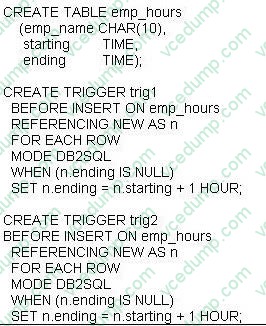
The table and triggers in the exhibit have been createdsuccessfully, when the statements shown below are executed.
INSERT INTO emp_hours VALUES('KAY', '9:00', '17:00');
INSERT INTO emp_hours (emp_name, starting) VALUES('BILL', '9:00');
What is the result?
A. Table EMP_HOURS will contain these rows: KAY 9:00:00 AM 5:00:00 PM BILL 9:00:00 AM 10:00:00 AM
B. Table EMP_HOURS will contain this row: BILL 9:00:00 AM
C. Table EMP_HOURS will contain these rows: KAY 9:00:00 AM 5:00:00 PM BILL 9:00:00 AM
D. Table EMP_HOURS will contain this row: BILL 9:00:00 AM 17:00:00 PM -
Question 42:
In which type of table space must global temporary tables be created?
A. REGULAR
B. LONG
C. SYSTEM TEMPORARY
D. USER TEMPORARY -
Question 43:
Which of the following CURSOR declare statement is incorrect?
A. DECLARE c1 CURSOR WITHOUT RETURN FOR SELECT * FROM tab1
B. DECLARE c1 ASENSITIVE CURSOR WITH RETURN TO CLIENT FOR SELECT * FROM tab1
C. DECLARE c1 INSENSITIVE CURSOR WITH RETURN TO CLIENT FOR SELECT * FROM tab1
D. DECLARE c1 SENSITIVE CURSOR WITH RETURN TO CLIENT FOR SELECT * FROM tab1 -
Question 44:
The cursor BASEINFO was defined as follow:

Which statement would be used to create a local variable named BASEINFOROW that can be used to store results from the BASEINFO cursor?
A. DEFINE ROW baseinforow FOR CURSOR baseinfo
B. DECLARE ROW baseinforow ASSOCIATED WITH CURSOR baseinfo
C. DECLARE baseinforow ANCHOR ROW baseinfo
D. CREATE VARIABLE baseinforow ASSOCIATED WITH baseinfo -
Question 45:
Which of the following statements is true for declared global temporary tables(DGTT)?
A. The value of the USER special register is the implicit schema name of the DGTT
B. B. The DGTT must be stored in a system temporary table space
C. SESSION is the implicit schema name of the DGTT
D. The data in a DGTT cannot be compressed. -
Question 46:
Which statement will create a scalar function named FCN1?
A. CREATE SCALAR FUNCTION fcn1(v1 CHAR(3)) RETURNS CHAR(3) ?CREATE SCALAR FUNCTION fcn1(v1 CHAR(3)) RETURNS CHAR(3)
B. CREATE FUNCTION fcn1(v1 CHAR(3)) RETURNS ROW CONTAINING CHAR(3) ?CREATE FUNCTION fcn1(v1 CHAR(3)) RETURNS ROW CONTAINING CHAR(3)
C. CREATE SCALAR FUNCTION fcn1(v1 CHAR(3)) RETURNS ROW CONTAINING CHAR(3) ?CREATE SCALAR FUNCTION fcn1(v1 CHAR(3)) RETURNS ROW CONTAINING CHAR(3)
D. CREATE FUNCTION fcn1(v1 CHAR(3)) RETURNS CHAR(3) ?CREATE FUNCTIONfcn1(v1 CHAR(3)) RETURNS CHAR(3) -
Question 47:
Given the following DDL:
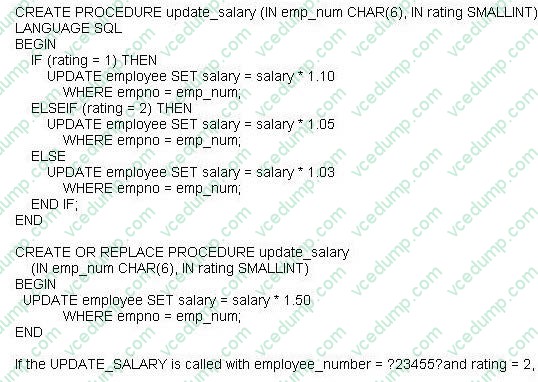
What will the SALARY be?
A. salary * 1.03
B. salary * 1.05
C. salary * 1.10
D. salary * 1.50 -
Question 48:
A developer wants to code the following statements in an SQL procedure:
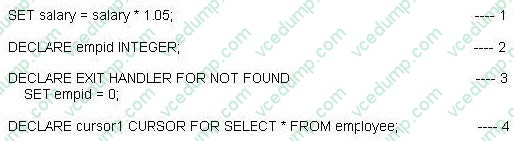
What order must thesestatements be coded in?
A. 1, 2, 3, 4
B. 2, 4, 3, 1
C. 3, 4, 2, 1
D. 4, 3, 2, 1 -
Question 49:
In the code segment shown below:
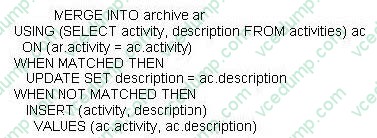
Which statement accurately describes the result?
A. For activities whose description has not changed, update the description in the ARCHIVE table. For new activities, insert into the ARCHIVE table. The ARCHIVE and ACTIVITIES table both have ACTIVITY as a primary key.
B. For activities whose description has changed, update the description in the ARCHIVE table. For new activities, insert into the ARCHIVE table. The ARCHIVE and ACTIVITIES tableboth have ACTIVITY as a primary key.
C. For activities whose description has changed, update the description in the ACTIVITY table. For new activities, insert into the ACTIVITIES table. The ARCHIVE and ACTIVITIES table both have ACTIVITY as a primary key.
D. The statement will fail since MERGE is not a supported operator. -
Question 50:
Which of the following can be used to assign multiple values to a row data type variable?
A. A SELECT * statement, a VALUES * statement, or a FETCH * statement.
B. A SELECT INTO statement, a VALUES INTO statement, or a FETCH INTO statement.
C. A DIRECT ASSIGNMENT statement.
D. D. A VARIABLE VALUES statement.
Related Exams:
-
C1000-002
IBM MQ V9.0 System Administration -
C1000-003
IBM Mobile Foundation v8.0 Application Development -
C1000-004
IBM Curam SPM V7.X Application Developer -
C1000-007
IBM Cloud Application Development v3 -
C1000-010
IBM Operational Decision Manager Standard V8.9.1 Application Development -
C1000-012
IBM Watson Application Developer V3.1 -
C1000-015
IBM Business Process Manager V8.6 Application Development using Process Designer -
C1000-018
IBM QRadar SIEM V7.3.2 Fundamental Analysis -
C1000-019
IBM Spectrum Protect Plus V10.1.1 Implementation -
C1000-020
IBM New Workloads Sales V2
Tips on How to Prepare for the Exams
Nowadays, the certification exams become more and more important and required by more and more enterprises when applying for a job. But how to prepare for the exam effectively? How to prepare for the exam in a short time with less efforts? How to get a ideal result and how to find the most reliable resources? Here on Vcedump.com, you will find all the answers. Vcedump.com provide not only IBM exam questions, answers and explanations but also complete assistance on your exam preparation and certification application. If you are confused on your C2090-545 exam preparations and IBM certification application, do not hesitate to visit our Vcedump.com to find your solutions here.