C2090-421 Exam Details
-
Exam Code
:C2090-421 -
Exam Name
:InfoSphere DataStage v8.5 -
Certification
:IBM Certifications -
Vendor
:IBM -
Total Questions
:194 Q&As -
Last Updated
:Dec 27, 2019
IBM C2090-421 Online Questions & Answers
-
Question 91:
What are three valid join operations for the Join stage? (Choose three.)
A. Inner Join
B. Top outer join
C. Left outer join
D. Right outer join
E. Bottom inner join -
Question 92:
You found there were common functional requirements in the data mapping specification. The required functions are same but the record formats are different. Which action will allow you to effectively implement common logic?
A. Create parallel routines.
B. Create separate jobs and choose appropriate job within a job sequence.
C. Create parallel shared containers and define columns combining all data formats.
D. Create parallel shared containers with Runtime Column Propagation (RCP) ON and define only necessary columns needed for the logic. -
Question 93:
Which two statements are true about the usage of scratch disk? (Choose two.)
A. The Sort stage always uses the scratch disk.
B. You can define multiple scratch disk spaces to distribute disk I/O.
C. If "buffer" scratch disk pool is defined,the framework uses this disk pool and the default disk pool.
D. The parallel framework uses the disk space specified in the scratch disk setting to buffer virtual data set records. -
Question 94:
Which three attributes are found for each segment in a Data Set descriptor file? (Select three)
A. Schema of Data Set.
B. Flag marking segment as valid or invalid.
C. Path names of all data files on all processing nodes.
D. Copy of the configuration file used when segment was created.
E. Statistical information such as number of records in the segment and number of bytes. -
Question 95:
Which two statements are true about DataStage Parallel Build stages? (Choose two.)
A. Build stages can only be used in a job that has Runtime Column Propagation (RCP) enabled.
B. The Build stage generates a C/C++ source file that is compiled and linked outside of DataStage.
C. On the Logic Post-Loop,you specify code that runs after all input records have been processed.
D. The Build stage can be programmed to read and write automatically or code can be written to manually read and write rows. -
Question 96:
In which two situations is it appropriate to use a Sparse Lookup? (Choose two.)
A. When accessing DB2 data using the DB2 API stage.
B. When the output of the Lookup stage needs to be hashed partitioned.
C. When reference data is significantly larger than the streaming data (100:1).
D. When invoking a stored procedure within a database per row in the streaming link. -
Question 97:
Click on the Exhibit button.
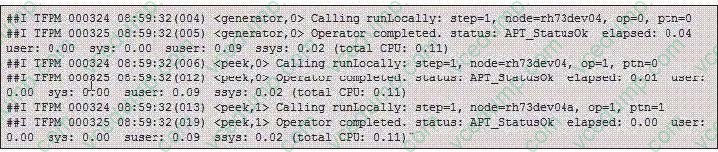
Which environment variable would provide this information?
A. APT_STATUS
B. APT_DEBUG_PARTITION
C. APT_PM_PLAYER_TIMING
D. APT_SHOW_COMPONENT_CALLS -
Question 98:
Your job design calls for using a target ODBC Connector stage. The target database is found on a remote server. The target table you are writing into contains a single column primary key. What are the three "Write mode" properties that allow the possibility of multiple SQL actions? (Choose three.)
A. Join then update
B. Truncate then add
C. Insert then update
D. Delete then insert
E. Update then insert -
Question 99:
Rows of data going into a Transformer stage are sorted and hash partitioned by the Input.Product column. Using stage variables, how can you determine when a new row is the first of a new group of Product rows?
A. Create a stage variable named sv_IsNewProduct and follow it by a second stage variable named sv_Product. Map the Input.Product column tosv_Product. The derivation for sv_IsNewProduct is: IF Input.Product = sv_Product THEN "YES" ELSE "NO".
B. Create a stage variable named sv_IsNewProduct and follow it by a second stage variable named sv_Product. Map the Input.Product column tosv_Product. The derivation for sv_IsNewProduct is: IF Input.Product sv_Product THEN "YES" ELSE "NO".
C. Create a stage variable named sv_Product and follow it by a second stage variable named sv_IsNewProduct . Map the Input.Product column tosv_Product. The derivation for sv_IsNewProduct is: IF Input.Product = sv_Product THEN "YES" ELSE "NO".
D. Create a stage variable named sv_Product and follow it by a second stage variable named sv_IsNewProduct . Map the Input.Product column tosv_Product. The derivation for sv_IsNewProduct is: IF Input.Product sv_Product THEN "YES" ELSE "NO". -
Question 100:
Which two statements are correct about XML stages and their usage? (Choose two.)
A. XML Input stage converts XML data to hierarchical format.
B. XML Input stage transforms hierarchical XSLT data to tabular format.
C. XML Transformer stage converts an XML document to another XML hierarchical format.
D. XML Output stage converts relational tables and sequential files to XML hierarchical structures.
Related Exams:
-
C1000-002
IBM MQ V9.0 System Administration -
C1000-003
IBM Mobile Foundation v8.0 Application Development -
C1000-004
IBM Curam SPM V7.X Application Developer -
C1000-007
IBM Cloud Application Development v3 -
C1000-010
IBM Operational Decision Manager Standard V8.9.1 Application Development -
C1000-012
IBM Watson Application Developer V3.1 -
C1000-015
IBM Business Process Manager V8.6 Application Development using Process Designer -
C1000-018
IBM QRadar SIEM V7.3.2 Fundamental Analysis -
C1000-019
IBM Spectrum Protect Plus V10.1.1 Implementation -
C1000-020
IBM New Workloads Sales V2
Tips on How to Prepare for the Exams
Nowadays, the certification exams become more and more important and required by more and more enterprises when applying for a job. But how to prepare for the exam effectively? How to prepare for the exam in a short time with less efforts? How to get a ideal result and how to find the most reliable resources? Here on Vcedump.com, you will find all the answers. Vcedump.com provide not only IBM exam questions, answers and explanations but also complete assistance on your exam preparation and certification application. If you are confused on your C2090-421 exam preparations and IBM certification application, do not hesitate to visit our Vcedump.com to find your solutions here.