C2090-303 Exam Details
-
Exam Code
:C2090-303 -
Exam Name
:IBM InfoSphere DataStage v9.1 -
Certification
:IBM Certifications -
Vendor
:IBM -
Total Questions
:139 Q&As -
Last Updated
:Dec 27, 2019
IBM C2090-303 Online Questions & Answers
-
Question 31:
Each row contains the CustID, ProductID, ProductType and TotalAmount columns. You want to retain the record with the largest value in the TotalAmount column for each CustID and ProductType using a RemoveDuplicates stage.
How can this be accomplished?
A. Hash-partition on CustID. Sort on CustID, ProductType and TotalAmount.
B. Hash-partition on TotalAmount. Sort on CustID, ProductType and TotalAmount.
C. Hash-partition on ProductType. Sort on ProductType, CustID and TotalAmount.
D. Hash-partition on CustID, ProductType and TotalAmount. Sort on CustID, ProductType and TotalAmount. -
Question 32:
Which two pieces of information are required to be specified for the input link on a Netezza Connector stage? (Choose two.)
A. Partitioning
B. Server name
C. Table definitions
D. Buffering settings
E. Error log directory -
Question 33:
The ODBC stage can handle which two SQL Server data types? (Choose two.)
A. Date
B. Time
C. GUID
D. Datetime
E. SmallDateTime -
Question 34:
You are asked to optimize the fork join job design in the exhibit. This job uses the sort aggregator and a left outer join on the ZIP code column. Currently all partitioning is set to "Auto" and automatic sort insertion is allowed.
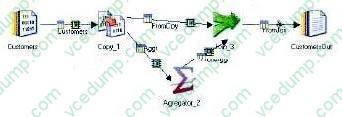
Which change will reduce the cost of partitioning that occurs in this job?
A. Use Entire partitioning on the input links to the Aggregator and Join stages.
B. Hash partition and sort on ZIP code column on the input links to the Aggregator and Join stages.
C. Hash partition and sort on ZIP code column prior to the Copy stage and use entire partitioning on the Aggregator and Join stages.
D. Hash partition and sort on ZIP code column prior to the Copy stage, and use same partitioning on the Aggregator and Join stages. -
Question 35:
Configuring the weighting column of an Aggregator stage affects which two options. (Choose two.)
A. Sum
B. Maximum Value
C. Average of Weights
D. Coefficient of Variation
E. Uncorrected Sum of Squares -
Question 36:
You are assigned to correct a job from another developer. The job contains 20 stages sourcing data from two Data Sets and many sequential files. The annotation in the job indicates who wrote the job and when, not the objective of the job. All link and stage names use the default names.
One of the output columns has an incorrect value which should have been obtained using a lookup.
What could the original developer have done to make this task easier for maintenance purposes?
A. Name all stage and links the same.
B. Name all stages and links based on what they do.
C. Indicate all stage names within the job annotation.
D. Name all stage and links with column names and ideas. -
Question 37:
What are two advantages of using Runtime Column Propagation (RCP)? (Choose two.)
A. RCP forces a developer to define all columns explicitly.
B. Only columns used in the data flow need to be defined.
C. Sequential files don't require schema files when using RCP.
D. Only columns that are defined as VarChar need RCP enabled.
E. Columns not specifically used in the flow are propagated as if they were. -
Question 38:
What role must a user have to delete shared metadata assets from the repository?
A. DataStage Administrator
B. Business Glossary Administrator
C. Common Metadata Administrator
D. Information Analyzer Administrator -
Question 39:
Click the Exhibit button.
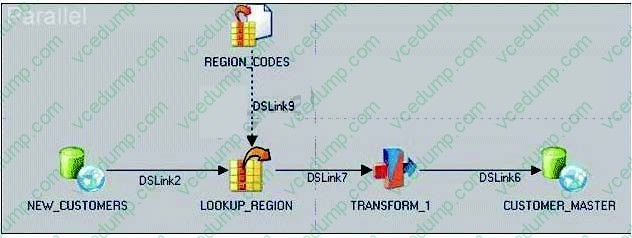
The job in the exhibit runs to successful completion with no warnings. However, a validation test identifies that the CUSTOMER_MASTER table is empty. You suspect the cause to be related to the NEW_CUSTOMERS table or a defect in the job. Examining runtime metadata may help you track down the problem.
Which two product features will help you isolate the cause of the problem? (Choose two.)
A. Director job monitor tool.
B. Designer Performance Analyzer tool.
C. Designer "Show performance statistics" option.
D. The view data button in the target Connector stage.
E. InfoSphere Metadata Asset Manager (IMAM) operational metadata reports. -
Question 40:
When using a Sequential File stage as a source what are the two reject mode property options? (Choose two.)
A. Set
B. Fail
C. Save
D. Continue
E. Convert
Related Exams:
-
C1000-002
IBM MQ V9.0 System Administration -
C1000-003
IBM Mobile Foundation v8.0 Application Development -
C1000-004
IBM Curam SPM V7.X Application Developer -
C1000-007
IBM Cloud Application Development v3 -
C1000-010
IBM Operational Decision Manager Standard V8.9.1 Application Development -
C1000-012
IBM Watson Application Developer V3.1 -
C1000-015
IBM Business Process Manager V8.6 Application Development using Process Designer -
C1000-018
IBM QRadar SIEM V7.3.2 Fundamental Analysis -
C1000-019
IBM Spectrum Protect Plus V10.1.1 Implementation -
C1000-020
IBM New Workloads Sales V2
Tips on How to Prepare for the Exams
Nowadays, the certification exams become more and more important and required by more and more enterprises when applying for a job. But how to prepare for the exam effectively? How to prepare for the exam in a short time with less efforts? How to get a ideal result and how to find the most reliable resources? Here on Vcedump.com, you will find all the answers. Vcedump.com provide not only IBM exam questions, answers and explanations but also complete assistance on your exam preparation and certification application. If you are confused on your C2090-303 exam preparations and IBM certification application, do not hesitate to visit our Vcedump.com to find your solutions here.