C2060-220 Exam Details
-
Exam Code
:C2060-220 -
Exam Name
:IBM Sterling Connect Direct Administration -
Certification
:IBM Certifications -
Vendor
:IBM -
Total Questions
:120 Q&As -
Last Updated
:Jan 03, 2020
IBM C2060-220 Online Questions & Answers
-
Question 111:
A Sterling Connect:Direct for UNIX administrator needs to enable the node named CDLOCAL to exchange data with a remote node named CDREMOTE using Secure+ with SSL protocol. Both nodes will use server authentication level, and external authentication must not be enabled. The administrator will use the Secure+ Command Line Interface (SPCLI) to configure the Secure+. The administrator has saved the trusted root certificate with filename: /ibm/mft/cdunix41/ndm/secure+/certificates/CDREMOTE_trusted.txt The Key Certificate file is: /ibm/mft/cdunix41/ndm/secure+/certificates/keycert.txt Which sequence of commands will accomplish this task on the CDLOCAL side?
A. sync netmap path=/ibm/mft/cdunix41/ndm/cfg/CDLOCAL/netmap.cfg name=CDREMOTE; update remotenode name=CDREMOTE protocol=ssl override=n SSLTLSTRUSTEDROOTCERTFILE=/ibm/mft/cdunix41/ndm/secure+/certificates/ CDREMOTE_tru sted.txt SSLTLSCERTFILE=/ibm/mft/cdunix41/ndm/secure+/certificates/keycert.txt SSLTLSCERTPASSPHRASE=myprivkeypassword SslTlsEnableClientAuth=n SslTlsSeaEnable=y SeaCertValDef=CDREMOTESEA SSLTLSENABLECIPHER=all;
B. sync netmap path=/ibm/mft/cdunix41/ndm/cfg/CDLOCAL/netmap.cfg name=CDLOCAL; update remotenode name=CDREMOTE protocol=ssl override=n SSLTLSTRUSTEDROOTCERTFILE=/ibm/mft/cdunix41/ndm/secure+/certificates/CDREMOTE_tru sted.txt SSLTLSCERTFILE=/ibm/mft/cdunix41/ndm/secure+/certificates/keycert.txt SSLTLSCERTPASSPHRASE=myprivkeypassword SslTlsEnableClientAuth=n SslTlsSeaEnable=n SSLTLSENABLECIPHER=all;
C. sync netmap path=/ibm/mft/cdunix41/ndm/cfg/CDLOCAL/netmap.cfg name=*; update remotenode name=CDREMOTE protocol=ssl override=n SSLTLSTRUSTEDROOTCERTFILE=/ibm/mft/cdunix41/ndm/secure+/certificates/CDREMOTE_tru sted.txt SSLTLSCERTFILE=/ibm/mft/cdunix41/ndm/secure+/certificates/keycert.txt SSLTLSCERTPASSPHRASE=myprivkeypassword SslTlsEnableClientAuth=n SslTlsSeaEnable=n SSLTLSENABLECIPHER=all;
D. sync netmap path=/ibm/mft/cdunix41/ndm/cfg/CDLOCAL/netmap.cfg name=*; update remotenode name=CDREMOTE protocol=ssl override=n SSLTLSTRUSTEDROOTCERTFILE=/ibm/mft/cdunix41/ndm/secure+/certificates/keycert.txt SSLTLSCERTFILE=/ibm/mft/cdunix41/ndm/secure+/certificates/CDREMOTE_trusted.txt SSLTLSCERTPASSPHRASE=myprivkeypassword SslTlsEnableClientAuth=n SslTlsSeaEnable=n SSLTLSENABLECIPHER=all; -
Question 112:
Which component is invoked to stop Sterling Connect:Direct for UNIX?
A. Security Exit
B. User Manager
C. Session Manager
D. Process Manager -
Question 113:
When configuring a node in Sterling Connect:Direct for Windows, which field is found on the API properties tab in the CD Admin Tool?
A. Host Port
B. Buffer Size
C. TCQ Startup
D. Enable Dynamic Addressing (DHCP) -
Question 114:
An administrator has implemented a Sterling Connect Direct for z/OS Plex. The Company has a firewall which translates IP addresses back and forth from internal IP network addresses to external IP network addresses (NAT). What must an administrator do in order for the remote trading partners to communicate with the Connect Direct for z/OS Plex?
A. Code both the internal and External IP network addresses in the TCP LISTEN CDPLEX local initialization parameters.
B. Code both the internal and External IP network addresses in the TCP LISTEN CDPLEX global initialization parameters.
C. Code the CDPLEX.PEDIRECT Local sever initialization parameters to include both the internal and external IP network addresses.
D. Code the CDPLEX.PEDIRECT EXCEPTION local manager initialization parameters to include both the internal and external IP network addresses -
Question 115:
Cyclic redundancy check (CRC) is used:
A. to detect corrupted data.
B. as an extended compression algorithm.
C. to encode hash algorithms in SSL / TLS protocols.
D. to encode version 2 Function Management Headers. -
Question 116:
A Sterling Connect:Direct for z/OS administrator navigated to the CHANGE PROCESS Screen? shown here: The administrator can use the RESTART ALTERATIONS field to do which of the following?
A. Restart at beginning of transmission. B. Restart at the last checkpoint interval. C. Restart at any prior checkpoint interval.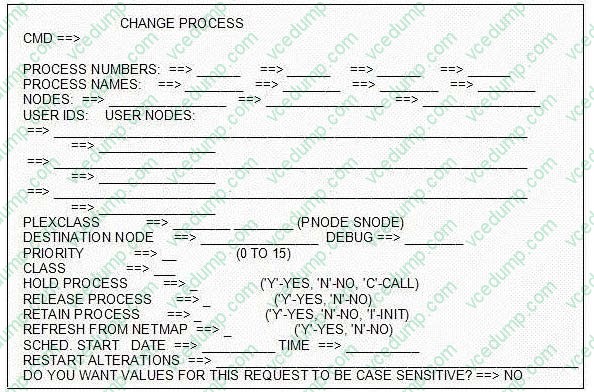
B. Restart at a specific Partitioned Data Set member.D.Restart at a specific Partitioned Data Set member. -
Question 117:
When using checkpointing with TCP/IP or LU62, what node records the checkpoint record?
A. The sending node.
B. The receiving node.
C. Both the sending and receiving nodes.
D. Neither the sending nor receiving nodes. -
Question 118:
A Sterling Connect:Direct for Windows user has written a batch file to transfer files. The batch file is utilizing the Command Line Interface (Direct.exe) to submit processes. When the user starts the batch file, it completes successfully. However, when the batch file is started by a scheduling service application, it fails. The error message indicates that the Command Line Interface is unable to attach to the Connect:Direct node. What is a secure way to specify credentials for an automatic logon to the Connect:Direct Windows node?
A. Specify Userid and password in the batch file: Direct.exe -uuser1 -psecret01
B. Add the following parameter to the Processes: SNODEID=(user1,secret01)
C. Add the following parameter to the Processes: PNODEID=(user1,secret01)
D. Run the Logon Configuration Utility to create a BIN file, then use: Direct.exe -fcddef.bin -
Question 119:
When using checkpointing with TCP/IP or LU62, what node controls the checkpoint interval?
A. The sending node.
B. The receiving node.
C. Both the sending and receiving nodes.
D. Neither the sending nor receiving nodes. -
Question 120:
A Sterling Connect:Direct administrator is viewing a trace where the PNODE is unable to send secure files to the SNODE. The following information was extracted from a trace:
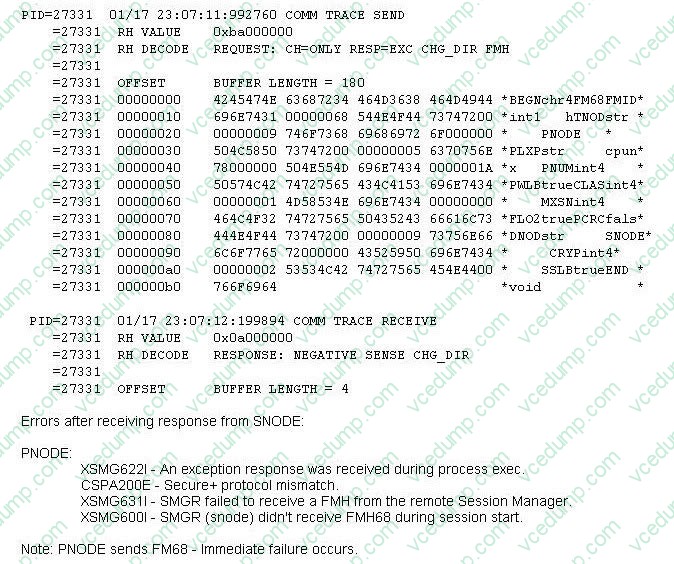
What is the cause of this problem?
A. The PNODE has common name enabled.A.The PNODE has common name enabled.
B. The SNODE has disabled Secure+ protocol.B.The SNODE has disabled Secure+ protocol.
C. The PNODE does not have a matching cipher suite for the SNODE.C.The PNODE does not have a matching cipher suite for the SNODE.
D. The PNODE has configured the wrong protocol (TLS or SSL) for the SNODE.D.The PNODE has configured the wrong protocol (TLS or SSL) for the SNODE.
Related Exams:
-
C1000-002
IBM MQ V9.0 System Administration -
C1000-003
IBM Mobile Foundation v8.0 Application Development -
C1000-004
IBM Curam SPM V7.X Application Developer -
C1000-007
IBM Cloud Application Development v3 -
C1000-010
IBM Operational Decision Manager Standard V8.9.1 Application Development -
C1000-012
IBM Watson Application Developer V3.1 -
C1000-015
IBM Business Process Manager V8.6 Application Development using Process Designer -
C1000-018
IBM QRadar SIEM V7.3.2 Fundamental Analysis -
C1000-019
IBM Spectrum Protect Plus V10.1.1 Implementation -
C1000-020
IBM New Workloads Sales V2
Tips on How to Prepare for the Exams
Nowadays, the certification exams become more and more important and required by more and more enterprises when applying for a job. But how to prepare for the exam effectively? How to prepare for the exam in a short time with less efforts? How to get a ideal result and how to find the most reliable resources? Here on Vcedump.com, you will find all the answers. Vcedump.com provide not only IBM exam questions, answers and explanations but also complete assistance on your exam preparation and certification application. If you are confused on your C2060-220 exam preparations and IBM certification application, do not hesitate to visit our Vcedump.com to find your solutions here.