AZ-500 Exam Details
-
Exam Code
:AZ-500 -
Exam Name
:Microsoft Azure Security Technologies -
Certification
:Microsoft Certifications -
Vendor
:Microsoft -
Total Questions
:626 Q&As -
Last Updated
:Jul 12, 2026
Microsoft AZ-500 Online Questions & Answers
-
Question 541:
HOTSPOT
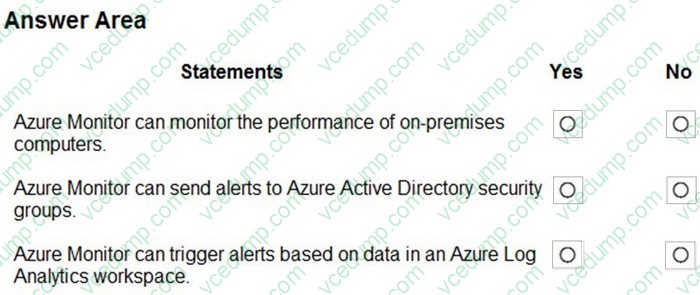
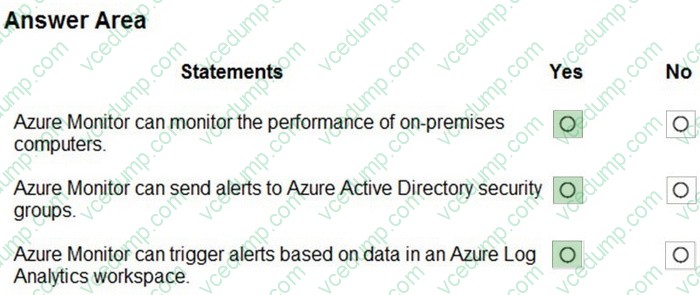
For each of the following statements, select Yes if the statement is true. Otherwise, select No.
NOTE: Each correct selection is worth one point.
-
Question 542:
Note: This question is part of a series of questions that present the same scenario. Each question in the series contains a unique solution that might meet the stated goals. Some question sets might have more than one correct solution, while others might not have a correct solution.
After you answer a question in this section, you will NOT be able to return to it. As a result, these questions will not appear in the review screen.
You have an Azure Subscription. The subscription contains 50 virtual machines that run Windows Server 2012 R2 or Windows Server 2016.
You need to deploy Microsoft Antimalware to the virtual machines.
Solution: You connect to each virtual machine and add a Windows feature.
Does this meet the goal?
A. Yes
B. No -
Question 543:
DRAG DROP
You have an Azure AD tenant and an application named App1.
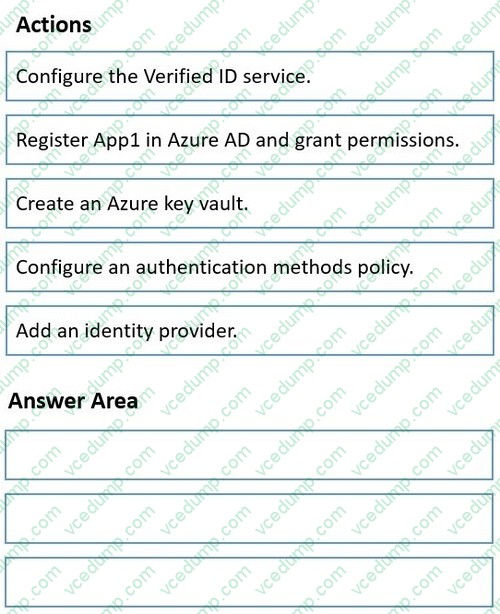
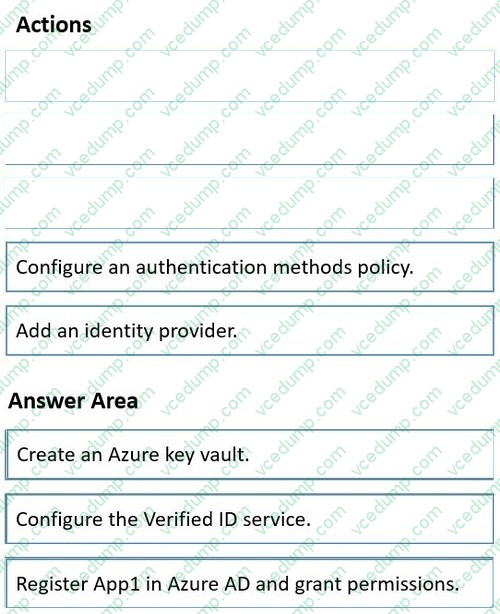
You need to ensure that App1 can use Microsoft Entra Verified ID to verify credentials.
Which three actions should you perform in sequence? To answer, move the appropriate actions from the list of actions to the answer area and arrange them in the correct order.
Select and Place:
-
Question 544:
You have Azure Resource Manager templates that you use to deploy Azure virtual machines.
You need to disable unused Windows features automatically as instances of the virtual machines are provisioned.
What should you use?
A. device compliance policies in Microsoft Intune
B. Azure Automation State Configuration
C. application security groups
D. Azure Advisor -
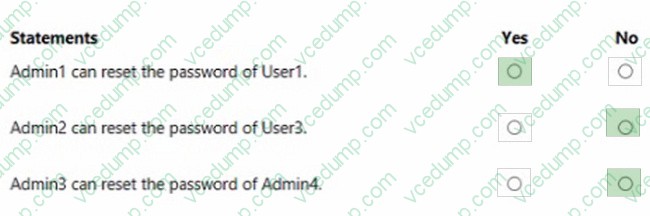
Question 545:
HOTSPOT
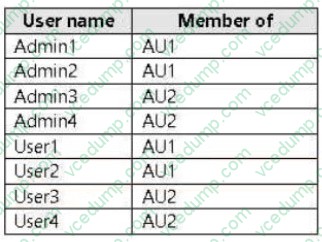
You have an Azure Active Directory (Azure AD) tenant that contains two administrative units named AU1 and AU2.
Users are assigned to the administrative units as shown in the following table.
Users are assigned the roles shown in the following table.

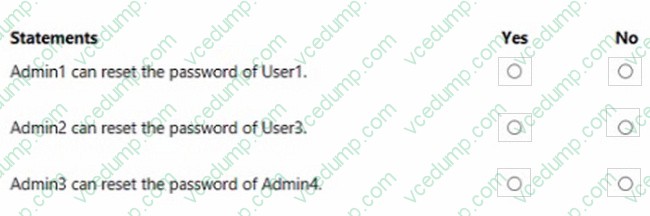
For each of the following statements, select Yes if the statement is true. Otherwise, select No.
NOTE: Each correct selection is worth one point
-
Question 546:
You have an Azure AD tenant that contains the identities shown in the following table.
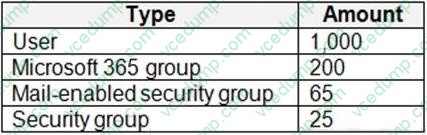
You plan to implement Azure AD Identity Protection.
What is the maximum number of user risk policies you can configure?
A. 1
B. 90
C. 200
D. 265
E. 1000 -
Question 547:
SIMULATION
You need to ensure that when administrators deploy resources by using an Azure Resource Manager template, the deployment can access secrets in an Azure key vault named KV31330471.
A. Please check the answer in the explantion
B. PlaceHolder
C. PlaceHolder
D. PlaceHolder -
Question 548:
You have an Azure key vault named Vault1 that stores the resources shown in the following table.
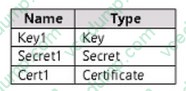
Which resources support the creation of a rotation policy?
A. Key 1 only
B. Cert1 only
C. Key1 and Secret1 only
D. Key1 and Cert1 only
E. Secret1 and Cert1 only
F. Key1, Secret1, and Cert1 -
Question 549:
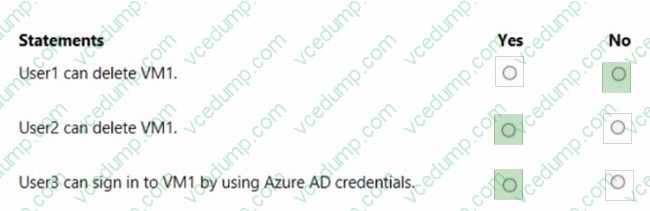
HOTSPOT
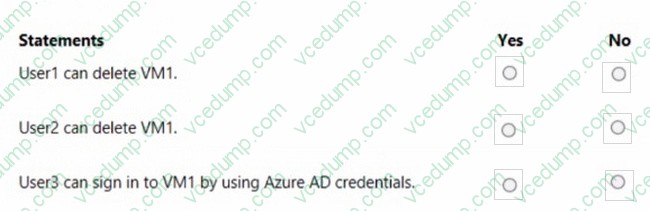
You have an Azure subscription that contains a resource group named RG1. RG1 contains a virtual machine named VM1 that uses Azure Active Directory (Azure AD) authentication.
You have two custom Azure roles named Role1 and Role2 that are scoped to RG1.
The permissions for Role1 are shown in the following JSON code.
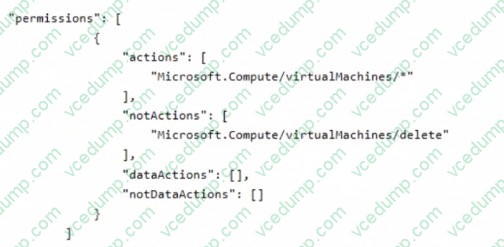
The permissions for Role2 are shown in the following JSON code.
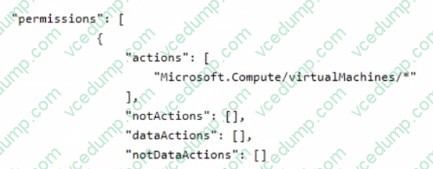
You assign the roles to the users shown in the following table.
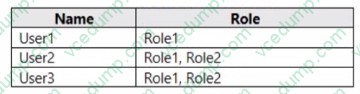
For each of the following statements, select Yes if the statement is true. Otherwise, select No.
NOTE: Each correct selection is worth one point.
-
Question 550:
You have an Azure subscription that contains a Microsoft Defender External Attack Surface Management (Defender EASM) resource named EASM1.
You review the Attack Surface Summary dashboard. You need to identify the following insights:
1. Deprecated technologies that are no longer supported
2. Infrastructure that will soon expire
Which section of the dashboard should you review?
A. Securing the Cloud
B. Sensitive Services
C. attack surface composition
D. Attack Surface Priorities
Related Exams:
-
62-193
Technology Literacy for Educators -
70-243
Administering and Deploying System Center 2012 Configuration Manager -
70-355
Universal Windows Platform – App Data, Services, and Coding Patterns -
77-420
Excel 2013 -
77-427
Excel 2013 Expert Part One -
77-725
Word 2016 Core Document Creation, Collaboration and Communication -
77-726
Word 2016 Expert Creating Documents for Effective Communication -
77-727
Excel 2016 Core Data Analysis, Manipulation, and Presentation -
77-728
Excel 2016 Expert: Interpreting Data for Insights -
77-731
Outlook 2016 Core Communication, Collaboration and Email Skills
Tips on How to Prepare for the Exams
Nowadays, the certification exams become more and more important and required by more and more enterprises when applying for a job. But how to prepare for the exam effectively? How to prepare for the exam in a short time with less efforts? How to get a ideal result and how to find the most reliable resources? Here on Vcedump.com, you will find all the answers. Vcedump.com provide not only Microsoft exam questions, answers and explanations but also complete assistance on your exam preparation and certification application. If you are confused on your AZ-500 exam preparations and Microsoft certification application, do not hesitate to visit our Vcedump.com to find your solutions here.