AZ-500 Exam Details
-
Exam Code
:AZ-500 -
Exam Name
:Microsoft Azure Security Technologies -
Certification
:Microsoft Certifications -
Vendor
:Microsoft -
Total Questions
:626 Q&As -
Last Updated
:Jul 12, 2026
Microsoft AZ-500 Online Questions & Answers
-
Question 181:
SIMULATION
You need to deploy an Azure firewall to a virtual network named VNET3.
To complete this task, sign in to the Azure portal and modify the Azure resources.
This task might take several minutes to complete. You can perform other tasks while the task completes.
A. See the explanation below. -
Question 182:
You have an Azure subscription that contains a user named UseR1.
You need to ensure that UseR1 can perform the following tasks:
1. Create groups.
2. Create access reviews for role-assignable groups.
3. Assign Azure AD roles to groups.
The solution must use the principle of least privilege.
Which role should you assign to User1?
A. Groups administrator
B. Authentication administrator
C. Identity Governance Administrator
D. Privileged role administrator -
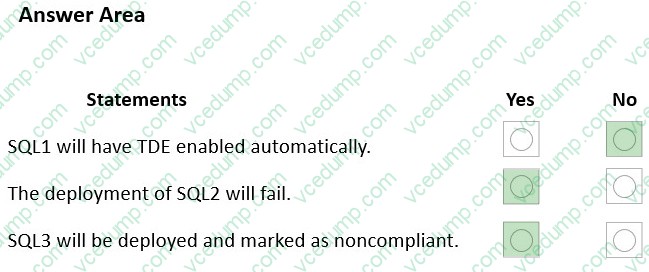
Question 183:
HOTSPOT
You have an Azure subscription that contains the resources shown in the following table.
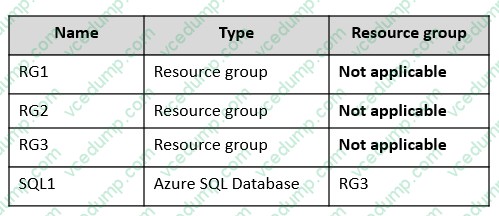
Transparent Data Encryption (TDE) is disabled on SQL1.
You assign policies to the resource groups as shown in the following table.
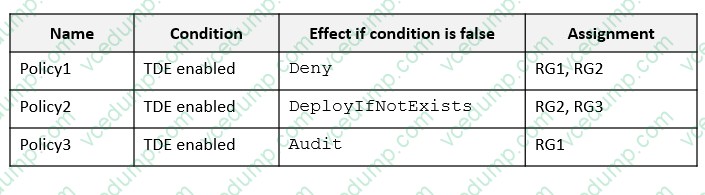
You plan to deploy Azure SQL databases by using an Azure Resource Manager (ARM) template. The databases will be configured as shown in the following table.
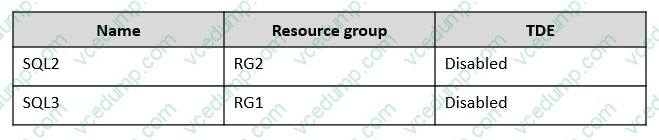
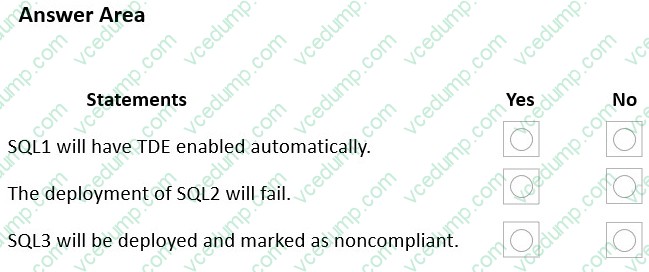
For each of the following statements, select Yes if the statement is true. Otherwise, select No.
NOTE: Each correct selection is worth one point.
-
Question 184:
Your on-premises network contains a Hyper-V virtual machine named VM1.
You need to use Azure Arc to onboard VM1 to Microsoft Defender for Cloud.
What should you install first?
A. the guest configuration agent
B. the Azure Monitor agent
C. the Log Analytics agent
D. the Azure Connected Machine agent -
Question 185:
Note: This question is part of a series of questions that present the same scenario.
Each question in the series contains a unique solution that might meet the stated goals. Some question sets might have more than one correct solution, while others might not have a correct solution. After you answer a question in this section, you will NOT be able to return to it. As a result, these questions will not appear in the review screen. You have an Azure environment. You need to create a new Azure virtual machine from a tablet that runs the Android operating system.
Solution: You use the PowerApps portal.
Does this meet the goal?
A. Yes
B. No -
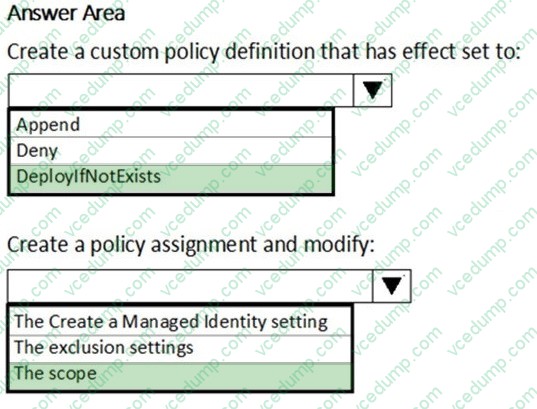
Question 186:
HOTSPOT
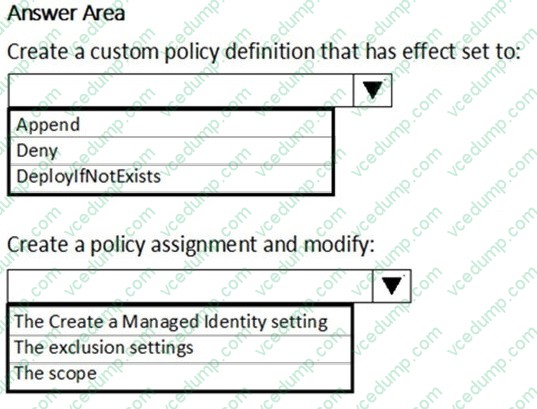
You need to deploy Microsoft Antimalware to meet the platform protection requirements.
What should you do? To answer, select the appropriate options in the answer area.
NOTE: Each correct selection is worth one point.
-
Question 187:
You have an Azure subscription that contains an Azure key vault named Vault1.
In Vault1, you create a secret named Secret1.
An application developer registers an application in Azure Active Directory (Azure AD).
You need to ensure that the application can use Secret1.
What should you do?
A. In Azure AD, create a role.
B. In Azure Key Vault, create a key.
C. In Azure Key Vault, create an access policy.
D. In Azure AD, enable Azure AD Application Proxy. -
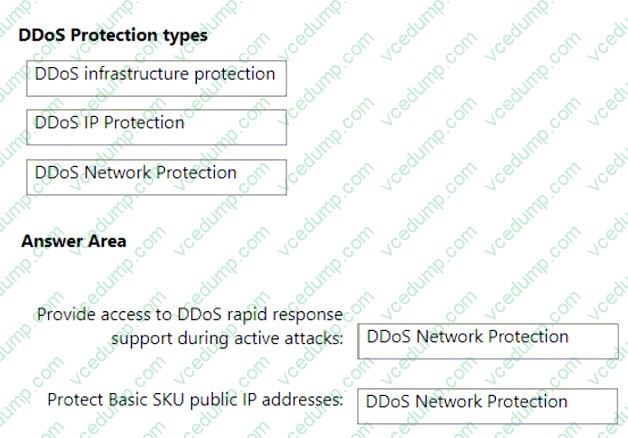
Question 188:
DRAG DROP
You have an Azure subscription.
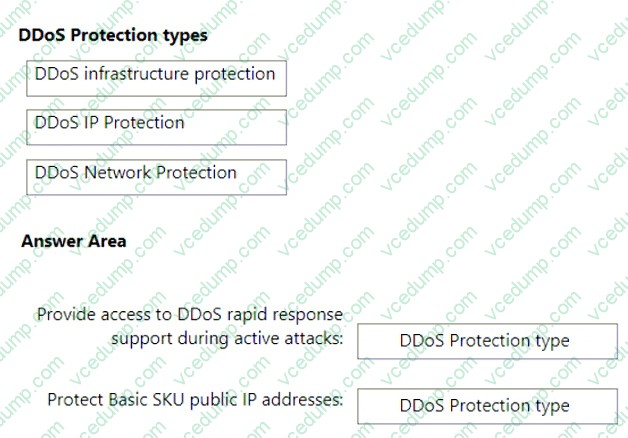
You plan to implement Azure DDoS Protection. The solution must meet the following requirement:
1. Provide access to DDoS rapid response support during active attacks.
2. Project Basic SKU public IP addresses.
You need to recommend which type of DDoS projection to use for each requirement.
What should you recommend? To answer, drag the appropriate DDoS projection types to the correct requirements. Each DDoS Projection type may be used once, or not at all. You may need to drag the split bar between panes or scroll to view connect.
NOTE: Each correct selection is worth one point.
Select and Place:
-
Question 189:
You have an Azure subscription that contains a resource group named RG1 and the network security groups (NSGs) shown in the following table.
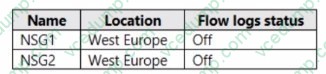
You create the Azure policy shown in the following exhibit.
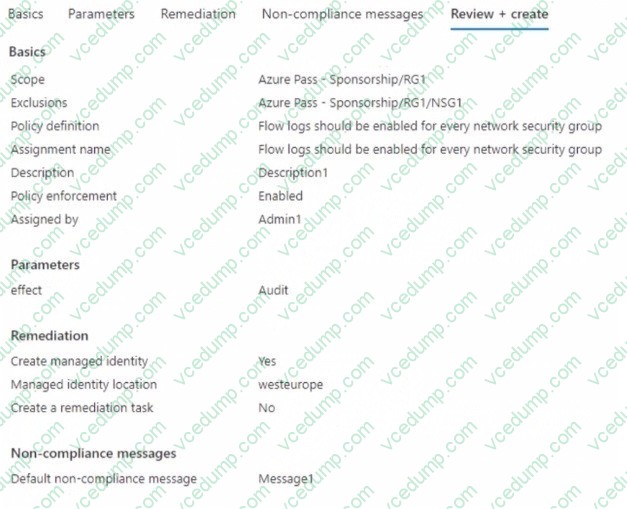
You assign the policy to RG1.
What will occur if you assign the policy to NSG1 and NSG2?
A. Flow logs will be enabled for NSG1 and NSG2.
B. Flow logs will be enabled for NSG2 only.
C. Flow logs will be disabled for NSG1 and NSG2.
D. Flow logs will be enabled for NSG1 only. -
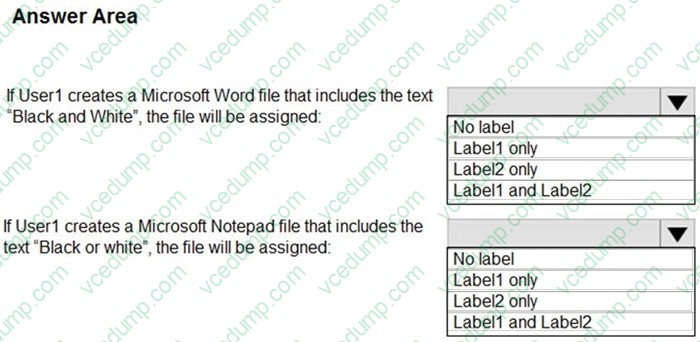
Question 190:
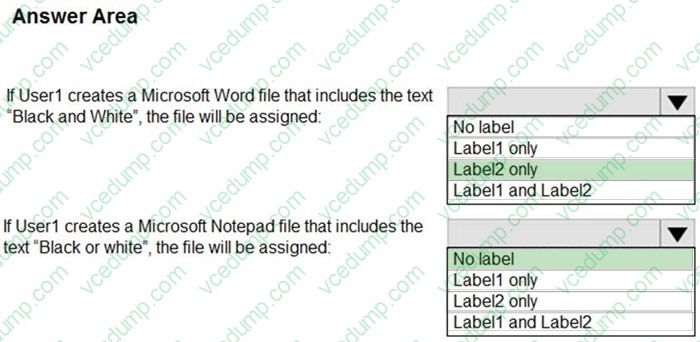
HOTSPOT
You have the Azure Information Protection labels as shown in the following table.

You have the Azure Information Protection policies as shown in the following table.

You need to identify how Azure Information Protection will label files.
What should you identify? To answer, select the appropriate options in the answer area.
NOTE: Each correct selection is worth one point.
Related Exams:
-
62-193
Technology Literacy for Educators -
70-243
Administering and Deploying System Center 2012 Configuration Manager -
70-355
Universal Windows Platform – App Data, Services, and Coding Patterns -
77-420
Excel 2013 -
77-427
Excel 2013 Expert Part One -
77-725
Word 2016 Core Document Creation, Collaboration and Communication -
77-726
Word 2016 Expert Creating Documents for Effective Communication -
77-727
Excel 2016 Core Data Analysis, Manipulation, and Presentation -
77-728
Excel 2016 Expert: Interpreting Data for Insights -
77-731
Outlook 2016 Core Communication, Collaboration and Email Skills
Tips on How to Prepare for the Exams
Nowadays, the certification exams become more and more important and required by more and more enterprises when applying for a job. But how to prepare for the exam effectively? How to prepare for the exam in a short time with less efforts? How to get a ideal result and how to find the most reliable resources? Here on Vcedump.com, you will find all the answers. Vcedump.com provide not only Microsoft exam questions, answers and explanations but also complete assistance on your exam preparation and certification application. If you are confused on your AZ-500 exam preparations and Microsoft certification application, do not hesitate to visit our Vcedump.com to find your solutions here.