AZ-204 Exam Details
-
Exam Code
:AZ-204 -
Exam Name
:Developing Solutions for Microsoft Azure -
Certification
:Microsoft Certifications -
Vendor
:Microsoft -
Total Questions
:588 Q&As -
Last Updated
:Jul 12, 2026
Microsoft AZ-204 Online Questions & Answers
-
Question 531:
You are building a web application that performs image analysis on user photos and returns metadata containing objects identified. The image is very costly in terms of time and compute resources. You are planning to use Azure Redis Cache so duplicate uploads do not need to be reprocessed.
In case of an Azure data center outage, metadata loss must be kept to a minimum. You need to configure the Azure Redis cache instance.
Which two actions should you perform?
A. Configure Azure Redis with AOF persistence.
B. Configure Azure Redis with RDB persistence.
C. Configure second storage account for persistence.
D. Set backup frequency to the minimum value. -
Question 532:
HOTSPOT
You are developing an application to store millions of images in Azure blob storage.
The application has the following requirements:
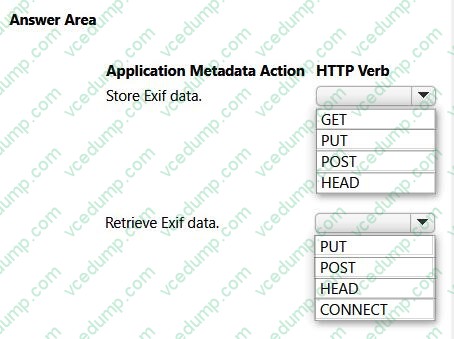
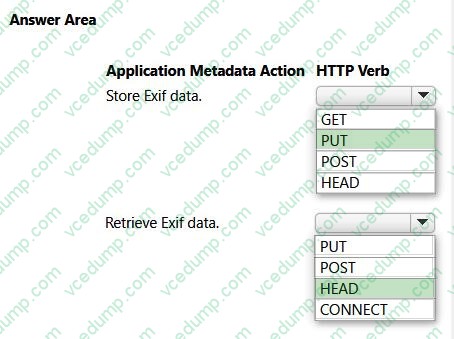
Store the Exif (exchangeable image file format) data from the image as blob metadata when the application uploads the image.
Retrieve the Exif data from the image while minimizing bandwidth and processing time.
Utilizes the REST API.
You need to use the image Exif data as blob metadata in the application.
Which HTTP verbs should you use? To answer, select the appropriate options in the answer area.
NOTE: Each correct selection is worth one point.
-
Question 533:
You are developing a solution that will use Azure messaging services.
You need to ensure that the solution uses a publish-subscribe model and eliminates the need for constant polling.
What are two possible ways to achieve the goal? Each correct answer presents a complete solution.
NOTE: Each correct selection is worth one point.
A. Service Bus
B. Event Hub
C. Event Grid
D. Queue -
Question 534:
HOTSPOT
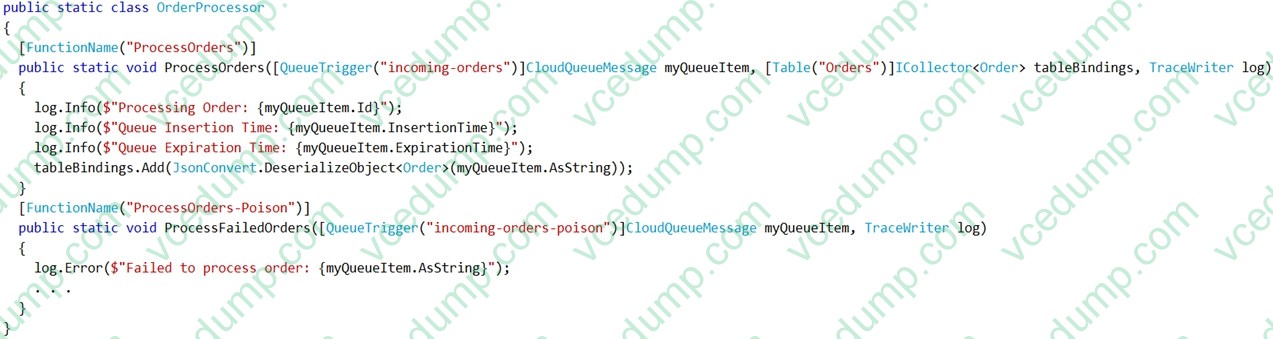
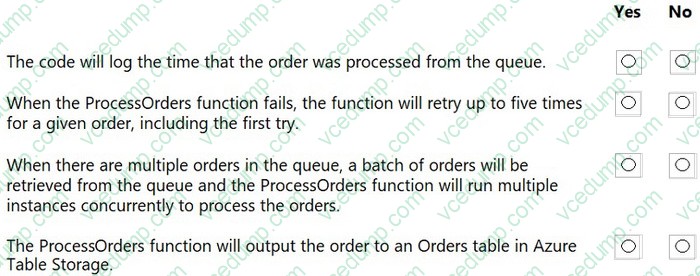
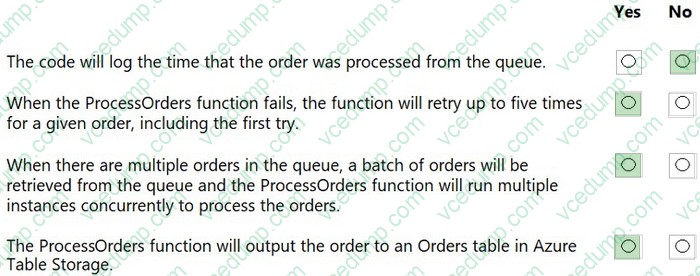
You are developing an Azure Function App by using Visual Studio. The app will process orders input by an Azure Web App. The web app places the order information into Azure Queue Storage.
You need to review the Azure Function App code shown below.
NOTE: Each correct selection is worth one point.
-
Question 535:
You develop Azure Durable Functions to manage vehicle loans.
The loan process includes multiple actions that must be run in a specified order. One of the actions includes a customer credit check process, which may require multiple days to process.
You need to implement Azure Durable Functions for the loan process.
Which Azure Durable Functions type should you use?
A. orchestrator
B. client
C. activity
D. entity -
Question 536:
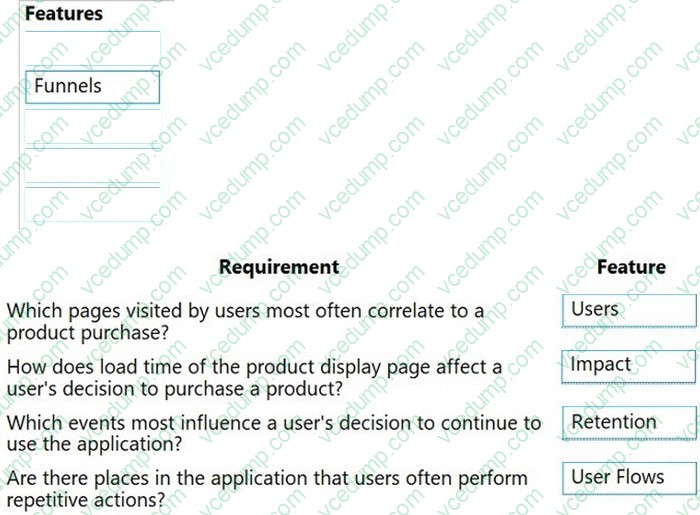
DRAG DROP
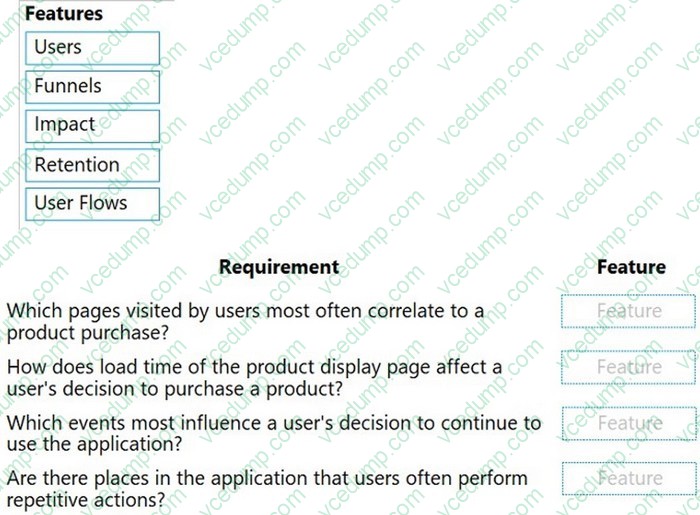
You develop an ASP.NET Core MVC application. You configure the application to track webpages and custom events.
You need to identify trends in application usage.
Which Azure Application Insights Usage Analysis features should you use? To answer, drag the appropriate features to the correct requirements. Each feature may be used once, more than once, or not at all. You may need to drag the split bar between panes or scroll to view content.
NOTE: Each correct selection is worth one point.
Select and Place:
-
Question 537:
You need to implement the processing of enqueuer inventory items.
Which message value should you use?
A. Session identifier
B. Sequence number
C. Partition key
D. Time stamp -
Question 538:
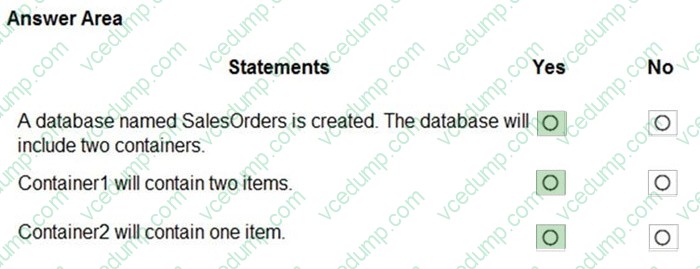
HOTSPOT
You are developing an Azure-hosted e-commerce web application. The application will use Azure Cosmos DB to store sales orders. You are using the latest SDK to manage the sales orders in the database.
You create a new Azure Cosmos DB instance. You include a valid endpoint and valid authorization key to an appSettings.json file in the code project.
You are evaluating the following application code: (Line number are included for reference only.)

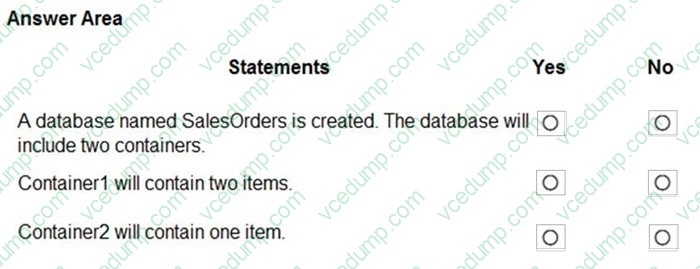
For each of the following statements, select Yes if the statement is true. Otherwise, select No.
NOTE: Each correct selection is worth one point.
-
Question 539:
You are developing an application that applies a set of governance policies for internal and external services, as well as for applications.
You develop a stateful ASP.NET Core 2.1 web application named PolicyApp and deploy it to an Azure App Service Web App. The PolicyApp reacts to events from Azure Event Grid and performs policy actions based on those events.
You have the following requirements:
Authentication events must be used to monitor users when they sign in and sign out. All authentication events must be processed by PolicyApp.
Sign outs must be processed as fast as possible.
What should you do?
A. Create a new Azure Event Grid subscription for all authentication events. Use the subscription to process sign-out events.
B. Create a separate Azure Event Grid handler for sign-in and sign-out events.
C. Create separate Azure Event Grid topics and subscriptions for sign-in and sign-out events.
D. Add a subject prefix to sign-out events. Create an Azure Event Grid subscription. Configure the subscription to use the subjectBeginsWith filter. -
Question 540:
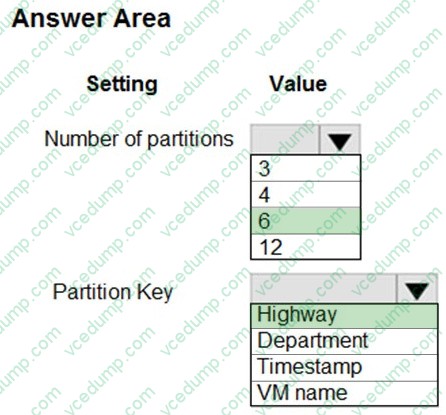
HOTSPOT
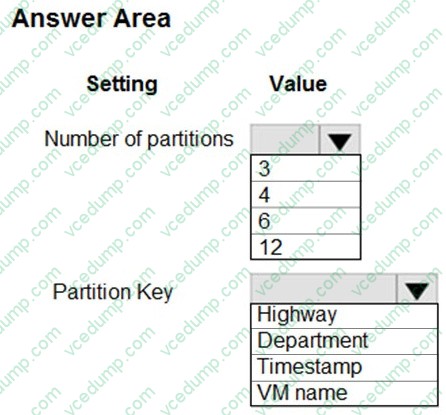
You are building a traffic monitoring system that monitors traffic along six highways. The system produces time series analysis-based reports for each highway. Data from traffic sensors are stored in Azure Event Hub.
Traffic data is consumed by four departments. Each department has an Azure Web App that displays the time-series-based reports and contains a WebJob that processes the incoming data from Event Hub. All Web Apps run on App Service Plans with three instances.
Data throughout must be maximized. Latency must be minimized.
You need to implement the Azure Event Hub.
Which settings should you use? To answer, select the appropriate options in the answer area.
NOTE: Each correct selection is worth one point.
Related Exams:
-
62-193
Technology Literacy for Educators -
70-243
Administering and Deploying System Center 2012 Configuration Manager -
70-355
Universal Windows Platform – App Data, Services, and Coding Patterns -
77-420
Excel 2013 -
77-427
Excel 2013 Expert Part One -
77-725
Word 2016 Core Document Creation, Collaboration and Communication -
77-726
Word 2016 Expert Creating Documents for Effective Communication -
77-727
Excel 2016 Core Data Analysis, Manipulation, and Presentation -
77-728
Excel 2016 Expert: Interpreting Data for Insights -
77-731
Outlook 2016 Core Communication, Collaboration and Email Skills
Tips on How to Prepare for the Exams
Nowadays, the certification exams become more and more important and required by more and more enterprises when applying for a job. But how to prepare for the exam effectively? How to prepare for the exam in a short time with less efforts? How to get a ideal result and how to find the most reliable resources? Here on Vcedump.com, you will find all the answers. Vcedump.com provide not only Microsoft exam questions, answers and explanations but also complete assistance on your exam preparation and certification application. If you are confused on your AZ-204 exam preparations and Microsoft certification application, do not hesitate to visit our Vcedump.com to find your solutions here.