AZ-204 Exam Details
-
Exam Code
:AZ-204 -
Exam Name
:Developing Solutions for Microsoft Azure -
Certification
:Microsoft Certifications -
Vendor
:Microsoft -
Total Questions
:588 Q&As -
Last Updated
:Jul 12, 2026
Microsoft AZ-204 Online Questions & Answers
-
Question 41:
HOTSPOT
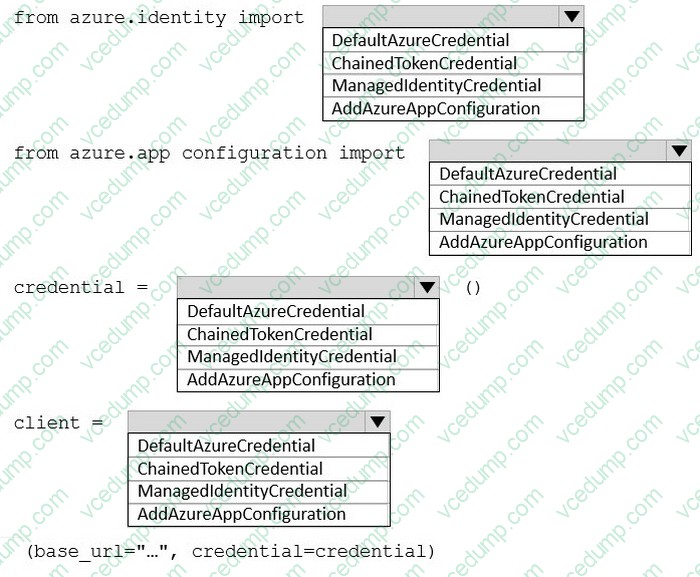
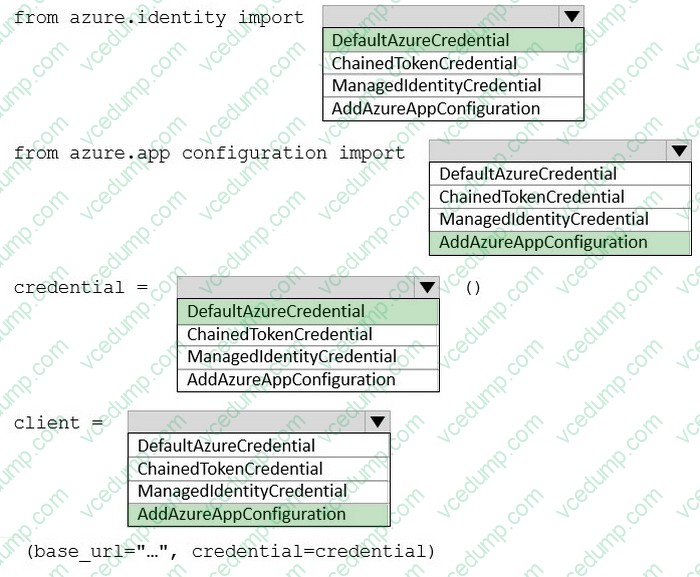
You are a developer building a web site using a web app. The web site stores configuration data in Azure App Configuration.
Access to Azure App Configuration has been configured to use the identity of the web app for authentication. Security requirements specify that no other authentication systems must be used.
You need to load configuration data from Azure App Configuration.
How should you complete the code? To answer, select the appropriate options in the answer area.
NOTE: Each correct selection is worth one point.
-
Question 42:
Note: This question is part of a series of questions that present the same scenario. Each question in the series contains a unique solution that might meet the stated goals. Some question sets might have more than one correct solution, while others might not have a correct solution.
After you answer a question in this section, you will NOT be able to return to it. As a result, these questions will not appear in the review screen.
You develop a software as a service (SaaS) offering to manage photographs. Users upload photos to a web service which then stores the photos in Azure Storage Blob storage. The storage account type is General-purpose V2.
When photos are uploaded, they must be processed to produce and save a mobile-friendly version of the image. The process to produce a mobile-friendly version of the image must start in less than one minute.
You need to design the process that starts the photo processing.
Solution: Trigger the photo processing from Blob storage events.
Does the solution meet the goal?
A. Yes
B. No -
Question 43:
HOTSPOT
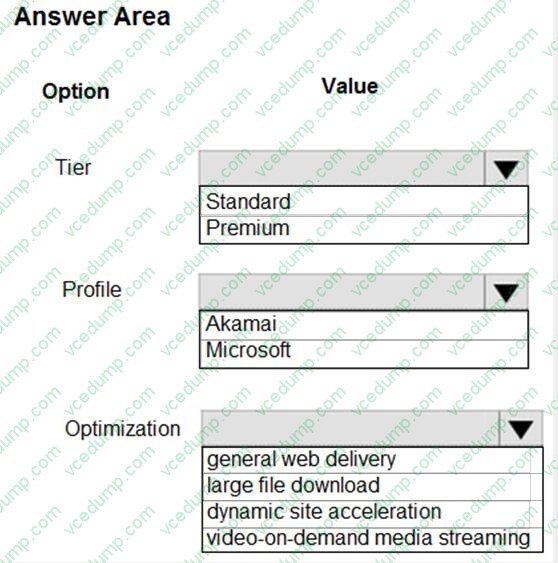
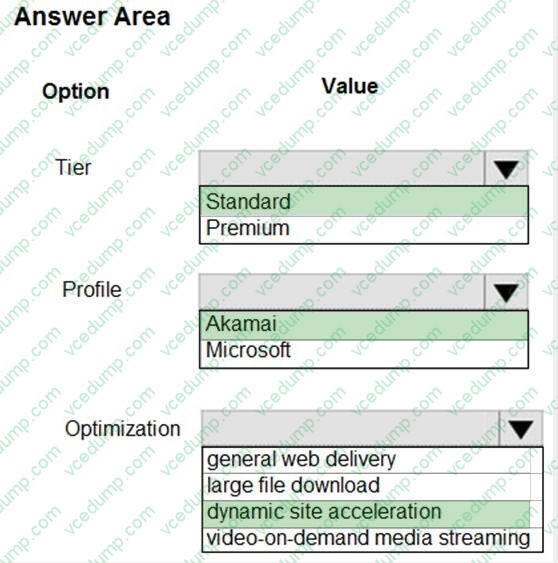
You need to configure Azure CDN for the Shipping web site.
Which configuration options should you use? To answer, select the appropriate options in the answer area.
NOTE: Each correct selection is worth one point.
-
Question 44:
Note: This question is part of a series of questions that present the same scenario. Each question in the series contains a unique solution that might meet the stated goals. Some question sets might have more than one correct solution, while others might not have a correct solution.
After you answer a question in this section, you will NOT be able to return to it. As a result, these questions will not appear in the review screen.
You are designing an Azure WebJob that will run on the same instances as a web app.
You want to make use of a suitable WebJob type. The webjob type should also allow for the option to restrict the WebJob to a single instance.
Solution: You configure the use of the Continuous WebJob type.
Does the solution meet the goal?
A. Yes
B. No -
Question 45:
DRAG DROP
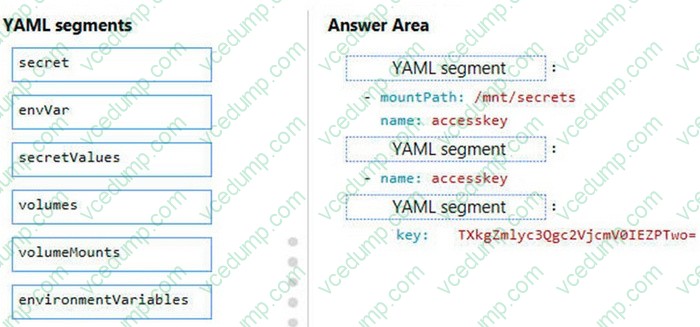
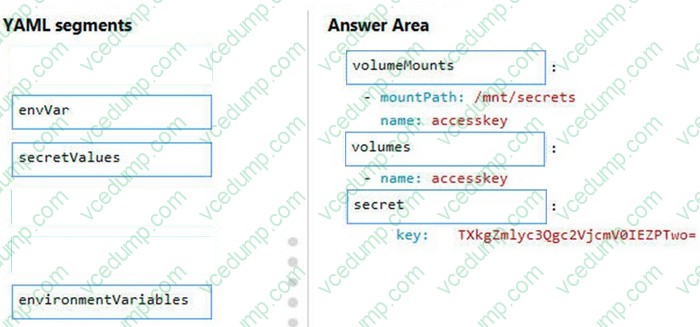
You need to add YAML markup at line CS17 to ensure that the ContentUploadService can access Azure Storage access keys.
How should you complete the YAML markup? To answer, drag the appropriate YAML segments to the correct locations. Each YAML segment may be used once, more than once, or not at all. You may need to drag the split bar between panes or scroll to view content.
NOTE: Each correct selection is worth one point.
Select and Place:
-
Question 46:
A company is developing a solution that allows smart refrigerators to send temperature information to a central location.
The solution must receive and store messages until they can be processed. You create an Azure Service Bus instance by providing a name, pricing tier, subscription, resource group, and location.
You need to complete the configuration.
Which Azure CLI or PowerShell command should you run?
A. Option A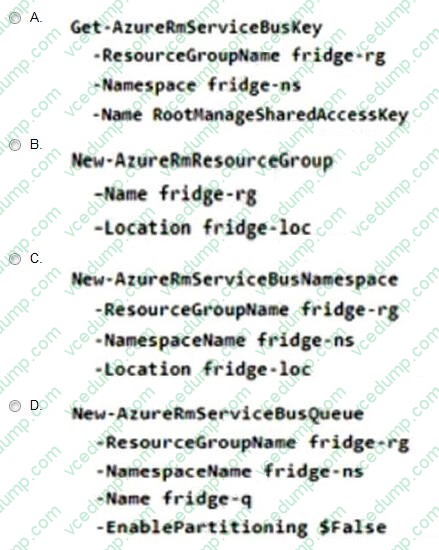
B. Option B
C. Option C
D. Option D -
Question 47:
HOTSPOT
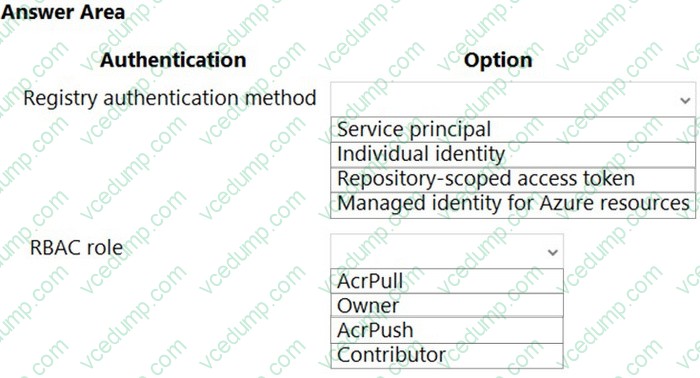
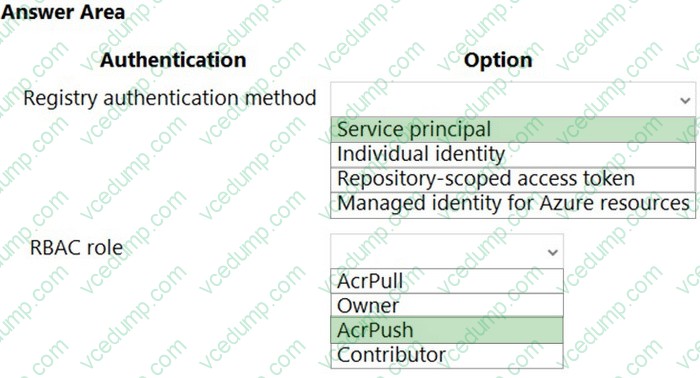
You develop a containerized application. You plan to deploy the application to a new Azure Container instance by using a third-party continuous integration and continuous delivery (CI/CD) utility.
The deployment must be unattended and include all application assets. The third-party utility must only be able to push and pull images from the registry. The authentication must be managed by Azure Active Directory (Azure AD). The solution must use the principle of least privilege.
You need to ensure that the third-party utility can access the registry.
Which authentication options should you use? To answer, select the appropriate options in the answer area.
NOTE: Each correct selection is worth one point.
-
Question 48:
You need to mitigate the Azure Cache for Redis issue.
What are two possible ways to achieve this goal? Each correct answer presents part of the solution.
NOTE: Each correct selection is worth one point.
A. Increase the maxmemory-reserved and maxfragmenTationmemory-reserved values
B. Modify the maxmemory policy to evict the least frequently used keys out of all keys.
C. Configure client connections to retry commands with exponential backoff.
D. Test application code by purging the cache in the test environment.
E. Test application code by rebooting all nodes in the test environment. -
Question 49:
HOTSPOT
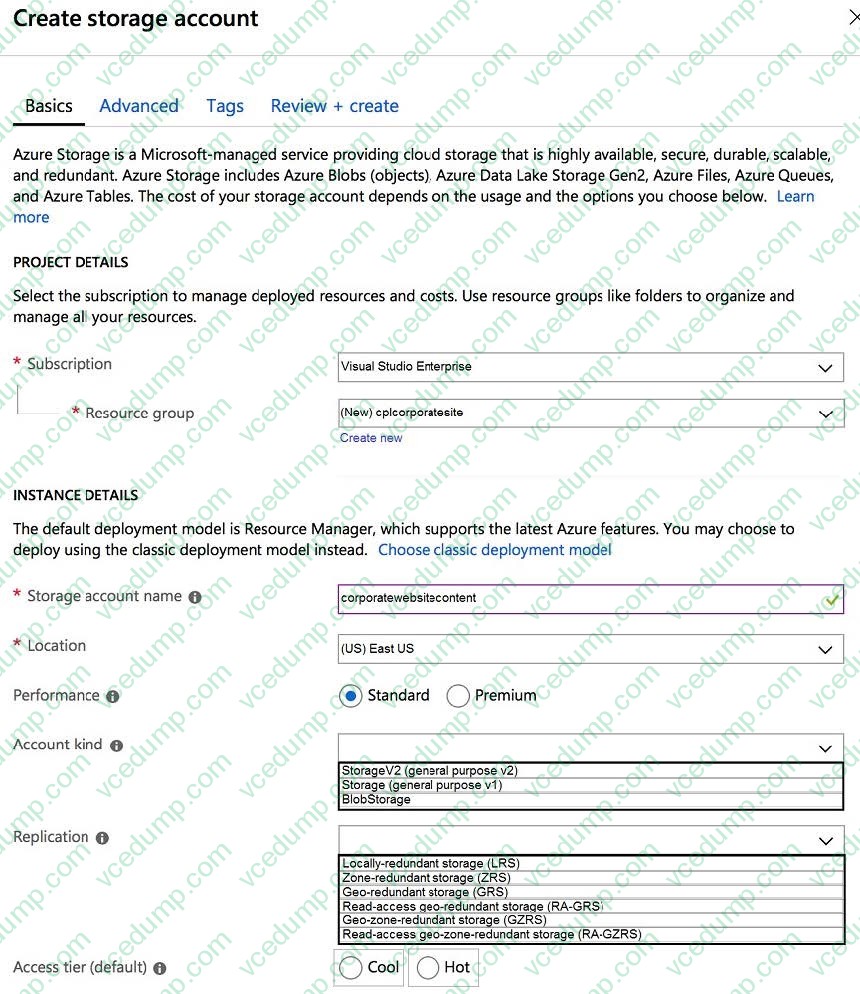
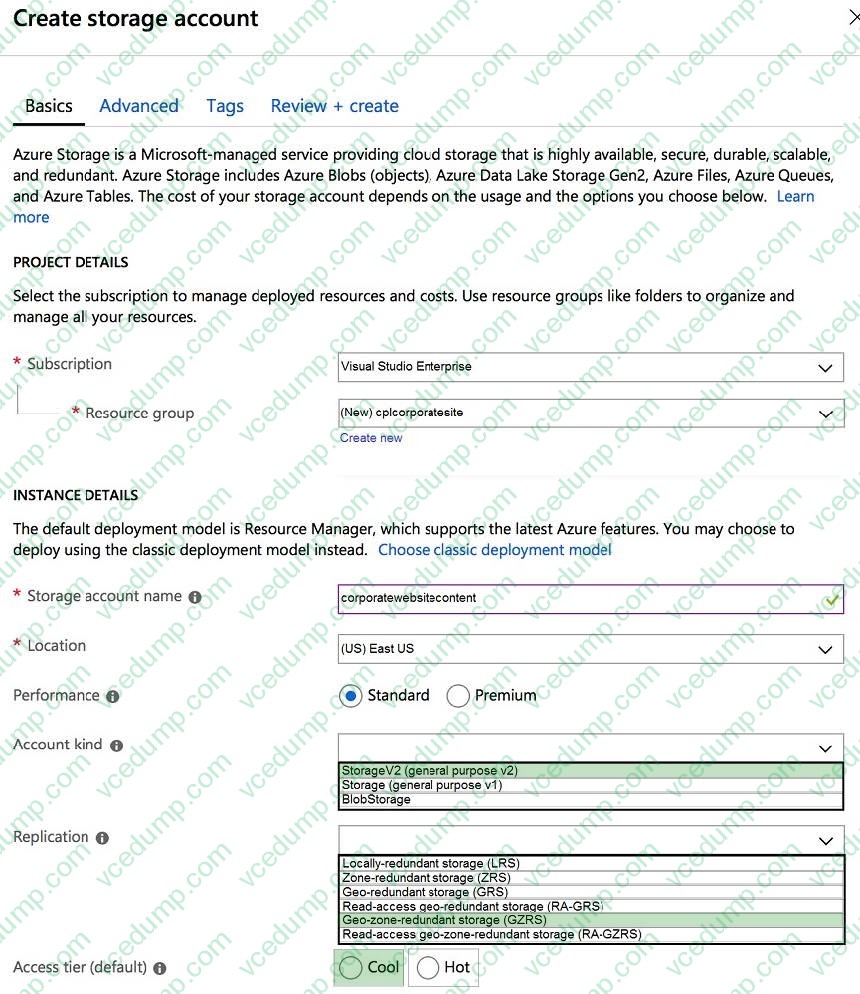
You need to configure the Account Kind, Replication, and Storage tier options for the corporate website's Azure Storage account.
How should you complete the configuration? To answer, select the appropriate options in the dialog box in the answer area.
NOTE: Each correct selection is worth one point.
-
Question 50:
Note: This question is part of a series of questions that present the same scenario. Each question in the series contains a unique solution that might meet the stated goals. Some question sets might have more than one correct solution, while others might not have a correct solution.
After you answer a question in this section, you will NOT be able to return to it. As a result, these questions will not appear in the review screen.
You develop an HTTP triggered Azure Function app to process Azure Storage blob data. The app is triggered using an output binding on the blob.
The app continues to time out after four minutes. The app must process the blob data.
You need to ensure the app does not time out and processes the blob data.
Solution: Update the functionTimeout property of the host.json project file to 10 minutes.
Does the solution meet the goal?
A. Yes
B. No
Related Exams:
-
62-193
Technology Literacy for Educators -
70-243
Administering and Deploying System Center 2012 Configuration Manager -
70-355
Universal Windows Platform – App Data, Services, and Coding Patterns -
77-420
Excel 2013 -
77-427
Excel 2013 Expert Part One -
77-725
Word 2016 Core Document Creation, Collaboration and Communication -
77-726
Word 2016 Expert Creating Documents for Effective Communication -
77-727
Excel 2016 Core Data Analysis, Manipulation, and Presentation -
77-728
Excel 2016 Expert: Interpreting Data for Insights -
77-731
Outlook 2016 Core Communication, Collaboration and Email Skills
Tips on How to Prepare for the Exams
Nowadays, the certification exams become more and more important and required by more and more enterprises when applying for a job. But how to prepare for the exam effectively? How to prepare for the exam in a short time with less efforts? How to get a ideal result and how to find the most reliable resources? Here on Vcedump.com, you will find all the answers. Vcedump.com provide not only Microsoft exam questions, answers and explanations but also complete assistance on your exam preparation and certification application. If you are confused on your AZ-204 exam preparations and Microsoft certification application, do not hesitate to visit our Vcedump.com to find your solutions here.