AZ-204 Exam Details
-
Exam Code
:AZ-204 -
Exam Name
:Developing Solutions for Microsoft Azure -
Certification
:Microsoft Certifications -
Vendor
:Microsoft -
Total Questions
:588 Q&As -
Last Updated
:Jul 12, 2026
Microsoft AZ-204 Online Questions & Answers
-
Question 381:
You deploy an Azure App Service web app. You create an app registration for the app in Azure Active Directory (Azure AD) and Twitter.
The app must authenticate users and must use SSL for all communications. The app must use Twitter as the identity provider.
You need to validate the Azure AD request in the app code.
What should you validate?
A. ID token header
B. ID token signature
C. HTTP response code
D. Tenant ID -
Question 382:
HOTSPOT
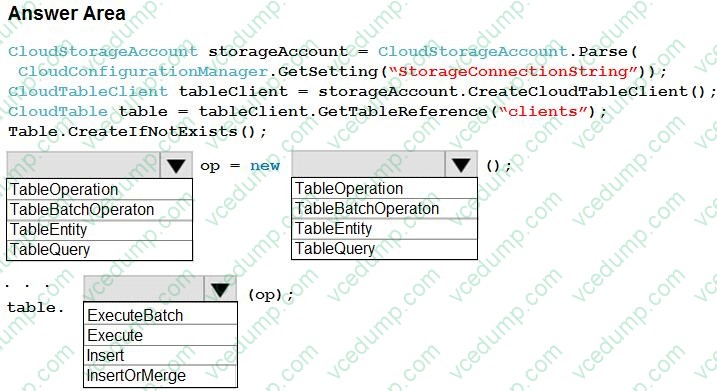
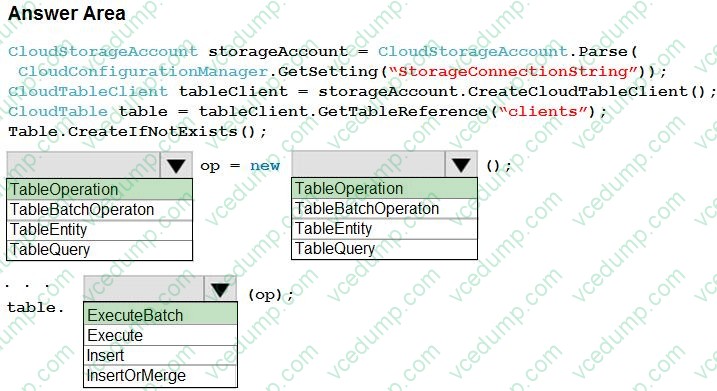
You are developing a data storage solution for a social networking app.
The solution requires a mobile app that stores user information using Azure Table Storage.
You need to develop code that can insert multiple sets of user information.
How should you complete the code? To answer, select the appropriate options in the answer area.
NOTE: Each correct selection is worth one point.
-
Question 383:
You are developing an Azure App Service REST API.
The API must be called by an Azure App Service web app. The API must retrieve and update user profile information stored in Azure Active Directory (Azure AD).
You need to configure the API to make the updates.
Which two tools should you use? Each correct answer presents part of the solution
NOTE: Each correct selection is worth one point.
A. Microsoft Graph API
B. Microsoft Authentication Library (MSAL)
C. Azure API Management
D. Microsoft Azure Security Center
E. Microsoft Azure Key Vault SDK -
Question 384:
DRAG DROP
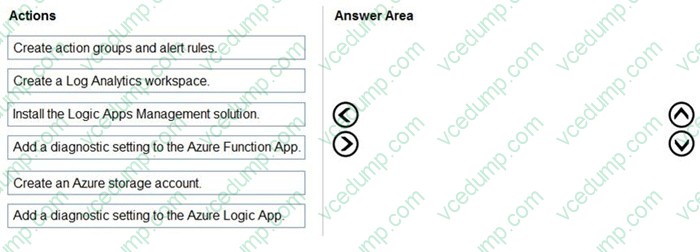
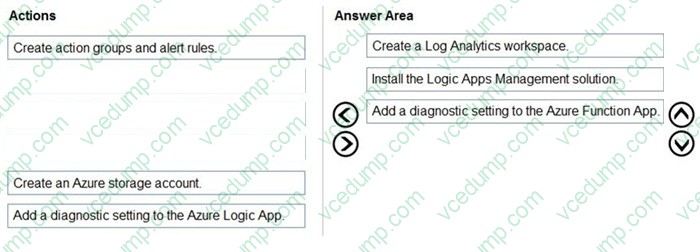
You develop and deploy an Azure Logic App that calls an Azure Function app. The Azure Function App includes an OpenAPI (Swagger) definition and uses an Azure Blob storage account. All resources are secured by using Azure Active Directory (Azure AD).
The Logic App must use Azure Monitor logs to record and store information about runtime data and events. The logs must be stored in the Azure Blob storage account.
You need to set up Azure Monitor logs and collect diagnostics data for the Azure Logic App.
Which three actions should you perform in sequence? To answer, move the appropriate actions from the list of actions to the answer area and arrange them in the correct order.
Select and Place:
-
Question 385:
Note: This question is part of a series of questions that present the same scenario. Each question in the series contains a unique solution that might meet the stated goals. Some question sets might have more than one correct solution, while others might not have a correct solution.
After you answer a question in this question, you will NOT be able to return to it. As a result, these questions will not appear in the review screen.
You are developing a solution that will be deployed to an Azure Kubernetes Service (AKS) cluster. The solution will include a custom VNet, Azure Container Registry images, and an Azure Storage account.
The solution must allow dynamic creation and management of all Azure resources within the AKS cluster.
You need to configure an AKS cluster for use with the Azure APIs.
Solution: Enable the Azure Policy Add-on for Kubernetes to connect the Azure Policy service to the GateKeeper admission controller for the AKS cluster. Apply a built-in policy to the cluster.
Does the solution meet the goal?
A. Yes
B. No -
Question 386:
HOTSPOT
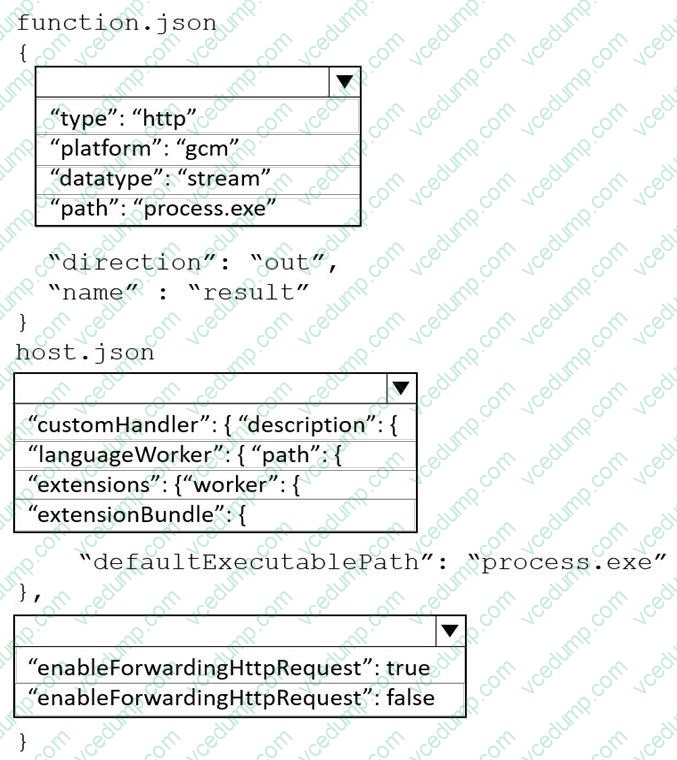
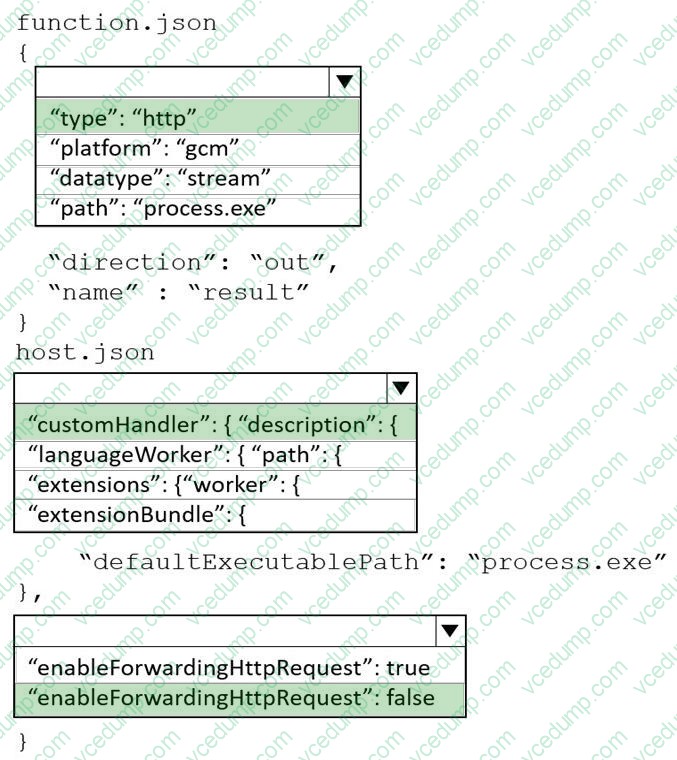
You are developing a C+ + application that compiles to a native application named process.exe. The application accepts images as input and returns images in one of the following image formats: GIF, PNG, or JPEG.
You must deploy the application as an Azure Function.
You need to configure the function and host json files.
How should you complete the json files? To answer, select the appropriate options in the answer area.
NOTE: Each correct selection is worth one point.
-
Question 387:
An organization deploys Azure Cosmos DB.
You need to ensure that the index is updated as items are created, updated, or deleted.
What should you do?
A. Set the indexing mode to Lazy.
B. Set the value of the automatic property of the indexing policy to False.
C. Set the value of the EnableScanInQuery option to True.
D. Set the indexing mode to Consistent. -
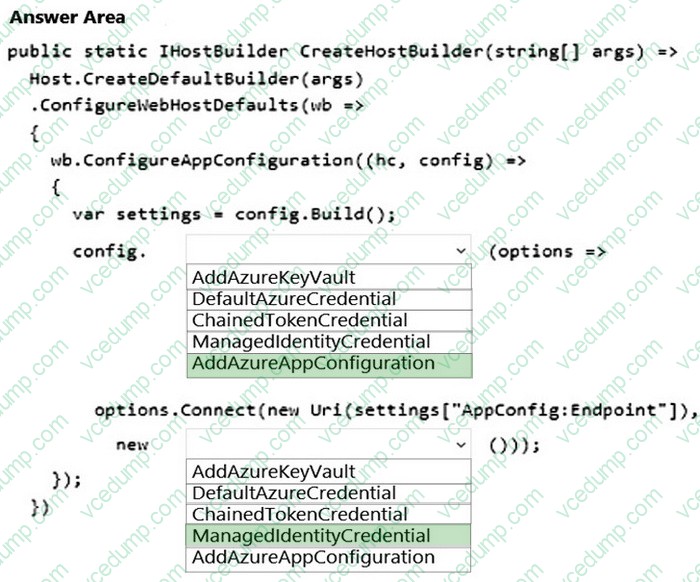
Question 388:
HOTSPOT
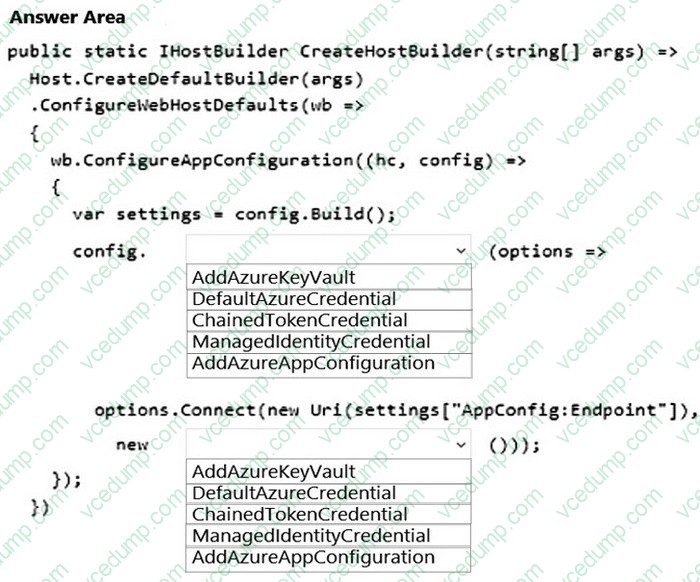
You are a developer building a web site using a web app. The web site stores configuration data in Azure App Configuration.
Access to Azure App Configuration has been configured to use the identity of the web app for authentication. Security requirements specify that no other authentication systems must be used.
You need to load configuration data from Azure App Configuration.
How should you complete the code? To answer, select the appropriate options in the answer area.
NOTE: Each correct selection is worth one point.
-
Question 389:
You provide an Azure API Management managed web service to clients. The back-end web service implements HTTP Strict Transport Security (HSTS).
Every request to the backend service must include a valid HTTP authorization header.
You need to configure the Azure API Management instance with an authentication policy.
Which two policies can you use? Each correct answer presents a complete solution.
NOTE: Each correct selection is worth one point.
A. Basic Authentication
B. Digest Authentication
C. Certificate Authentication
D. OAuth Client Credential Grant -
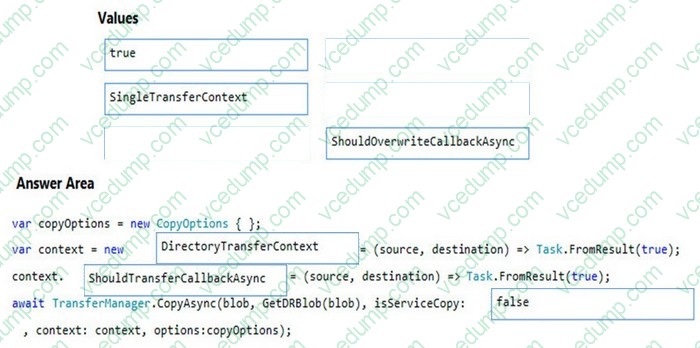
Question 390:
DRAG DROP
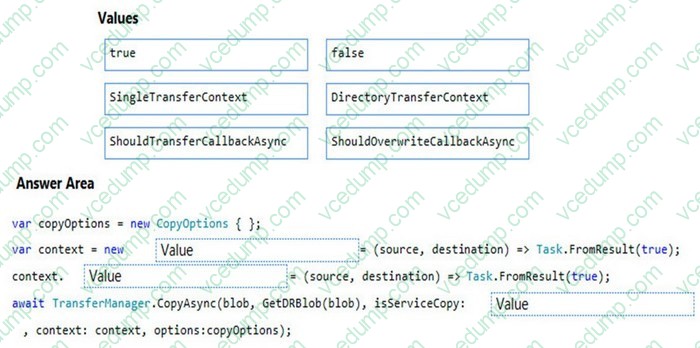
You need to ensure disaster recovery requirements are met.
What code should you add at line PC16?
To answer, drag the appropriate code fragments to the correct locations. Each code fragment may be used once, more than once, or not at all. You may need to drag the split bar between panes or scroll to view content.
NOTE: Each correct selection is worth one point.
Select and Place:
Related Exams:
-
62-193
Technology Literacy for Educators -
70-243
Administering and Deploying System Center 2012 Configuration Manager -
70-355
Universal Windows Platform – App Data, Services, and Coding Patterns -
77-420
Excel 2013 -
77-427
Excel 2013 Expert Part One -
77-725
Word 2016 Core Document Creation, Collaboration and Communication -
77-726
Word 2016 Expert Creating Documents for Effective Communication -
77-727
Excel 2016 Core Data Analysis, Manipulation, and Presentation -
77-728
Excel 2016 Expert: Interpreting Data for Insights -
77-731
Outlook 2016 Core Communication, Collaboration and Email Skills
Tips on How to Prepare for the Exams
Nowadays, the certification exams become more and more important and required by more and more enterprises when applying for a job. But how to prepare for the exam effectively? How to prepare for the exam in a short time with less efforts? How to get a ideal result and how to find the most reliable resources? Here on Vcedump.com, you will find all the answers. Vcedump.com provide not only Microsoft exam questions, answers and explanations but also complete assistance on your exam preparation and certification application. If you are confused on your AZ-204 exam preparations and Microsoft certification application, do not hesitate to visit our Vcedump.com to find your solutions here.