AZ-204 Exam Details
-
Exam Code
:AZ-204 -
Exam Name
:Developing Solutions for Microsoft Azure -
Certification
:Microsoft Certifications -
Vendor
:Microsoft -
Total Questions
:588 Q&As -
Last Updated
:Jul 12, 2026
Microsoft AZ-204 Online Questions & Answers
-
Question 91:
HOTSPOT
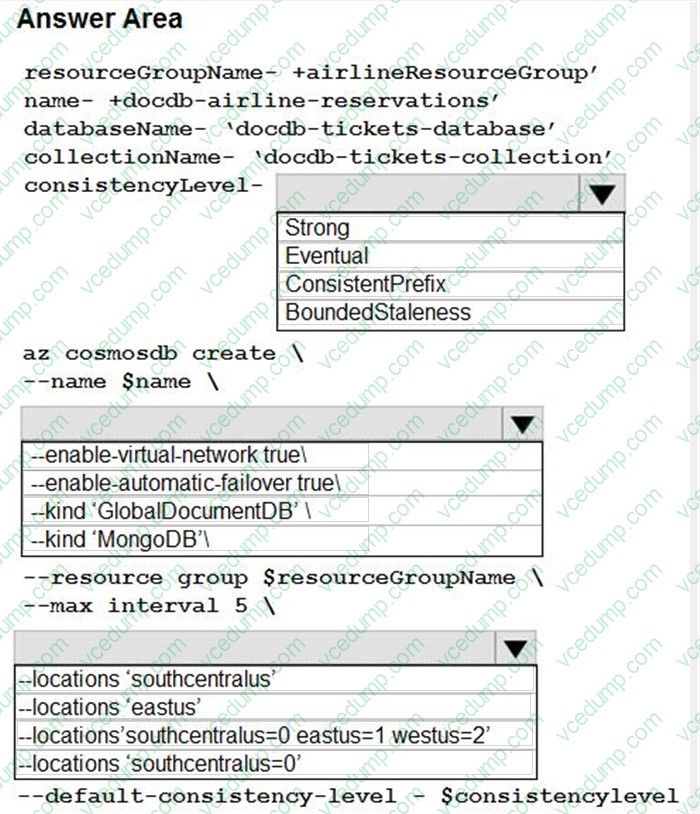
You are developing a ticket reservation system for an airline.
The storage solution for the application must meet the following requirements:
1. Ensure at least 99.99% availability and provide low latency.
2. Accept reservations event when localized network outages or other unforeseen failures occur.
3. Process reservations in the exact sequence as reservations are submitted to minimize overbooking or selling the same seat to multiple travelers.
4. Allow simultaneous and out-of-order reservations with a maximum five-second tolerance window.
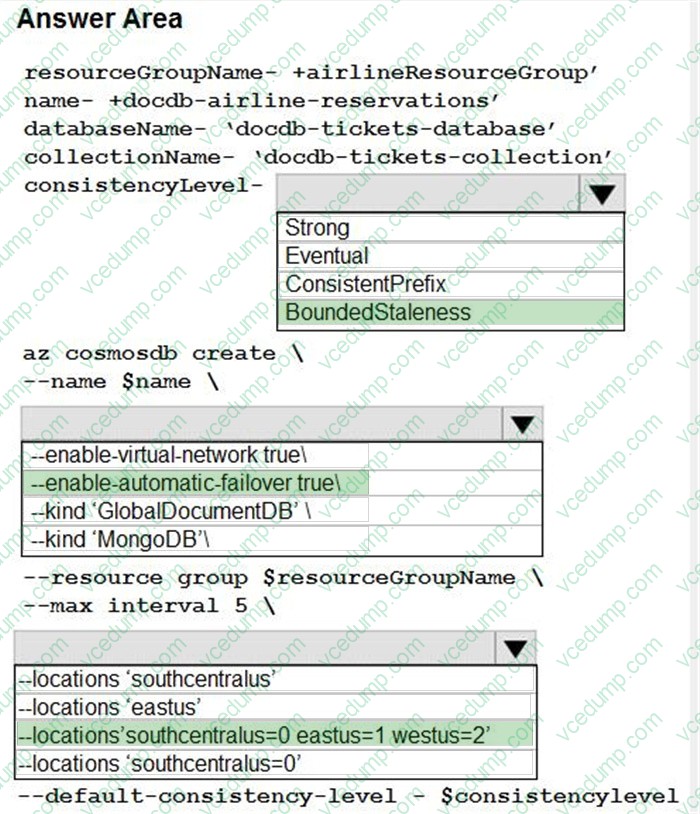
You provision a resource group named airlineResourceGroup in the Azure South-Central US region.
You need to provision a SQL SPI Cosmos DB account to support the app.
How should you complete the Azure CLI commands? To answer, select the appropriate options in the answer area.
NOTE: Each correct selection is worth one point.
-
Question 92:
Your company has an Azure subscription.
You need to deploy a number of Azure virtual machines to the subscription by using Azure Resource Manager (ARM) templates. The virtual machines will be included in a single availability set.
You need to ensure that the ARM template allows for as many virtual machines as possible to remain accessible in the event of fabric failure or maintenance.
Which of the following is the value that you should configure for the platformUpdateDomainCount property?
A. 10
B. 20
C. 30
D. 40 -
Question 93:
DRAG DROP
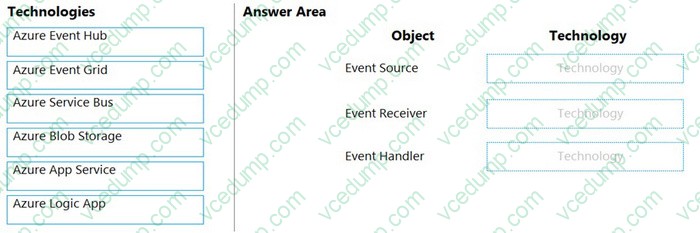
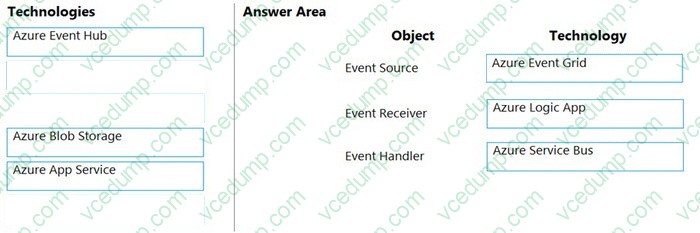
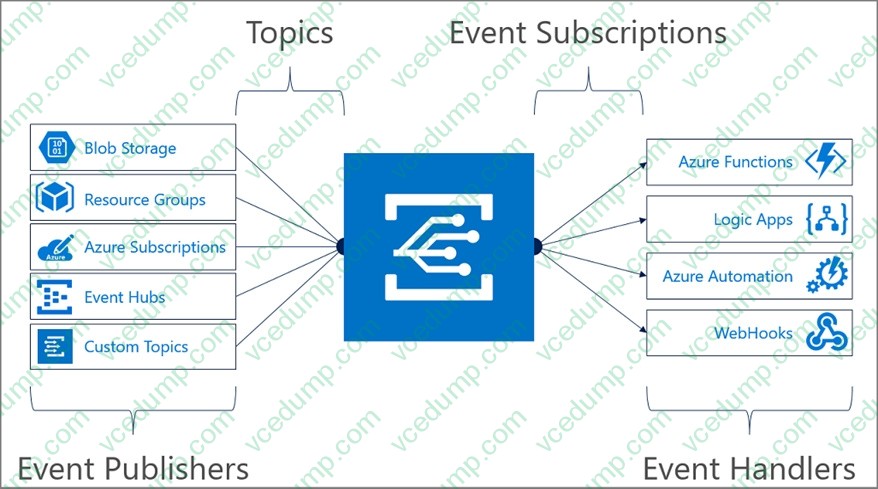
You are developing an Azure solution to collect inventory data from thousands of stores located around the world. Each store location will send the inventory data hourly to an Azure Blob storage account for processing.
The solution must meet the following requirements:
1. Begin processing when data is saved to Azure Blob storage.
2. Filter data based on store location information.
3. Trigger an Azure Logic App to process the data for output to Azure Cosmos DB.
4. Enable high availability and geographic distribution.
5. Allow 24-hours for retries.
6. Implement an exponential back off data processing.
You need to configure the solution.
What should you implement? To answer, select the appropriate options in the answer area.
NOTE: Each correct selection is worth one point.
Select and Place:
-
Question 94:
Note: This question is part of a series of questions that present the same scenario. Each question in the series contains a unique solution that might meet the stated goals. Some question sets might have more than one correct solution, while others might not have a correct solution.
After you answer a question in this section, you will NOT be able to return to it. As a result, these questions will not appear in the review screen.
You are developing an Azure solution to collect point-of-sale (POS) device data from 2,000 stores located throughout the world. A single device can produce 2 megabytes (MB) of data every 24 hours. Each store location has one to five devices that send data.
You must store the device data in Azure Blob storage. Device data must be correlated based on a device identifier. Additional stores are expected to open in the future.
You need to implement a solution to receive the device data.
Solution: Provision an Azure Service Bus. Configure a topic to receive the device data by using a correlation filter.
Does the solution meet the goal?
A. Yes
B. No -
Question 95:
HOTSPOT
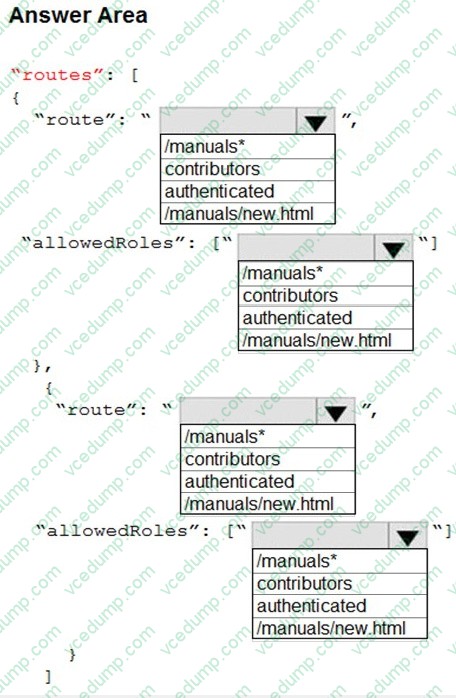
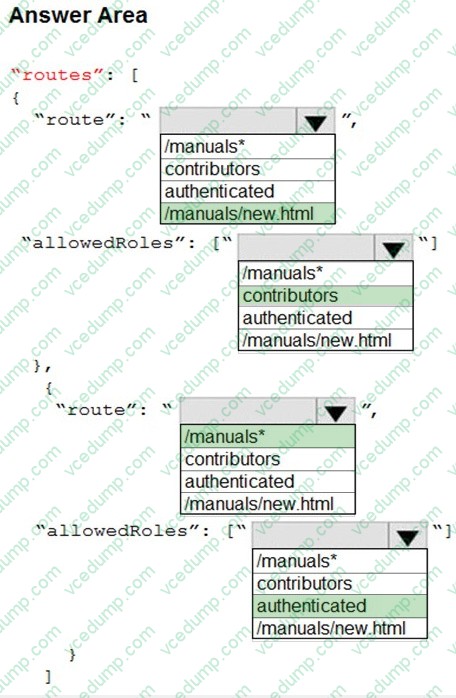
You are developing a content management application for technical manuals. The application is deployed as an Azure Static Web app.
Authenticated users can view pages under/manuals but only contributors can access the page /manuals/new.html.
You need to configure the routing for the web app.
How should you complete the configuration? To answer, select the appropriate options in the answer area.
NOTE: Each correct selection is worth one point.
-
Question 96:
You develop and deploy an Azure App Service web app to a production environment. You enable the Always On setting and the Application Insights site extensions.
You deploy a code update and receive multiple failed requests and exceptions in the web app.
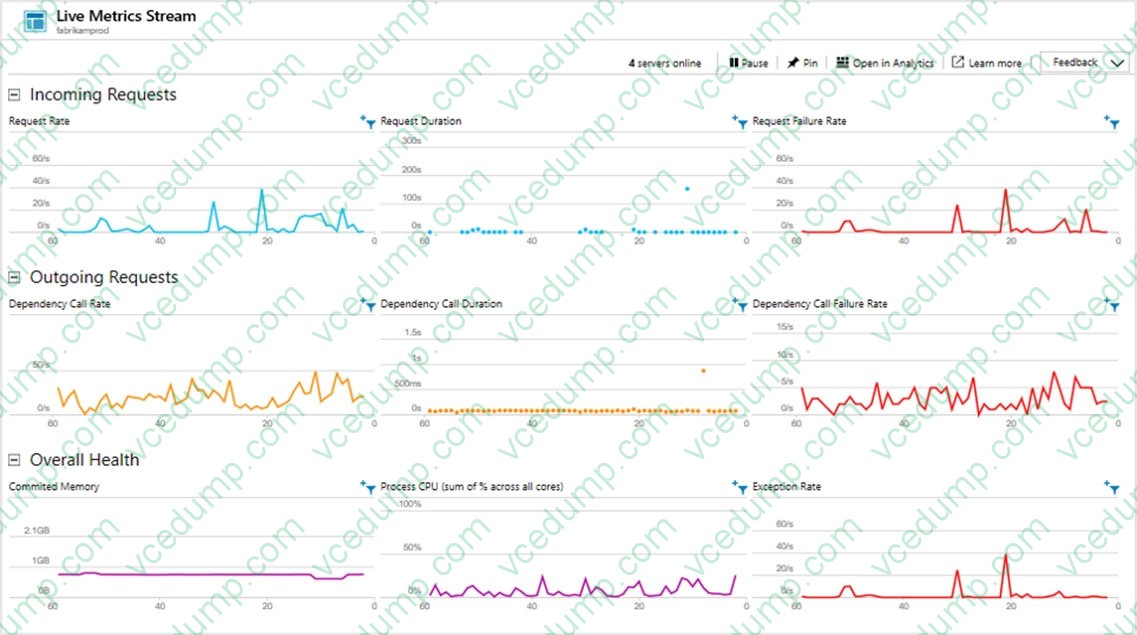
You need to validate the performance and failure counts of the web app in near real time.
Which Application Insights tool should you use?
A. Snapshot Debugger
B. Profiler
C. Smart Detection
D. Live Metrics Stream
E. Application Map -
Question 97:
DRAG DROP
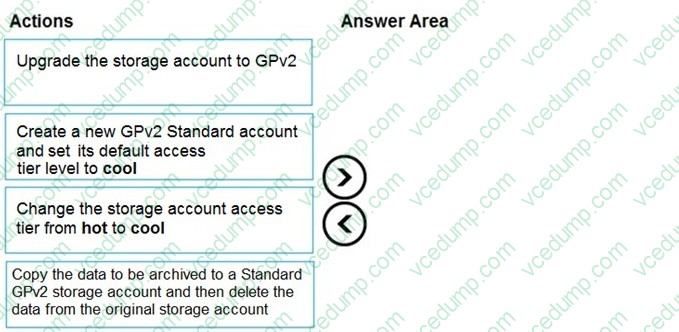
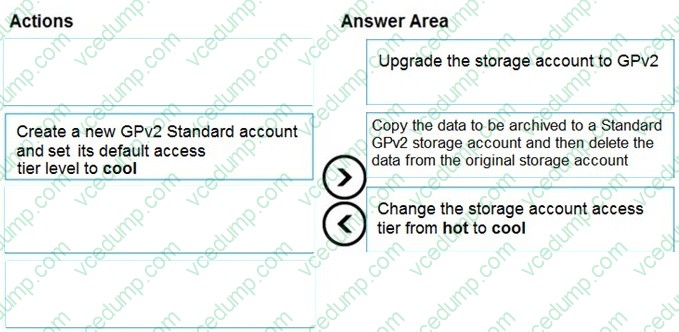
You are maintaining an existing application that uses an Azure Blob GPv1 Premium storage account. Data older than three months is rarely used.
Data newer than three months must be available immediately. Data older than a year must be saved but does not need to be available immediately.
You need to configure the account to support a lifecycle management rule that moves blob data to archive storage for data not modified in the last year.
Which three actions should you perform in sequence? To answer, move the appropriate actions from the list of actions to the answer area and arrange them in the correct order.
Select and Place:
-
Question 98:
You are developing several Azure API Management (APIM) hosted APIs.
You must make several minor and non-breaking changes to one of the APIs. The API changes include the following requirements:
Must not disrupt callers of the API.
Enable roll back if you find issues.
Documented to enable developers to understand what is new.
Tested before publishing.
You need to update the API.
What should you do?
A. Configure and apply header-based versioning.
B. Create and publish a product.
C. Configure and apply a custom policy.
D. Add a new revision to the API.
E. Configure and apply query string-based versioning. -
Question 99:
You are developing an Azure Cosmos DB solution by using the Azure Cosmos DB SQL API. The data includes millions of documents. Each document may contain hundreds of properties.
The properties of the documents do not contain distinct values for partitioning. Azure Cosmos DB must scale individual containers in the database to meet the performance needs of the application by spreading the workload evenly across all partitions over time.
You need to select a partition key.
Which two partition keys can you use? Each correct answer presents a complete solution.
NOTE: Each correct selection is worth one point.
A. a single property value that does not appear frequently in the documents
B. a value containing the collection name
C. a single property value that appears frequently in the documents
D. a concatenation of multiple property values with a random suffix appended
E. a hash suffix appended to a property value -
Question 100:
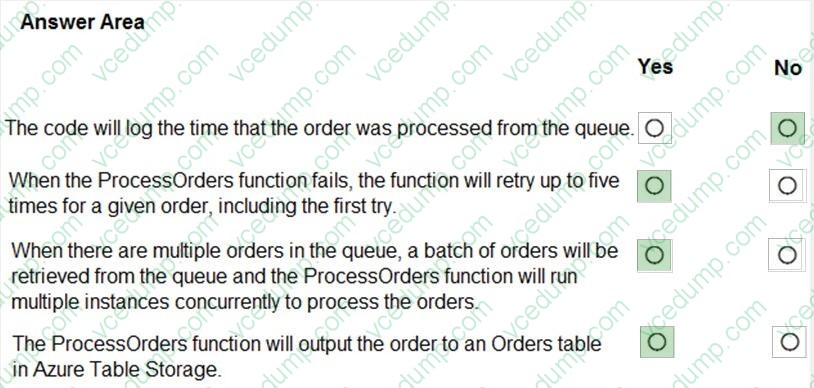
HOTSPOT
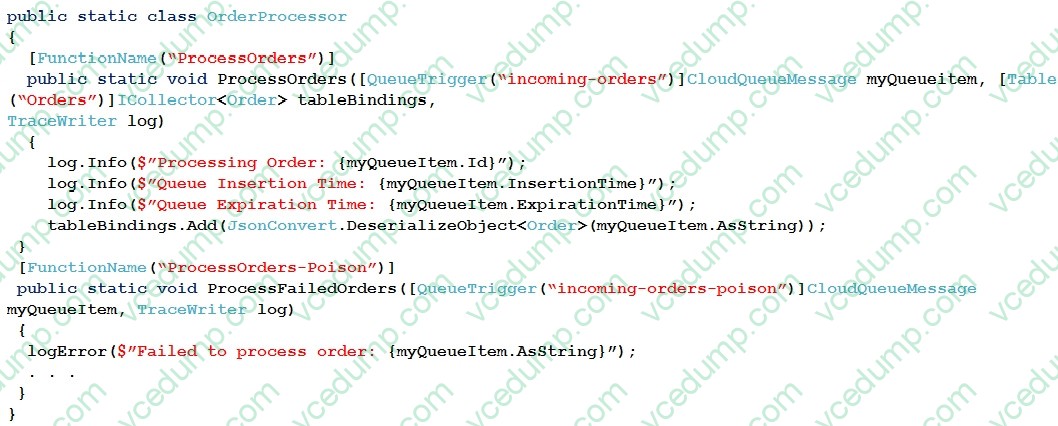
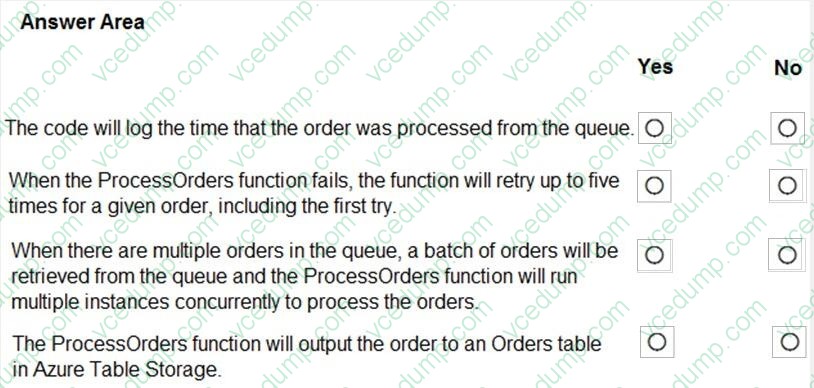
You are developing an Azure Function App by using Visual Studio. The app will process orders input by an Azure Web App. The web app places the order information into Azure Queue Storage.
You need to review the Azure Function App code shown below.
NOTE: Each correct selection is worth one point.
Related Exams:
-
62-193
Technology Literacy for Educators -
70-243
Administering and Deploying System Center 2012 Configuration Manager -
70-355
Universal Windows Platform – App Data, Services, and Coding Patterns -
77-420
Excel 2013 -
77-427
Excel 2013 Expert Part One -
77-725
Word 2016 Core Document Creation, Collaboration and Communication -
77-726
Word 2016 Expert Creating Documents for Effective Communication -
77-727
Excel 2016 Core Data Analysis, Manipulation, and Presentation -
77-728
Excel 2016 Expert: Interpreting Data for Insights -
77-731
Outlook 2016 Core Communication, Collaboration and Email Skills
Tips on How to Prepare for the Exams
Nowadays, the certification exams become more and more important and required by more and more enterprises when applying for a job. But how to prepare for the exam effectively? How to prepare for the exam in a short time with less efforts? How to get a ideal result and how to find the most reliable resources? Here on Vcedump.com, you will find all the answers. Vcedump.com provide not only Microsoft exam questions, answers and explanations but also complete assistance on your exam preparation and certification application. If you are confused on your AZ-204 exam preparations and Microsoft certification application, do not hesitate to visit our Vcedump.com to find your solutions here.