DOP-C01 Exam Details
-
Exam Code
:DOP-C01 -
Exam Name
:AWS Certified DevOps Engineer - Professional (DOP-C01) -
Certification
:Amazon Certifications -
Vendor
:Amazon -
Total Questions
:559 Q&As -
Last Updated
:Dec 22, 2024
Amazon DOP-C01 Online Questions & Answers
-
Question 381:
A DevOps engineer is creating a CI/CD pipeline for an Amazon ECS service. The ECS container instances run behind an Application Load Balancer as the web tier of a three-tier application. An acceptance criterion for a successful deployment is the verification that the web tier can communicate with the database and middleware tiers of the application upon deployment.
How can this be accomplished in an automated fashion?
A. Create a health check endpoint in the web application that tests connectivity to the data and middleware tiers. Use this endpoint as the health check URL for the load balancer.
B. Create an approval step for the quality assurance team to validate connectivity. Reject changes in the pipeline if there is an issue with connecting to the dependent tiers.
C. Use an Amazon RDS active connection count and an Amazon CloudWatch ELB metric to alarm on a significant change to the number of open connections.
D. Use Amazon Route 53 health checks to detect issues with the web service and roll back the CI/CD pipeline if there is an error. -
Question 382:
A company is hosting a web application in an AWS Region. For disaster recovery purposes, a second region is being used as a standby. Disaster recovery requirements state that session data must be replicated between regions in near-real
time and 1% of requests should route to the secondary region to continuously verify system functionality. Additionally, if there is a disruption in service in the main region, traffic should be automatically routed to the secondary region, and the
secondary region must be able to scale up to handle all traffic.
How should a DevOps Engineer meet these requirements?
A. In both regions, deploy the application on AWS Elastic Beanstalk and use Amazon DynamoDB global tables for session data. Use an Amazon Route 53 weighted routing policy with health checks to distribute the traffic across the regions.
B. In both regions, launch the application in Auto Scaling groups and use DynamoDB for session data. Use a Route 53 failover routing policy with health checks to distribute the traffic across the regions.
C. In both regions, deploy the application in AWS Lambda, exposed by Amazon API Gateway, and use Amazon RDS PostgreSQL with cross-region replication for session data. Deploy the web application with client-side logic to call the API Gateway directly.
D. In both regions, launch the application in Auto Scaling groups and use DynamoDB global tables for session data. Enable an Amazon CloudFront weighted distribution across regions. Point the Amazon Route 53 DNS record at the CloudFront distribution. -
Question 383:
A company is building a web and mobile application that uses a serverless architecture powered by AWS Lambda and Amazon API Gateway. The company wants to fully automate the backend Lambda deployment based on code that is pushed to the appropriate environment branch in an AWS CodeCommit repository.
The deployment must have the following:
1.
Separate environment pipelines for testing and production.
2.
Automatic deployment that occurs for test environments only.
Which steps should be taken to meet these requirements?
A. Configure a new AWS CodePipeline service. Create a CodeCommit repository for each environment. Set up CodePipeline to retrieve the source code from the appropriate repository. Set up the deployment step to deploy the Lambda functions with AWS CloudFormation.
B. Create two AWS CodePipeline configurations for test and production environments. Configure the production pipeline to have a manual approval step. Create a CodeCommit repository for each environment. Set up each CodePipeline to retrieve the source code from the appropriate repository. Set up the deployment step to deploy the Lambda functions with AWS CloudFormation.
C. Create two AWS CodePipeline configurations for test and production environments. Configure the production pipeline to have a manual approval step. Create one CodeCommit repository with a branch for each environment. Set up each CodePipeline to retrieve the source code from the appropriate branch in the repository. Set up the deployment step to deploy the Lambda functions with AWS CloudFormation.
D. Create an AWS CodeBuild configuration for test and production environments. Configure the production pipeline to have a manual approval step. Create one CodeCommit repository with a branch for each environment. Push the Lambda function code to an Amazon S3 bucket. Set up the deployment step to deploy the Lambda functions from the S3 bucket. -
Question 384:
As part of your continuous deployment process, your application undergoes an I/O load performance test before it is deployed to production using new AMIs. The application uses one Amazon Elastic Block Store (EBS) PIOPS volume per instance and requires consistent I/O performance. Which of the following must be carried out to ensure that I/O load performance tests yield the correct results in a repeatable manner?
A. Ensure that the I/O block sizes for the test are randomly selected.
B. Ensure that the Amazon EBS volumes have been pre-warmed by reading all the blocks before the test.
C. Ensure that snapshots of the Amazon EBS volumes are created as a backup.
D. Ensure that the Amazon EBS volume is encrypted.
E. Ensure that the Amazon EBS volume has been pre-warmed by creating a snapshot of the volume before the test. -
Question 385:
A company is implementing AWS CodePipeline to automate its testing process. The company wants to be notified when the execution state fails and used the following custom event pattern in Amazon CloudWatch:
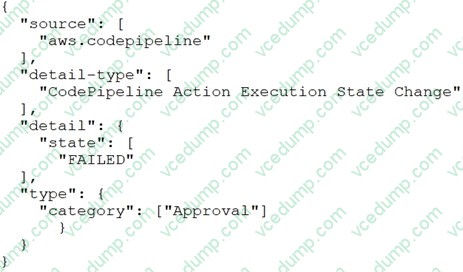
Which type of events will match this event pattern?
A. Failed deploy and build actions across all the pipelines.
B. All rejected or failed approval actions across all the pipelines.
C. All the events across all pipelines.
D. Approval actions across all the pipelines. -
Question 386:
A company develops and maintains a web application using Amazon EC2 instances and an Amazon RDS for SQL Server DB instance in a single Availability Zone. The resources need to run only when new deployments are being tested using AWS CodePipeline. Testing occurs one or more times a week and each test takes 2-3 hours to run. A DevOps engineer wants a solution that does not change the architecture components.
Which solution will meet these requirements in the MOST cost-effective manner?
A. Convert the RDS database to an Amazon Aurora Serverless database. Use an AWS Lambda function to start and stop the EC2 instances before and after tests.
B. Put the EC2 instances into an Auto Scaling group. Schedule scaling to run at the start of the deployment tests.
C. Replace the EC2 instances with EC2 Spot Instances and the RDS database with an RDS Reserved Instance.
D. Subscribe Amazon Cloud Watch Events to CodePipeline to trigger AWS Systems Manager Automation documents that start and stop all EC2 and RDS instances before and after deployment tests. -
Question 387:
A company has containerized all of its in-house quality control applications. The company is running Jenkins on Amazon EC2, which requires patching and upgrading. The Compliance Officer has requested a DevOps Engineer begin encrypting build artifacts since they contain company intellectual property.
What should the DevOps Engineer do to accomplish this in the MOST maintainable manner?
A. Automate patching and upgrading using AWS Systems Manager on EC2 instances and encrypt Amazon EBS volumes by default.
B. Deploy Jenkins to an Amazon ECS cluster and copy build artifacts to an Amazon S3 bucket with default encryption enabled.
C. Leverage AWS CodePipeline with a build action and encrypt the artifacts using AWS Secrets Manager.
D. Use AWS CodeBuild with artifact encryption to replace the Jenkins instance running on Amazon EC2. -
Question 388:
A DevOps Engineer is using AWS CodeDeploy across a fleet of Amazon EC2 instances in an EC2 Auto Scaling group. The associated CodeDeploy deployment group, which is integrated with EC2 Auto Scaling, is configured to perform in-
place deployments with CodeDeployDefault.OneAtATime. During an ongoing new deployment, the Engineer discovers that, although the overall deployment finished successfully, two out of five instances have the previous application revision
deployed. The other three instances have the newest application revision.
What is likely causing this issue?
A. The two affected instances failed to fetch the new deployment.
B. A failed AfterInstall lifecycle event hook caused the CodeDeploy agent to roll back to the previous version on the affected instances.
C. The CodeDeploy agent was not installed in two affected instances.
D. EC2 Auto Scaling launched two new instances while the new deployment had not yet finished, causing the previous version to be deployed on the affected instances. -
Question 389:
A large enterprise is deploying a web application on AWS. The application runs on Amazon EC2 instances behind an Application Load Balancer. The instances run in an Auto Scaling group across multiple Availability Zones. The application stores data in an Amazon RDS Oracle DB instance and Amazon DynamoDB. There are separate environments for development, testing, and production. What is the MOST secure and flexible way to obtain password credentials during deployment?
A. Retrieve an access key from an AWS Systems Manager SecureString parameter to access AWS services. Retrieve the database credentials from a Systems Manager SecureString parameter.
B. Launch the EC2 instances with an EC2 IAM role to access AWS services. Retrieve the database credentials from AWS Secrets Manager.
C. Retrieve an access key from an AWS Systems Manager plaintext parameter to access AWS services. Retrieve the database credentials from a Systems Manager SecureString parameter.
D. Launch the EC2 instances with an EC2 IAM role to access AWS services. Store the database passwords in an encrypted config file with the application artifacts. -
Question 390:
When thinking of AWS Elastic Beanstalk, which statement is true?
A. Worker tiers pull jobs from SNS.
B. Worker tiers pull jobs from HTTP.
C. Worker tiers pull jobs from JSON.
D. Worker tiers pull jobs from SQS.
Related Exams:
-
AIF-C01
Amazon AWS Certified AI Practitioner (AIF-C01) -
AIP-C01
AWS Certified Generative AI Developer - Professional -
ANS-C00
AWS Certified Advanced Networking - Specialty (ANS-C00) -
ANS-C01
AWS Certified Advanced Networking - Specialty (ANS-C01) -
AXS-C01
AWS Certified Alexa Skill Builder - Specialty (AXS-C01) -
BDS-C00
AWS Certified Big Data - Speciality (BDS-C00) -
CLF-C02
AWS Certified Cloud Practitioner (CLF-C02) -
DAS-C01
AWS Certified Data Analytics - Specialty (DAS-C01) -
DATA-ENGINEER-ASSOCIATE
AWS Certified Data Engineer - Associate (DEA-C01) -
DBS-C01
AWS Certified Database - Specialty (DBS-C01)
Tips on How to Prepare for the Exams
Nowadays, the certification exams become more and more important and required by more and more enterprises when applying for a job. But how to prepare for the exam effectively? How to prepare for the exam in a short time with less efforts? How to get a ideal result and how to find the most reliable resources? Here on Vcedump.com, you will find all the answers. Vcedump.com provide not only Amazon exam questions, answers and explanations but also complete assistance on your exam preparation and certification application. If you are confused on your DOP-C01 exam preparations and Amazon certification application, do not hesitate to visit our Vcedump.com to find your solutions here.