DOP-C01 Exam Details
-
Exam Code
:DOP-C01 -
Exam Name
:AWS Certified DevOps Engineer - Professional (DOP-C01) -
Certification
:Amazon Certifications -
Vendor
:Amazon -
Total Questions
:559 Q&As -
Last Updated
:Dec 22, 2024
Amazon DOP-C01 Online Questions & Answers
-
Question 321:
You have an application running on Amazon EC2 in an Auto Scaling group. Instances are being bootstrapped dynamically, and the bootstrapping takes over 15 minutes to complete. You find that instances are reported by Auto Scaling as being In Service before bootstrapping has completed. You are receiving application alarms related to new instances before they have completed bootstrapping, which is causing confusion. You find the cause: your application monitoring tool is polling the Auto Scaling Service API for instances that are In Service, and creating alarms for new previously unknown instances. Which of the following will ensure that new instances are not added to your application monitoring tool before bootstrapping is completed?
A. Create an Auto Scaling group lifecycle hook to hold the instance in a pending: wait state until your bootstrapping is complete. Once bootstrapping is complete, notify Auto Scaling to complete the lifecycle hook and move the instance into a pending: complete state.
B. Use the default Amazon CloudWatch application metrics to monitor your application's health. Configure an Amazon SNS topic to send these CloudWatch alarms to the correct recipients.
C. Tag all instances on launch to identify that they are in a pending state. Change your application monitoring tool to look for this tag before adding new instances, and the use the Amazon API to set the instance state to 'pending' until bootstrapping is complete.
D. Increase the desired number of instances in your Auto Scaling group configuration to reduce the time it takes to bootstrap future instances. -
Question 322:
A company has developed an AWS Lambda function that handles orders received through an API. The company is using AWS CodeDeploy to deploy the Lambda function as the final stage of a CI/CD pipeline.
A DevOps Engineer has noticed there are intermittent failures of the ordering API for a few seconds after deployment. After some investigation, the DevOps Engineer believes the failures are due to database changes not having fully propagated before the Lambda function begins executing.
How should the DevOps Engineer overcome this?
A. Add a BeforeAllowTraffic hook to the AppSpec file that tests and waits for any necessary database changes before traffic can flow to the new version of the Lambda function
B. Add an AfterAllowTraffic hook to the AppSpec file that forces traffic to wait for any pending database changes before allowing the new version of the Lambda function to respond
C. Add a BeforeInstall hook to the AppSpec file that tests and waits for any necessary database changes before deploying the new version of the Lambda function
D. Add a ValidateService hook to the AppSpec file that inspects incoming traffic and rejects the payload if dependent services, such as the database, are not yet ready -
Question 323:
A DevOps Engineer is working on a project that is hosted on Amazon Linux and has failed a security review. The DevOps Manager has been asked to review the company buildspec.yaml file for an AWS CodeBuild project and provide recommendations. The buildspec.yaml file is configured as follows:
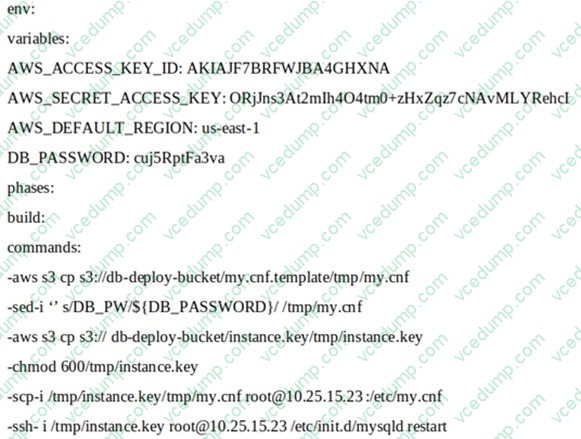
What changes should be recommended to comply with AWS security best practices? (Choose three.)
A. Add a post-build command to remove the temporary files from the container before termination to ensure they cannot be seen by other CodeBuild users.
B. Update the CodeBuild project role with the necessary permissions and then remove the AWS credentials from the environment variable.
C. Store the DB_PASSWORD as a SecureString value in AWS Systems Manager Parameter Store and then remove the DB_PASSWORD from the environment variables.
D. Move the environment variables to the `db-deploy-bucket' Amazon S3 bucket, add a prebuild stage to download, then export the variables.
E. Use AWS Systems Manager run command versus scp and ssh commands directly to the instance.
F. Scramble the environment variables using XOR followed by Base64, add a section to install, and then run XOR and Base64 to the build phase. -
Question 324:
You are running a Docker daemon on a Linux host and it becomes unresponsive. Which signal, when sent to a Docker process with the kill command, forces the full stack trace to be logged for debugging purposes?
A. –TRACE
B. –IOTRACE
C. -SIGUSER1
D. –KILLTRACE -
Question 325:
You are hired as the new head of operations for a SaaS company. Your CTO has asked you to make debugging any part of your entire operation simpler and as fast as possible. She complains that she has no idea what is going on in the complex, service-oriented architecture, because the developers just log to disk, and it's very hard to find errors in logs on so many services. How can you best meet this requirement and satisfy your CTO?
A. Copy all log files into AWS S3 using a cron job on each instance. Use an S3 Notification Configuration on the PutBucket event and publish events to AWS Lambda. Use the Lambda to analyze logs as soon as they come in and flag issues.
B. Begin using CloudWatch Logs on every service. Stream all Log Groups into S3 objects. Use AWS EMR cluster jobs to perform ad-hoc MapReduce analysis and write new queries when needed.
C. Copy all log files into AWS S3 using a cron job on each instance. Use an S3 Notification Configuration on the PutBucket event and publish events to AWS Kinesis. Use Apache Spark on AWS EMR to perform at-scale stream processing queries on the log chunks and flag issues.
D. Begin using CloudWatch Logs on every service. Stream all Log Groups into an AWS Elasticsearch Service Domain running Kibana 4 and perform log analysis on a search cluster. -
Question 326:
A company is adopting AWS CodeDeploy to automate its application deployments for a Java-Apache Tomcat application with an Apache webserver. The Development team started with a proof of concept, created a deployment group for a developer environment, and performed functional tests within the application. After completion, the team will create additional deployment groups for staging and production The current log level is configured within the Apache settings, but the team wants to change this configuration dynamically when the deployment occurs, so that they can set different log level configurations depending on the deployment group without having a different application revision for each group. How can these requirements be met with the LEAST management overhead and without requiring different script versions for each deployment group?
A. Tag the Amazon EC2 instances depending on the deployment group. Then place a script into the application revision that calls the metadata service and the EC2 API to identify which deployment group the instance is part of. Use this information to configure the log level settings. Reference the script as part of the Afterinstall lifecycle hook in the appspec.yml file.
B. Create a script that uses the CodeDeploy environment variable DEPLOYMENT_GROUP_NAME to identify which deployment group the instances is part of. Use this information to configure the log level settings. Reference this script as part of the BeforeInstall lifecycle hook in the appspec.yml file
C. Create a CodeDeploy custom environment variable for each environment. Then place a script into the application revision that checks this environment variable to identify which deployment group the instance is part of. Use this information to configure the log level settings. Reference this script as part of the ValidateService lifecycle hook in the appspec.yml file.
D. Create a script that uses the CodeDeploy environment variable DEPLOYMENT_GROUP_ID to identify which deployment group the instance is part of to configure the log level settings. Reference this script as part of the Install lifecycle hook in the appspec.yml file. -
Question 327:
Your application consists of 10% writes and 90% reads. You currently service all requests through a Route53 Alias Record directed towards an AWS ELB, which sits in front of an EC2 Auto Scaling Group. Your system is getting very expensive when there are large traffic spikes during certain news events, during which many more people request to read similar data all at the same time. What is the simplest and cheapest way to reduce costs and scale with spikes like this?
A. Create an S3 bucket and asynchronously replicate common requests responses into S3 objects. When a request comes in for a precomputed response, redirect to AWS S3.
B. Create another ELB and Auto Scaling Group layer mounted on top of the other system, adding a tier to the system. Serve most read requests out of the top layer.
C. Create a CloudFront Distribution and direct Route53 to the Distribution. Use the ELB as an Origin and specify Cache Behaviours to proxy cache requests which can be served late.
D. Create a Memcached cluster in AWS ElastiCache. Create cache logic to serve requests which can be served late from the in-memory cache for increased performance. -
Question 328:
A DevOps Engineer must create a Linux AMI in an automated fashion. The newly created AMI identification must be stored in a location where other build pipelines can access the new identification programmatically What is the MOST cost-effective way to do this?
A. Build a pipeline in AWS CodePipeline to download and save the latest operating system Open Virtualization Format (OVF) image to an Amazon S3 bucket, then customize the image using the guestfish utility. Use the virtual machine (VM) import command to convert the OVF to an AMI, and store the AMI identification output as an AWS Systems Manager parameter.
B. Create an AWS Systems Manager automation document with values instructing how the image should be created. Then build a pipeline in AWS CodePipeline to execute the automation document to build the AMI when triggered. Store the AMI identification output as a Systems Manager parameter.
C. Build a pipeline in AWS CodePipeline to take a snapshot of an Amazon EC2 instance running the latest version of the application. Then start a new EC2 instance from the snapshot and update the running instance using an AWS Lambda function. Take a snapshot of the updated instance, then convert it to an AMI. Store the AMI identification output in an Amazon DynamoDB table.
D. Launch an Amazon EC2 instance and install Packer. Then configure a Packer build with values defining how the image should be created. Build a Jenkins pipeline to invoke the Packer build when triggered to build an AMI. Store the AMI identification output in an Amazon DynamoDB table. -
Question 329:
An application is being deployed with two Amazon EC2 Auto Scaling groups, each configured with an Application Load Balancer. The application is deployed to one of the Auto Scaling groups and an Amazon Route 53 alias record is pointed to the Application Load Balancer of the last deployed Auto Scaling group. Deployments alternate between the two Auto Scaling groups. Home security devices are making requests into the application. The Development team notes that new requests are coming into the old stack days after the deployment. The issue is caused by devices that are not observing the Time to Live (TTL) setting on the Amazon Route 53 alias record. What steps should the DevOps Engineer take to address the issue with requests coming to the old stacks, while creating minimal additional resources?
A. Create a fleet of Amazon EC2 instances running HAProxy behind an Application Load Balancer. The HAProxy instances will proxy the requests to one of the existing Auto Scaling groups. After a deployment the HAProxy instances are updated to send requests to the newly deployed Auto Scaling group.
B. Reduce the application to one Application Load Balancer. Create two target groups named Blue and Green. Create a rule on the Application Load Balancer pointed to a single target group. Add logic to the deployment to update the Application Load Balancer rule to the target group of the newly deployed Auto Scaling group.
C. Move the application to an AWS Elastic Beanstalk application with two environments. Perform new deployments on the non-live environment. After a deployment, perform an Elastic Beanstalk CNAME swap to make the newly deployed environment the live environment.
D. Create an Amazon CloudFront distribution. Set the two existing Application Load Balancers as origins on the distribution. After a deployment, update the CloudFront distribution behavior to send requests to the newly deployed Auto Scaling group. -
Question 330:
Your application uses Amazon SQS and Auto Scaling to process background jobs. The Auto Scaling policy is based on the number of messages in the queue, with a maximum Instance count of 100. Since the application was launched, the
group has never scaled above 50. The Auto Scaling group has now scaled to 100, the queue size is increasing, and very few Jobs are being completed. The number of messages being sent to the queue is at normal levels.
What should you do to identify why the queue size is unusually high, and to reduce it?
A. Temporarily increase the Auto Scaling group's desired value to 200. When the queue size has been reduced, reduce it to 50.
B. Analyze the application logs to identify possible reasons for message processing failure and resolve the cause for failures.
C. Create additional Auto Scaling groups, enabling the processing of the queue to be performed in parallel.
D. Analyze CloudTrail logs for Amazon SQS to ensure that the instances' Amazon EC2 role has permission to receive messages from the queue.
Related Exams:
-
AIF-C01
Amazon AWS Certified AI Practitioner (AIF-C01) -
AIP-C01
AWS Certified Generative AI Developer - Professional -
ANS-C00
AWS Certified Advanced Networking - Specialty (ANS-C00) -
ANS-C01
AWS Certified Advanced Networking - Specialty (ANS-C01) -
AXS-C01
AWS Certified Alexa Skill Builder - Specialty (AXS-C01) -
BDS-C00
AWS Certified Big Data - Speciality (BDS-C00) -
CLF-C02
AWS Certified Cloud Practitioner (CLF-C02) -
DAS-C01
AWS Certified Data Analytics - Specialty (DAS-C01) -
DATA-ENGINEER-ASSOCIATE
AWS Certified Data Engineer - Associate (DEA-C01) -
DBS-C01
AWS Certified Database - Specialty (DBS-C01)
Tips on How to Prepare for the Exams
Nowadays, the certification exams become more and more important and required by more and more enterprises when applying for a job. But how to prepare for the exam effectively? How to prepare for the exam in a short time with less efforts? How to get a ideal result and how to find the most reliable resources? Here on Vcedump.com, you will find all the answers. Vcedump.com provide not only Amazon exam questions, answers and explanations but also complete assistance on your exam preparation and certification application. If you are confused on your DOP-C01 exam preparations and Amazon certification application, do not hesitate to visit our Vcedump.com to find your solutions here.