DOP-C01 Exam Details
-
Exam Code
:DOP-C01 -
Exam Name
:AWS Certified DevOps Engineer - Professional (DOP-C01) -
Certification
:Amazon Certifications -
Vendor
:Amazon -
Total Questions
:559 Q&As -
Last Updated
:Dec 22, 2024
Amazon DOP-C01 Online Questions & Answers
-
Question 21:
A DevOps engineer is troubleshooting deployments to a new application that runs on Amazon EC2 instances behind an Application Load Balancer. The instances run in an EC2 Auto Scaling group across multiple Availability Zones. Instances sometimes come online before they are ready, which is leading to increased error rates among users. The current health check configuration gives instances a 60-second grace period and considers instances healthy after two 200 response codes from /index.php, a page that may respond intermittently during the deployment process. The development team wants instances to come online as soon as possible.
Which strategy would address this issue?
A. Increase the instance grace period from 60 seconds to 180 seconds, and the consecutive health check requirement from 2 to 3.
B. Increase the instance grace period from 60 second to 120 seconds, and change the response code requirement from 200 to 204.
C. Modify the deployment script to create a /health-check.php file when the deployment begins, then modify the health check path to point to that file.
D. Modify the deployment script to create a /health-check.php file when all tasks are complete, then modify the health check path to point to that file. -
Question 22:
Which of the following Dockerfile commands cannot be overridden at runtime?
A. VOLUME
B. USER
C. ADD
D. CMD -
Question 23:
If you're trying to configure an AWS Elastic Beanstalk worker tier for easy debugging if there are problems finishing queue jobs, what should you configure?
A. Configure Rolling Deployments.
B. Configure Enhanced Health Reporting
C. Configure Blue-Green Deployments.
D. Configure a Dead Letter Queue -
Question 24:
What is the maximum time messages can be stored in SQS?
A. 14 days
B. one month
C. 4 days
D. 7 days -
Question 25:
A DevOps engineer wants to deploy a serverless web application that is based on AWS Lambda. The deployment must meet the following requirements:
Provide staging and production environments.
Restrict developers from accessing the production environment.
Avoid hardcoding passwords in the Lambda functions.
Store source code in AWS CodeCommit.
Use AWS CodePipeline to automate the deployment.
What is the MOST operationally efficient solution that meets these requirements?
A. Create separate staging and production accounts to segregate deployment targets. Use AWS Key Management Service (AWS KMS) to store environment-specific values. Use CodePipeline to automate deployments with AWS CodeDeploy.
B. Create separate staging and production accounts to segregate deployment targets. Use Lambda environment variables to store environment-specific values. Use CodePipeline to automate deployments with AWS CodeDeploy.
C. Define tagging conventions for staging and production environments to segregate deployment targets. Use AWS Key Management Service (AWS KMS) to store environment-specific values. Use CodePipeline to automate deployments with AWS CodeDeploy.
D. Define tagging conventions for staging and production environments to segregate deployment targets. Use Lambda environment variables to store environment-specific values. Use CodePipeline to automate deployments with AWS CodeDeploy. -
Question 26:
Your system automatically provisions EIPs to EC2 instances in a VPC on boot. The system provisions the whole VPC and stack at once. You have two of them per VPC. On your new AWS account, your attempt to create a Development
environment failed, after successfully creating Staging and Production environments in the same region.
What happened?
A. You didn't choose the Development version of the AMI you are using.
B. You didn't set the Development flag to true when deploying EC2 instances.
C. You hit the soft limit of 5 EIPs per region and requested a 6th.
D. You hit the soft limit of 2 VPCs per region and requested a 3rd. -
Question 27:
A DevOps team manages an API running on-premises that serves as a backend for an Amazon API Gateway endpoint. Customers have been complaining about high response latencies, which the development team has verified using the API Gateway latency metrics in Amazon CloudWatch. To identify the cause, the team needs to collect relevant data without introducing additional latency.
Which actions should be taken to accomplish this? (Choose two.)
A. Install the CloudWatch agent server side and configure the agent to upload relevant logs to CloudWatch.
B. Enable AWS X-Ray tracing in API Gateway, modify the application to capture request segments, and upload those segments to X-Ray during each request.
C. Enable AWS X-Ray tracing in API Gateway, modify the application to capture request segments, and use the X-Ray daemon to upload segments to X-Ray.
D. Modify the on-premises application to send log information back to API Gateway with each request.
E. Modify the on-premises application to calculate and upload statistical data relevant to the API service requests to CloudWatch metrics. -
Question 28:
An online company uses Amazon EC2 Auto Scaling extensively to provide an excellent customer experience while minimizing the number of running EC2 instances. The company's self-hosted Puppet environment in the application layer
manages the configuration of the instances. The IT manager wants the lowest licensing costs and wants to ensure that whenever the EC2 Auto Scaling group scales down, removed EC2 instances are deregistered from the Puppet master as
soon as possible.
How can the requirement be met?
A. At instance launch time, use EC2 user data to deploy the AWS CodeDeploy agent. Use CodeDeploy to install the Puppet agent. When the Auto Scaling group scales out, run a script to register the newly deployed instances to the Puppet master. When the Auto Scaling group scales in, use the EC2 Auto Scaling EC2_INSTANCE_TERMINATING lifecycle hook to trigger de-registration from the Puppet master.
B. Bake the AWS CodeDeploy agent into the base AMI. When the Auto Scaling group scales out, use CodeDeploy to install the Puppet agent, and execute a script to register the newly deployed instances to the Puppet master. When the Auto Scaling group scales in, use the CodeDeploy ApplicationStop lifecycle hook to run a script to de-register the instance from the Puppet master.
C. At instance launch time, use EC2 user data to deploy the AWS CodeDeploy agent. When the Auto Scaling group scales out, use CodeDeploy to install the Puppet agent, and run a script to register the newly deployed instances to the Puppet master. When the Auto Scaling group scales in, use the EC2 user data instance stop script to run a script to de-register the instance from the Puppet master.
D. Bake the AWS Systems Manager agent into the base AMI. When the Auto Scaling group scales out, use the AWS Systems Manager to install the Puppet agent, and run a script to register the newly deployed instances to the Puppet master. When the Auto Scaling group scales in, use the Systems Manager instance stop lifecycle hook to run a script to de-register the instance from the Puppet master. -
Question 29:
A company has deployed several applications globally. Recently, Security Auditors found that few Amazon EC2 instances were launched without Amazon EBS disk encryption. The Auditors have requested a report detailing all EBS volumes
that were not encrypted in multiple AWS accounts and regions. They also want to be notified whenever this occurs in future.
How can this be automated with the LEAST amount of operational overhead?
A. Create an AWS Lambda function to set up an AWS Config rule on all the target accounts. Use AWS Config aggregators to collect data from multiple accounts and regions. Export the aggregated report to an Amazon S3 bucket and use Amazon SNS to deliver the notifications.
B. Set up AWS CloudTrail to deliver all events to an Amazon S3 bucket in a centralized account. Use the S3 event notification feature to invoke an AWS Lambda function to parse AWS CloudTrail logs whenever logs are delivered to the S3 bucket. Publish the output to an Amazon SNS topic using the same Lambda function.
C. Create an AWS CloudFormation template that adds an AWS Config managed rule for EBS encryption. Use a CloudFormation stack set to deploy the template across all accounts and regions. Store consolidated evaluation results from config rules in Amazon S3. Send a notification using Amazon SNS when non-compliant resources are detected.
D. Using AWS CLI, run a script periodically that invokes the aws ec2 describe-volumes query with a JMESPATH query filter. Then, write the output to an Amazon S3 bucket. Set up an S3 event notification to send events using Amazon SNS when new data is written to the S3 bucket. -
Question 30:
A root account has created an IAM group and defined the policy as:
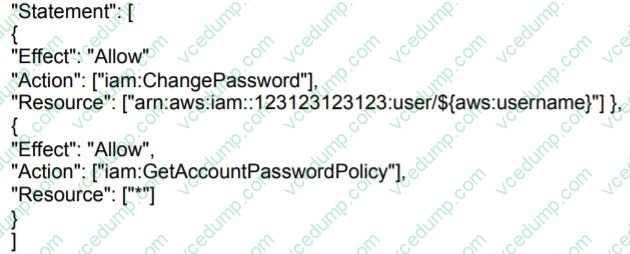
What will this policy do?
A. Allow this group to view the password policy of all the users added only to that group
B. Allow all the users of IAM to modify their password
C. Allow an IAM user in this group to view the password policy and modify only his/her password
D. Allow this group to view the password policy of all the IAM users
Related Exams:
-
AIF-C01
Amazon AWS Certified AI Practitioner (AIF-C01) -
AIP-C01
AWS Certified Generative AI Developer - Professional -
ANS-C00
AWS Certified Advanced Networking - Specialty (ANS-C00) -
ANS-C01
AWS Certified Advanced Networking - Specialty (ANS-C01) -
AXS-C01
AWS Certified Alexa Skill Builder - Specialty (AXS-C01) -
BDS-C00
AWS Certified Big Data - Speciality (BDS-C00) -
CLF-C02
AWS Certified Cloud Practitioner (CLF-C02) -
DAS-C01
AWS Certified Data Analytics - Specialty (DAS-C01) -
DATA-ENGINEER-ASSOCIATE
AWS Certified Data Engineer - Associate (DEA-C01) -
DBS-C01
AWS Certified Database - Specialty (DBS-C01)
Tips on How to Prepare for the Exams
Nowadays, the certification exams become more and more important and required by more and more enterprises when applying for a job. But how to prepare for the exam effectively? How to prepare for the exam in a short time with less efforts? How to get a ideal result and how to find the most reliable resources? Here on Vcedump.com, you will find all the answers. Vcedump.com provide not only Amazon exam questions, answers and explanations but also complete assistance on your exam preparation and certification application. If you are confused on your DOP-C01 exam preparations and Amazon certification application, do not hesitate to visit our Vcedump.com to find your solutions here.