DOP-C01 Exam Details
-
Exam Code
:DOP-C01 -
Exam Name
:AWS Certified DevOps Engineer - Professional (DOP-C01) -
Certification
:Amazon Certifications -
Vendor
:Amazon -
Total Questions
:559 Q&As -
Last Updated
:Dec 22, 2024
Amazon DOP-C01 Online Questions & Answers
-
Question 181:
A company is using AWS CodePipeline to automate its release pipeline. AWS CodeDeploy is being used in the pipeline to deploy an application to Amazon ECS using the blue/green deployment model. The company wants to implement scripts to test the green version of the application before shifting traffic. These scripts will complete in 5 minutes or less. If errors are discovered during these tests, the application must be rolled back.
Which strategy will meet these requirements?
A. Add a stage to the CodePipeline pipeline between the source and deploy stages. Use AWS CodeBuild to create an execution environment and build commands in the buildspec file to invoke test scripts. If errors are found, use the aws deploy stop-deployment command to stop the deployment.
B. Add a stage to the CodePipeline pipeline between the source and deploy stages. Use this stage to execute an AWS Lambda function that will run the test scripts. If errors are found, use the aws deploy stop-deployment command to stop the deployment.
C. Add a hooks section to the CodeDeploy AppSpec file. Use the AfterAllowTestTraffic lifecycle event to invoke an AWS Lambda function to run the test scripts. If errors are found, exit the Lambda function with an error to trigger rollback.
D. Add a hooks section to the CodeDeploy AppSpec file. Use the AfterAllowTraffic lifecycle event to invoke the test scripts. If errors are found, use the aws deploy stop-deployment CLI command to stop the deployment. -
Question 182:
You have an application consisting of a stateless web server tier running on Amazon EC2 instances behind load balancer, and are using Amazon RDS with read replicas. Which of the following methods should you use to implement a self-healing and cost-effective architecture? (Choose two.)
A. Set up a third-party monitoring solution on a cluster of Amazon EC2 instances in order to emit custom CloudWatch metrics to trigger the termination of unhealthy Amazon EC2 instances.
B. Set up scripts on each Amazon EC2 instance to frequently send ICMP pings to the load balancer in order to determine which instance is unhealthy and replace it.
C. Set up an Auto Scaling group for the web server tier along with an Auto Scaling policy that uses the Amazon RDS DB CPU utilization CloudWatch metric to scale the instances.
D. Set up an Auto Scaling group for the web server tier along with an Auto Scaling policy that uses the Amazon EC2 CPU utilization CloudWatch metric to scale the instances.
E. Use a larger Amazon EC2 instance type for the web server tier and a larger DB instance type for the data storage layer to ensure that they don't become unhealthy.
F. Set up an Auto Scaling group for the database tier along with an Auto Scaling policy that uses the Amazon RDS read replica lag CloudWatch metric to scale out the Amazon RDS read replicas.
G. Use an Amazon RDS Multi-AZ deployment. -
Question 183:
A healthcare provider has a hybrid architecture that includes 120 on-premises VMware servers running RedHat and 50 Amazon EC2 instances running Amazon Linux. The company is in the middle of an all-in migration to AWS and wants to implement a solution for collecting information from the on-premises virtual machines and the EC2 instances for data analysis. The information includes:
-Operating system type and version
-Data for installed applications
- Network configuration information, such as MAC and IP addresses
-Amazon EC2 instance AMI ID and IAM profile
How can these requirements be met with the LEAST amount of administration?
A. Write a shell script to run as a cron job on EC2 instances to collect and push the data to Amazon S3. For on-premises resources, use VMware vSphere to collect the data and write it into a file gateway for storing the data in S3. Finally, use Amazon Athena on the S3 bucket for analytics.
B. Use a script on the on-premises virtual machines as well as the EC2 instances to gather and push the data into Amazon S3, and then use Amazon Athena for analytics.
C. Install AWS Systems Manager agents on both the on-premises virtual machines and the EC2 instances. Enable inventory collection and configure resource data sync to an Amazon S3 bucket to analyze the data with Amazon Athena.
D. Use AWS Application Discovery Service for deploying Agentless Discovery Connector in the VMware environment and Discovery Agents on the EC2 instances for collecting the data. Then use the AWS Migration Hub Dashboard for analytics. -
Question 184:
You are designing an enterprise data storage system. Your data management software system requires mountable disks and a real filesystem, so you cannot use S3 for storage. You need persistence, so you will be using AWS EBS Volumes for your system. The system needs as lowcost storage as possible, and access is not frequent or high throughput, and is mostly sequential reads. Which is the most appropriate EBS Volume Type for this scenario?
A. gp1
B. io1
C. standard
D. gp2 -
Question 185:
A DevOps Engineer manages a large commercial website that runs on Amazon EC2. The website uses Amazon Kinesis Data Streams to collect and process web logs. The Engineer manages the Kinesis consumer application, which also runs on EC2. Spikes of data cause the Kinesis consumer application to fall behind, and the streams drop records before they can be processed. What is the FASTEST method to improve stream handling?
A. Modify the Kinesis consumer application to store the logs durably in Amazon S3. Use Amazon EMR to process the data directly on S3 to derive customer insights and store the results in S3.
B. Horizontally scale the Kinesis consumer application by adding more EC2 instances based on the GetRecord.IteratorAgeMilliseconds Amazon CloudWatch metric. Increase the Kinesis Data Streams retention period.
C. Convert the Kinesis consumer application to run as an AWS Lambda function. Configure the Kinesis Data Streams as the event source for the Lambda function to process the data streams.
D. Increase the number of shards in the Kinesis Data Streams to increase the overall throughput so that the consumer processes data faster. -
Question 186:
If Ansible encounters a resource that does not meet the requirements specified in the play it makes the necessary changes to the resource; however if the resource is already in the desired state Ansible will do nothing. This is an example of which methodology?
A. Idempotency
B. Immutability
C. Convergence
D. Infrastructure as Code -
Question 187:
An IT team has built an AWS CloudFormation template so others in the company can quickly and reliably deploy and terminate an application. The template creates an Amazon EC2 instance with a user data script to install the application and
an Amazon S3 bucket that the application uses to serve static webpages while it is running.
All resources should be removed when the CloudFormation stack is deleted. However, the team observes that CloudFormation reports an error during stack deletion, and the S3 bucket created by the stack is not deleted.
How can the team resolve the error in the MOST efficient manner to ensure that all resources are deleted without errors?
A. Add DeletionPolicy attribute to the S3 bucket resource, with the value Delete forcing the bucket to be removed when the stack is deleted.
B. Add a custom resource when an AWS Lambda function with the DependsOn attribute specifying the S3 bucket, and an IAM role. Writhe the Lambda function to delete all objects from the bucket when the RequestType is Delete.
C. Identify the resource that was not deleted. From the S3 console, empty the S3 bucket and then delete it.
D. Replace the EC2 and S3 bucket resources with a single AWS OpsWorks Stacks resource. Define a custom recipe for the stack to create and delete the EC2 instance and the S3 bucket. -
Question 188:
A company wants to use Amazon DynamoDB for maintaining metadata on its forums. See the sample data set in the image below.
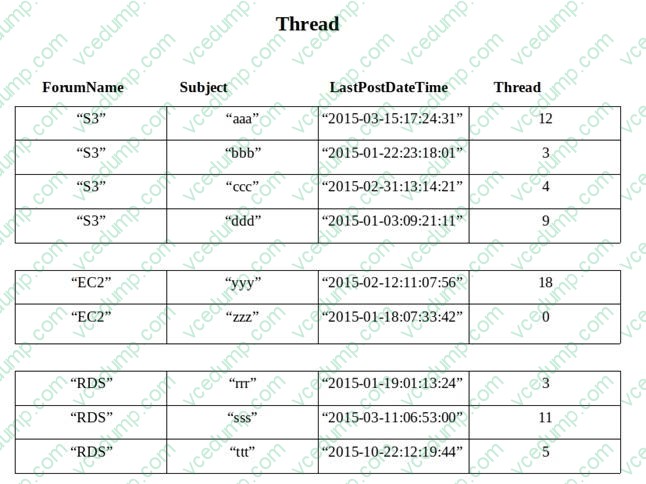
A DevOps Engineer is required to define the table schema with the partition key, the sort key, the local secondary index, projected attributes, and fetch operations. The schema should support the following example searches using the least provisioned read capacity units to minimize cost. -Search within ForumName for items where the subject starts with `a'. -Search forums within the given LastPostDateTime time frame. -Return the thread value where LastPostDateTime is within the last three months.
Which schema meets the requirements?
A. Use Subject as the primary key and ForumName as the sort key. Have LSI with LastPostDateTime as the sort key and fetch operations for thread.
B. Use ForumName as the primary key and Subject as the sort key. Have LSI with LastPostDateTime as the sort key and the projected attribute thread.
C. Use ForumName as the primary key and Subject as the sort key. Have LSI with Thread as the sort key and the projected attribute LastPostDateTime.
D. Use Subject as the primary key and ForumName as the sort key. Have LSI with Thread as the sort key and fetch operations for LastPostDateTime. -
Question 189:
When deploying to a Docker swarm, which section of the docker-compose file defines configuration related to the deployment and running of services?
A. services
B. build
C. deploy
D. args -
Question 190:
To run an application, a DevOps Engineer launches an Amazon EC2 instances with public IP addresses in a public subnet. A user data script obtains the application artifacts and installs them on the instances upon launch. A change to the
security classification of the application now requires the instances to run with no access to the Internet. While the instances launch successfully and show as healthy, the application does not seem to be installed.
Which of the following should successfully install the application while complying with the new rule?
A. Launch the instances in a public subnet with Elastic IP addresses attached. Once the application is installed and running, run a script to disassociate the Elastic IP addresses afterwards.
B. Set up a NAT gateway. Deploy the EC2 instances to a private subnet. Update the private subnet's route table to use the NAT gateway as the default route.
C. Publish the application artifacts to an Amazon S3 bucket and create a VPC endpoint for S3. Assign an IAM instance profile to the EC2 instances so they can read the application artifacts from the S3 bucket.
D. Create a security group for the application instances and whitelist only outbound traffic to the artifact repository. Remove the security group rule once the install is complete.
Related Exams:
-
AIF-C01
Amazon AWS Certified AI Practitioner (AIF-C01) -
AIP-C01
AWS Certified Generative AI Developer - Professional -
ANS-C00
AWS Certified Advanced Networking - Specialty (ANS-C00) -
ANS-C01
AWS Certified Advanced Networking - Specialty (ANS-C01) -
AXS-C01
AWS Certified Alexa Skill Builder - Specialty (AXS-C01) -
BDS-C00
AWS Certified Big Data - Speciality (BDS-C00) -
CLF-C02
AWS Certified Cloud Practitioner (CLF-C02) -
DAS-C01
AWS Certified Data Analytics - Specialty (DAS-C01) -
DATA-ENGINEER-ASSOCIATE
AWS Certified Data Engineer - Associate (DEA-C01) -
DBS-C01
AWS Certified Database - Specialty (DBS-C01)
Tips on How to Prepare for the Exams
Nowadays, the certification exams become more and more important and required by more and more enterprises when applying for a job. But how to prepare for the exam effectively? How to prepare for the exam in a short time with less efforts? How to get a ideal result and how to find the most reliable resources? Here on Vcedump.com, you will find all the answers. Vcedump.com provide not only Amazon exam questions, answers and explanations but also complete assistance on your exam preparation and certification application. If you are confused on your DOP-C01 exam preparations and Amazon certification application, do not hesitate to visit our Vcedump.com to find your solutions here.