DOP-C01 Exam Details
-
Exam Code
:DOP-C01 -
Exam Name
:AWS Certified DevOps Engineer - Professional (DOP-C01) -
Certification
:Amazon Certifications -
Vendor
:Amazon -
Total Questions
:559 Q&As -
Last Updated
:Dec 22, 2024
Amazon DOP-C01 Online Questions & Answers
-
Question 91:
You are using a configuration management system to manage your Amazon EC2 instances. On your Amazon EC2 Instances, you want to store credentials for connecting to an Amazon RDS DB instance. How should you securely store these credentials?
A. Give the Amazon EC2 instances an IAM role that allows read access to a private Amazon S3 bucket. Store a file with database credentials in the Amazon S3 bucket. Have your configuration management system pull the file from the bucket when it is needed.
B. Launch an Amazon EC2 instance and use the configuration management system to bootstrap the instance with the Amazon RDS DB credentials. Create an AMI from this instance.
C. Store the Amazon RDS DB credentials in Amazon EC2 user data. Import the credentials into the Instance on boot.
D. Assign an IAM role to your Amazon RDS instance, and use this IAM role to access the Amazon RDS DB from your Amazon EC2 instances.
E. Store your credentials in your version control system, in plaintext. Check out a copy of your credentials from the version control system on boot. Use Amazon EBS encryption on the volume storing the Amazon RDS DB credentials. -
Question 92:
What is the order of most-to-least rapidly-scaling (fastest to scale first)?
A- EC2 + ELB + Auto Scaling B- Lambda C- RDS
A. B, A, C
B. C, B, A
C. C, A, B
D. A, C, B -
Question 93:
There are a number of ways to purchase compute capacity on AWS. Which orders the price per compute or memory unit from LOW to HIGH (cheapest to most expensive), on average?
A- On-Demand B- Spot C- Reserved
A. A, B, C
B. C, B, A
C. B, C, A
D. A, C, B -
Question 94:
When thinking of DynamoDB, what are true of Local Secondary Key properties?
A. Either the partition key or the sort key can be different from the table, but not both.
B. Only the sort key can be different from the table.
C. The partition key and sort key can be different from the table.
D. Only the partition key can be different from the table. -
Question 95:
You were just hired as a DevOps Engineer for a startup. Your startup uses AWS for 100% of their infrastructure. They currently have no automation at all for deployment, and they have had many failures while trying to deploy to production. The company has told you deployment process risk mitigation is the most important thing now, and you have a lot of budget for tools and AWS resources. Their stack:
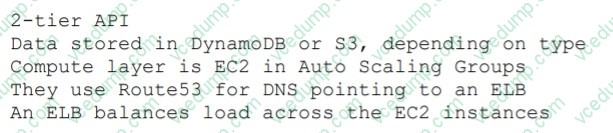
The scaling group properly varies between 4 and 12 EC2 servers. Which of the following approaches, given this company's stack and their priorities, best meets the company's needs?
A. Model the stack in AWS Elastic Beanstalk as a single Application with multiple Environments. Use Elastic Beanstalk's Rolling Deploy option to progressively roll out application code changes when promoting across environments.
B. Model the stack in 3 CloudFormation templates: Data layer, compute layer, and networking layer. Write stack deployment and integration testing automation following Blue-Green methodologies.
C. Model the stack in AWS OpsWorks as a single Stack, with 1 compute layer and its associated ELB. Use Chef and App Deployments to automate Rolling Deployment.
D. Model the stack in 1 CloudFormation template, to ensure consistency and dependency graph resolution. Write deployment and integration testing automation following Rolling Deployment methodologies. -
Question 96:
For AWS Auto Scaling, what is the first transition state an instance enters after leaving steady state when scaling in due to health check failure or decreased load?
A. Terminating
B. Detaching
C. Terminating:Wait
D. EnteringStandby -
Question 97:
You run a large number of applications on Amazon EC2 instances. Each application has associated metadata, such as cost center, support contact, and application ID. Many applications usually co-exist on each Amazon EC2 instance, so the amount of metadata per instance can range from 10 to 200 items. The customer wants to be able to quickly access this metadata using an API without logging into the instances. Which of the following options will satisfy their requirements? (Choose two.)
A. Create individual Amazon EC2 tags for each metadata item, and associate them with the Amazon EC2 instances. Access the metadata by using the ec2-describe-instance API call.
B. Create compound Amazon EC2 tags for the metadata items, where multiple items are joined together in individual tags, and associate them with the Amazon EC2 instances. Access the metadata by using the ec2-describe-tags API call.
C. Create a DynamoDB table to hold the metadata, and associate it with the Amazon EC2 instance IDs running the applications. Access the metadata by querying the database via the DynamoDB API.
D. As part of the Amazon EC2 Instance bootstrapping process, add the metadata to the Amazon EC2 user data. Access the metadata by using the ec2-describe-instance API call.
E. As part of the Amazon EC2 instance bootstrapping process, add the metadata to the Amazon EC2 user data. Access the metadata by accessing its loopback address from a management instance in the same VPC. -
Question 98:
A company is reviewing its IAM policies. One policy written by the DevOps Engineer has been flagged as too permissive. The policy is used by an AWS Lambda function that issues a stop command to Amazon EC2 instances tagged with
Environment: NonProduction over the weekend. The current policy is:
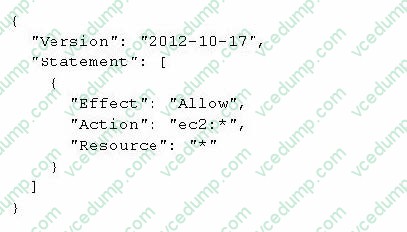
What changes should the Engineer make to achieve a policy of least permission? (Choose three.)
A. Option A
B. Option B
C. Option C
D. Option D
E. Option E
F. Option F -
Question 99:
Your mobile application includes a photo-sharing service that is expecting tens of thousands of users at launch. You will leverage Amazon Simple Storage Service (S3) for storage of the user Images, and you must decide how to authenticate
and authorize your users for access to these images. You also need to manage the storage of these images.
Which two of the following approaches should you use? (Choose two.)
A. Create an Amazon S3 bucket per user, and use your application to generate the S3 URI for the appropriate content.
B. Use AWS Identity and Access Management (IAM) user accounts as your application-level user database, and offload the burden of authentication from your application code.
C. Authenticate your users at the application level, and use AWS Security Token Service (STS) to grant token-based authorization to S3 objects.
D. Authenticate your users at the application level, and send an SMS token message to the user. Create an Amazon S3 bucket with the same name as the SMS message token, and move the user's objects to that bucket.
E. Use a key-based naming scheme comprised from the user IDs for all user objects in a single Amazon S3 bucket. -
Question 100:
A company recently launched an application that is more popular than expected. The company wants to ensure the application can scale to meet increasing demands and provide reliability using multiple Availability Zones (AZs). The application runs on a fleet of Amazon EC2 instances behind an Application Load Balancer (ALB). A DevOps engineer has created an Auto Scaling group across multiple AZs for the application. Instances launched in the newly added AZs are not receiving any traffic for the application.
What is likely causing this issue?
A. Auto Scaling groups can create new instances in a single AZ only.
B. The EC2 instances have not been manually associated to the ALB.
C. The ALB should be replaced with a Network Load Balancer (NLB).
D. The new AZ has not been added to the ALB.
Related Exams:
-
AIF-C01
Amazon AWS Certified AI Practitioner (AIF-C01) -
AIP-C01
AWS Certified Generative AI Developer - Professional -
ANS-C00
AWS Certified Advanced Networking - Specialty (ANS-C00) -
ANS-C01
AWS Certified Advanced Networking - Specialty (ANS-C01) -
AXS-C01
AWS Certified Alexa Skill Builder - Specialty (AXS-C01) -
BDS-C00
AWS Certified Big Data - Speciality (BDS-C00) -
CLF-C02
AWS Certified Cloud Practitioner (CLF-C02) -
DAS-C01
AWS Certified Data Analytics - Specialty (DAS-C01) -
DATA-ENGINEER-ASSOCIATE
AWS Certified Data Engineer - Associate (DEA-C01) -
DBS-C01
AWS Certified Database - Specialty (DBS-C01)
Tips on How to Prepare for the Exams
Nowadays, the certification exams become more and more important and required by more and more enterprises when applying for a job. But how to prepare for the exam effectively? How to prepare for the exam in a short time with less efforts? How to get a ideal result and how to find the most reliable resources? Here on Vcedump.com, you will find all the answers. Vcedump.com provide not only Amazon exam questions, answers and explanations but also complete assistance on your exam preparation and certification application. If you are confused on your DOP-C01 exam preparations and Amazon certification application, do not hesitate to visit our Vcedump.com to find your solutions here.