SCS-C01 Exam Details
-
Exam Code
:SCS-C01 -
Exam Name
:AWS Certified Security - Specialty (SCS-C01) -
Certification
:Amazon Certifications -
Vendor
:Amazon -
Total Questions
:733 Q&As -
Last Updated
:May 27, 2026
Amazon SCS-C01 Online Questions & Answers
-
Question 571:
An application developer is using an AWS Lambda function that must use AWS KMS to perform encrypt and decrypt operations for API keys that are less than 2 KB. Which key policy would allow the application to do this while granting least privilege?
A. Option A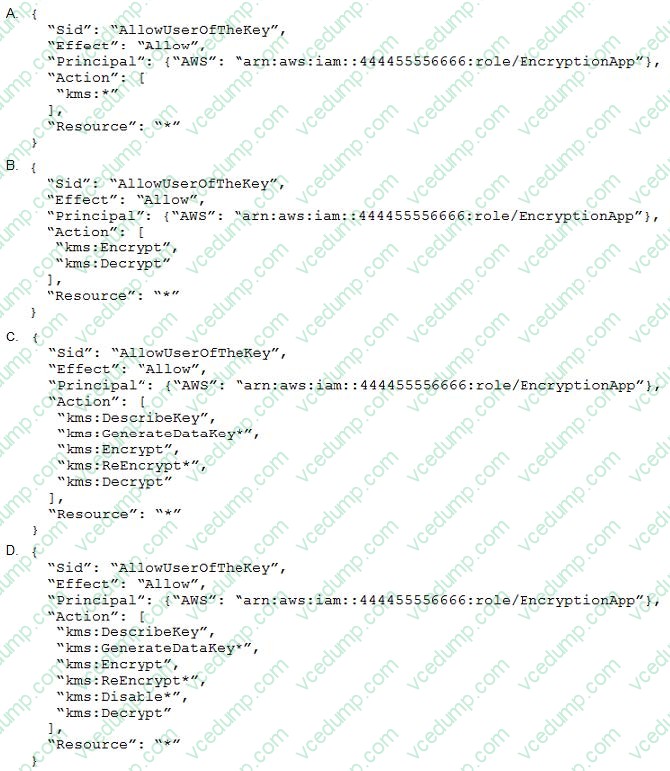
B. Option B
C. Option C
D. Option D -
Question 572:
A large corporation is creating a multi-account strategy and needs to determine how its employees should access the AWS infrastructure.
Which of the following solutions would provide the MOST scalable solution?
A. Create dedicated IAM users within each AWS account that employees can assume through federation based upon group membership in their existing identity provider
B. Use a centralized account with IAM roles that employees can assume through federation with their existing identity provider Use cross-account roles to allow the federated users to assume their target role in the resource accounts.
C. Configure the AWS Security Token Service to use Kerberos tokens so that users can use their existing corporate user names and passwords to access AWS resources directly
D. Configure the IAM trust policies within each account's role to set up a trust back to the corporation's existing identity provider allowing users to assume the role based off their SAML token -
Question 573:
Some highly sensitive analytics workloads are to be moved to Amazon EC2 hosts. Threat modeling has found that a risk exists where a subnet could be maliciously or accidentally exposed to the internet. Which of the following mitigations should be recommended?
A. Use AWS Config to detect whether an Internet Gateway is added and use an AWS Lambda function to provide auto-remediation.
B. Within the Amazon VPC configuration, mark the VPC as private and disable Elastic IP addresses.
C. Use IPv6 addressing exclusively on the EC2 hosts, as this prevents the hosts from being accessed from the internet.
D. Move the workload to a Dedicated Host, as this provides additional network security controls and monitoring. -
Question 574:
A company's security engineer has been tasked with restricting a contractor's 1AM account access to the company's Amazon EC2 console without providing access to any other AWS services The contractors 1AM account must not be able to gain access to any other AWS service, even it the 1AM account rs assigned additional permissions based on 1AM group membership What should the security engineer do to meet these requirements''
A. Create an mime 1AM user policy that allows for Amazon EC2 access for the contractor's 1AM user
B. Create an 1AM permissions boundary policy that allows Amazon EC2 access Associate the contractor's 1AM account with the 1AM permissions boundary policy
C. Create an 1AM group with an attached policy that allows for Amazon EC2 access Associate the contractor's 1AM account with the 1AM group
D. Create a 1AM role that allows for EC2 and explicitly denies all other services Instruct the contractor to always assume this role -
Question 575:
A company's AWS account consists of approximately 300 IAM users. Now there is a mandate that an access change is required for 100 IAM users to have unlimited privileges to S3.As a system administrator, how can you implement this effectively so that there is no need to apply the policy at the individual user level?
Please select:
A. Create a new role and add each user to the IAM role
B. Use the IAM groups and add users, based upon their role, to different groups and apply the policy to group
C. Create a policy and apply it to multiple users using a JSON script
D. Create an S3 bucket policy with unlimited access which includes each user's AWS account ID -
Question 576:
A large government organization is moving to the cloud and has specific encryption requirements. The first workload to move requires that a customer's data be immediately destroyed when the customer makes that request.
Management has asked the security team to provide a solution that will securely store the data, allow only authorized applications to perform encryption and decryption, and allow for immediate destruction of the data.
Which solution will meet these requirements?
A. Use AWS Secrets Manager and an AWS SDK to create a unique secret for the customer-specific data.
B. Use AWS Key Management Service (AWS KMS) and the AWS Encryption SDK to generate and store a data encryption key for each customer.
C. Use AWS Key Management Service (AWS KMS) with service-managed keys to generate and store customer-specific data encryption keys.
D. Use AWS Key Management Service (AWS KMS) and create an AWS CloudHSM custom key store. Use CloudHSM to generate and store a new CMK for each customer. -
Question 577:
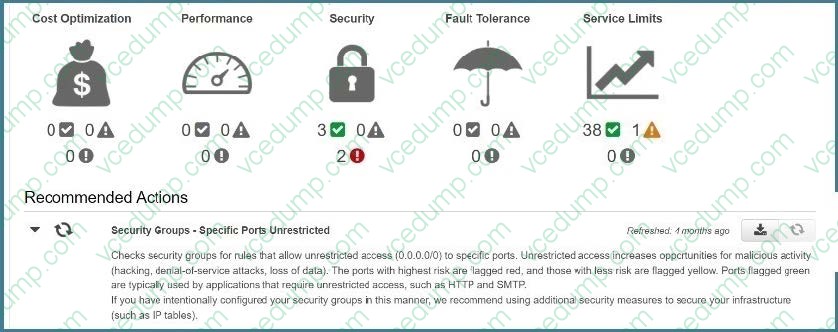
Your company has defined a number of EC2 Instances over a period of 6 months. They want to know if any of the security groups allow unrestricted access to a resource. What is the best option to accomplish this requirement?
Please select:
A. Use AWS Inspector to inspect all the security Groups
B. Use the AWS Trusted Advisor to see which security groups have compromised access.
C. Use AWS Config to see which security groups have compromised access.
D. Use the AWS CLI to query the security groups and then filter for the rules which have unrestricted accessd -
Question 578:
A company is collecting AWS CloudTrail log data from multiple AWS accounts by managing individual trails in each account and forwarding log data to a centralized Amazon S3 bucket residing in a log archive account. After CloudTrail introduced support for AWS Organizations trails, the company decided to further centralize management and automate deployment of the CloudTrail logging capability across all of its AWS accounts.
The company's security engineer created an AWS Organizations trail in the master account, enabled server-side encryption with AWS KMS managed keys (SSE-KMS) for the log files, and specified the same bucket as the storage location. However, the engineer noticed that logs recorded by the new trail were not delivered to the bucket.
Which factors could cause this issue? (Select TWO.)
A. The CMK key policy does not allow CloudTrail to make encrypt and decrypt API calls against the key.
B. The CMK key policy does not allow CloudTrail to make GenerateDataKey API calls against the key.
C. The IAM role used by the CloudTrail trail does not have permissions to make PutObject API calls against a folder created for the Organizations trail.
D. The S3 bucket policy does not allow CloudTrail to make PutObject API calls against a folder created for the Organizations trail.
E. The CMK key policy does not allow the IAM role used by the CloudTrail trail to use the key for crypto graphicaI operations. -
Question 579:
A company's Security Engineer is copying all application logs to centralized Amazon S3 buckets. Currently, each of the company's application is in its own AWS account, and logs are pushed into S3 buckets associated with each account. The Engineer will deploy an AWS Lambda function into each account that copies the relevant log files to the centralized S3 bucket.
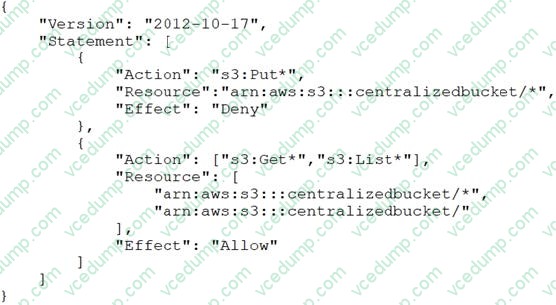
The Security Engineer is unable to access the log files in the centralized S3 bucket. The Engineer's IAM user policy from the centralized account looks like this:
The centralized S3 bucket policy looks like this:
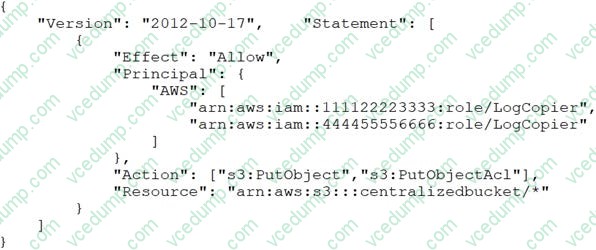
Why is the Security Engineer unable to access the log files?
A. The S3 bucket policy does not explicitly allow the Security Engineer access to the objects in the bucket.
B. The object ACLs are not being updated to allow the users within the centralized account to access the objects
C. The Security Engineers IAM policy does not grant permissions to read objects in the S3 bucket
D. The s3:PutObject and s3:PutObjectAcl permissions should be applied at the S3 bucket level. -
Question 580:
A company's development team is designing an application using AWS Lambda and Amazon Elastic Container Service (Amazon ECS). The development team needs to create IAM roles to support these systems. The company's security team wants to allow the developers to build IAM roles directly, but the security team wants to retain control over the permissions the developers can delegate to those roles. The development team needs access to more permissions than those required for application's AWS services. The solution must minimize management overhead.
How should the security team prevent privilege escalation for both teams?
A. Enable AWS CloudTrail. Create a Lambda function that monitors the event history for privilege escalation events and notifies the security team.
B. Create a managed IAM policy for the permissions required. Reference the IAM policy as a permissions boundary within the development team's IAM role.
C. Enable AWS Organizations. Create an SCP that allows the iam:CreateUser action but that has a condition that prevents API calls other than those required by the development team.
D. Create an IAM policy with a deny on the iam:CreateUser action and assign the policy to the development team. Use a ticket system to allow the developers to request new IAM roles for their applications. The IAM roles will then be created by the security team.
Related Exams:
-
AIF-C01
Amazon AWS Certified AI Practitioner (AIF-C01) -
AIP-C01
AWS Certified Generative AI Developer - Professional -
ANS-C00
AWS Certified Advanced Networking - Specialty (ANS-C00) -
ANS-C01
AWS Certified Advanced Networking - Specialty (ANS-C01) -
AXS-C01
AWS Certified Alexa Skill Builder - Specialty (AXS-C01) -
BDS-C00
AWS Certified Big Data - Speciality (BDS-C00) -
CLF-C02
AWS Certified Cloud Practitioner (CLF-C02) -
DAS-C01
AWS Certified Data Analytics - Specialty (DAS-C01) -
DATA-ENGINEER-ASSOCIATE
AWS Certified Data Engineer - Associate (DEA-C01) -
DBS-C01
AWS Certified Database - Specialty (DBS-C01)
Tips on How to Prepare for the Exams
Nowadays, the certification exams become more and more important and required by more and more enterprises when applying for a job. But how to prepare for the exam effectively? How to prepare for the exam in a short time with less efforts? How to get a ideal result and how to find the most reliable resources? Here on Vcedump.com, you will find all the answers. Vcedump.com provide not only Amazon exam questions, answers and explanations but also complete assistance on your exam preparation and certification application. If you are confused on your SCS-C01 exam preparations and Amazon certification application, do not hesitate to visit our Vcedump.com to find your solutions here.