SCS-C01 Exam Details
-
Exam Code
:SCS-C01 -
Exam Name
:AWS Certified Security - Specialty (SCS-C01) -
Certification
:Amazon Certifications -
Vendor
:Amazon -
Total Questions
:733 Q&As -
Last Updated
:May 27, 2026
Amazon SCS-C01 Online Questions & Answers
-
Question 181:
A company will store sensitive documents in three Amazon S3 buckets based on a data classification scheme of "Sensitive," "Confidential," and "Restricted." The security solution must meet all of the following requirements:
1.
Each object must be encrypted using a unique key. Items that are stored in the "Restricted" bucket require two-factor authentication for decryption.
2.
AWS KMS must automatically rotate encryption keys annually. Which of the following meets these requirements?
A. Create a Customer Master Key (CMK) for each data classification type, and enable the rotation of it annually. For the "Restricted" CMK, define the MFA policy within the key policy. Use S3 SSE-KMS to encrypt the objects.
B. Create a CMK grant for each data classification type with EnableKeyRotation and MultiFactorAuthPresent set to true. S3 can then use the grants to encrypt each object with a unique CMK.
C. Create a CMK for each data classification type, and within the CMK policy, enable rotation of it annually, and define the MFA policy. S3 can then create DEK grants to uniquely encrypt each object within the S3 bucket.
D. Create a CMK with unique imported key material for each data classification type, and rotate them annually. For the "Restricted" key material, define the MFA policy in the key policy. Use S3 SSE-KMS to encrypt the objects. -
Question 182:
Your CTO thinks your AWS account was hacked. What is the only way to know for certain if there was unauthorized access and what they did, assuming your hackers are very sophisticated AWS engineers and doing everything they can to cover their tracks?
Please select:
A. Use CloudTrail Log File Integrity Validation.
B. Use AWS Config SNS Subscriptions and process events in real time.
C. Use CloudTrail backed up to AWS S3 and Glacier.
D. Use AWS Config Timeline forensics. -
Question 183:
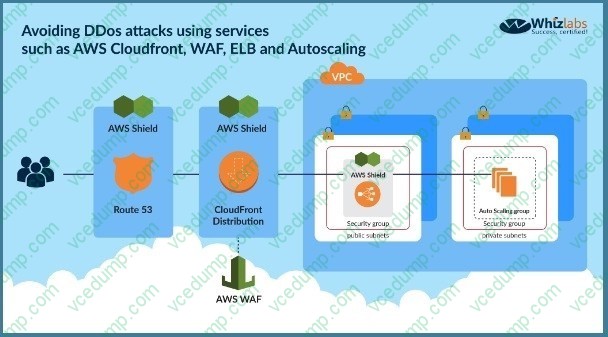
A company is deploying a new web application on AWS. Based on their other web applications, they anticipate being the target of frequent DDoS attacks. Which steps can the company use to protect their application? Select 2 answers from the options given below.
Please select:
A. Associate the EC2 instances with a security group that blocks traffic from blacklisted IP addresses.
B. Use an ELB Application Load Balancer and Auto Scaling group to scale to absorb application layer traffic.
C. Use Amazon Inspector on the EC2 instances to examine incoming traffic and discard malicious traffic.
D. Use CloudFront and AWS WAF to prevent malicious traffic from reaching the application
E. Enable GuardDuty to block malicious traffic from reaching the application -
Question 184:
A company recently adopted new compliance standards that require all user actions in AWS to be logged. The user actions must be logged for all accounts that belong to an organization in AWS Organizations. The company needs to set alarms that respond when specified actions occur. The alarms must forward alerts to an email distribution list. The alerts must occur in as close to real time as possible.
Which solution will meet these requirements?
A. Implement an AWS CloudTrail trail as an organizational trail. Configure the trail with Amazon CloudWatch Logs forwarding. In CloudWatch Logs, set a metric filter for any user action events that the company specifies. Create an Amazon CloudWatch alarm to provide alerts for occurrences within a reported period and to publish messages to an Amazon Simple Notification Service (Amazon SNS) topic.
B. Implement an AWS CloudTrail trail. Configure the trail with Amazon CloudWatch Logs forwarding. In CloudWatch Logs, set a metric filter for any user action events that the company specifies. Create an Amazon CloudWatch alarm to provide alerts for occurrences within a reported period and to send messages to an Amazon Simple Queue Service (Amazon SQS) queue.
C. Implement an AWS CloudTrail trail as an organizational trail. Configure the trail to store logs in an Amazon S3 bucket. Configure an Amazon EC2 instance to mount the S3 bucket as a file system to ingest new log files that are pushed to the S3 bucket. Configure the EC2 instance also to publish a message to an Amazon Simple Notification Service (Amazon SNS) topic when one of the specified actions is found in the logs.
D. Implement an AWS CloudTrail trail. Configure the trail to store logs in an Amazon S3 bucket. Each hour, create an AWS Glue Data Catalog that references the S3 bucket. Configure Amazon Athena to initiate queries against the Data Catalog to identify the specified actions in the logs. -
Question 185:
An application running on Amazon EC2 instances generates log files in a folder on a Linux file system. The instances block access to the console and file transfer utilities, such as Secure Copy Protocol (SCP) and Secure File Transfer Protocol (SFTP). The Application Support team wants to automatically monitor the application log files so the team can set up notifications in the future.
A Security Engineer must design a solution that meets the following requirements:
1.
Make the log files available through an AWS managed service.
2.
Allow for automatic monitoring of the logs.
3.
Provide an Interlace for analyzing logs.
4.
Minimize effort.
Which approach meets these requirements^
A. Modify the application to use the AWS SDK Write the application logs lo an Amazon S3 bucket
B. Install the unified Amazon CloudWatch agent on the instances. Configure the agent to collect the application log files on the EC2 file system and send them to Amazon CloudWatch Logs.
C. Install AWS Systems Manager Agent on the instances Configure an automation document to copy the application log files to AWS DeepLens
D. Install Amazon Kinesis Agent on the instances Stream the application log files to Amazon Kinesis Data Firehose and sot the destination to Amazon Elasticsearch Service -
Question 186:
You have setup a set of applications across 2 VPC's. You have also setup VPC Peering. The applications are still not able to communicate across the Peering connection. Which network troubleshooting steps should be taken to resolve the issue?
Please select:
A. Ensure the applications are hosted in a public subnet
B. Check to see if the VPC has an Internet gateway attached.
C. Check to see if the VPC has a NAT gateway attached.
D. Check the Route tables for the VPC's -
Question 187:
You want to get a list of vulnerabilities for an EC2 Instance as per the guidelines set by the Center of Internet Security. How can you go about doing this?
Please select:
A. Enable AWS Guard Duty for the Instance
B. Use AWS Trusted Advisor
C. Use AWS inspector
D. UseAWSMacie -
Question 188:
A company maintains sensitive data in an Amazon S3 bucket that must be protected using an AWS KMS CMK. The company requires that keys be rotated automatically every year.
How should the bucket be configured?
A. Select server-side encryption with Amazon S3-managed keys (SSE-S3) and select an AWS-managed CMK.
B. Select Amazon S3-AWS KMS managed encryption keys (S3-KMS) and select a customer-managed CMK with key rotation enabled.
C. Select server-side encryption with Amazon S3-managed keys (SSE-S3) and select a customer-managed CMK that has imported key material.
D. Select server-side encryption with AWS KMS-managed keys (SSE-KMS) and select an alias to an AWS-managed CMK. -
Question 189:
The Accounting department at Example Corp. has made a decision to hire a third-party firm, AnyCompany, to monitor Example Corp.'s AWS account to help optimize costs.
The Security Engineer for Example Corp. has been tasked with providing AnyCompany with access to the required Example Corp. AWS resources. The Engineer has created an IAM role and granted permission to AnyCompany's AWS account to assume this role.
When customers contact AnyCompany, they provide their role ARN for validation. The Engineer is concerned that one of AnyCompany's other customers might deduce Example Corp.'s role ARN and potentially compromise the company's account.
What steps should the Engineer perform to prevent this outcome?
A. Create an IAM user and generate a set of long-term credentials. Provide the credentials to AnyCompany. Monitor access in IAM access advisor and plan to rotate credentials on a recurring basis.
B. Request an external ID from AnyCompany and add a condition with sts:Externald to the role's trust policy.
C. Require two-factor authentication by adding a condition to the role's trust policy with aws:MultiFactorAuthPresent.
D. Request an IP range from AnyCompany and add a condition with aws:SourceIp to the role's trust policy. -
Question 190:
A company is developing a mobile shopping web app. The company needs an environment that is configured to encrypt all resources in transit and at rest.
A security engineer must develop a solution that will encrypt traffic in transit to the company's Application Load Balancer and Amazon API Gateway resources. The solution also must encrypt traffic at rest for Amazon S3 storage.
What should the security engineer do to meet these requirements?
A. Use AWS Certificate Manager (ACM) for encryption in transit. Use AWS Key Management Service for encryption at rest.
B. Use AWS Certificate Manager (ACM) for encryption in transit and encryption at rest.
C. Use AWS Key Management Service for encryption in transit. Use AWS Certificate Manager (ACM) for encryption at rest.
D. Use AWS Key Management Service for encryption in transit and encryption at rest.
Related Exams:
-
AIF-C01
Amazon AWS Certified AI Practitioner (AIF-C01) -
AIP-C01
AWS Certified Generative AI Developer - Professional -
ANS-C00
AWS Certified Advanced Networking - Specialty (ANS-C00) -
ANS-C01
AWS Certified Advanced Networking - Specialty (ANS-C01) -
AXS-C01
AWS Certified Alexa Skill Builder - Specialty (AXS-C01) -
BDS-C00
AWS Certified Big Data - Speciality (BDS-C00) -
CLF-C02
AWS Certified Cloud Practitioner (CLF-C02) -
DAS-C01
AWS Certified Data Analytics - Specialty (DAS-C01) -
DATA-ENGINEER-ASSOCIATE
AWS Certified Data Engineer - Associate (DEA-C01) -
DBS-C01
AWS Certified Database - Specialty (DBS-C01)
Tips on How to Prepare for the Exams
Nowadays, the certification exams become more and more important and required by more and more enterprises when applying for a job. But how to prepare for the exam effectively? How to prepare for the exam in a short time with less efforts? How to get a ideal result and how to find the most reliable resources? Here on Vcedump.com, you will find all the answers. Vcedump.com provide not only Amazon exam questions, answers and explanations but also complete assistance on your exam preparation and certification application. If you are confused on your SCS-C01 exam preparations and Amazon certification application, do not hesitate to visit our Vcedump.com to find your solutions here.