ASSOCIATE-ANDROID-DEVELOPER Exam Details
-
Exam Code
:ASSOCIATE-ANDROID-DEVELOPER -
Exam Name
:Associate Android Developer (Kotlin and Java) -
Certification
:Google Certifications -
Vendor
:Google -
Total Questions
:128 Q&As -
Last Updated
:Jul 14, 2026
Google ASSOCIATE-ANDROID-DEVELOPER Online Questions & Answers
-
Question 11:
For example, we have a BufferedReader reader, associated with the json file through InputStreamReader. To get a file data we can do this:
A. String line;try {while ((line = reader.readLine()) != null) {builder.append(line);}JSONObject json = new JSONObject(builder.toString());return json;} catch (IOException | JSONException exception) {exception.printStackTrace();}
B. JSONObject line;try {while ((line = reader.readJSONObject ()) != null) {builder.append(line);}JSONObject json = new JSONObject(builder.toString());return json;} catch (IOException | JSONException exception) {exception.printStackTrace();}
C. String line;try {while ((line = reader.readLine()) != null) {builder.append(line);}JSONObject json = new JSONObject(builder.toString());return json;} catch (RuntimeException|ArrayIndexOutOfBoundsException exception) {exception.printStackTrace();} -
Question 12:
With our Context we can get SharedPreferences with a method, named: getSharedPreferences (String name, int mode). What value can we transfer in a "mode"parameter?
A. MODE_PRIVATE or MODE_PUBLIC
B. combination of MODE_WORLD_READABLE and MODE_WORLD_WRITEABLE
C. Value is either 0 or a combination of MODE_PRIVATE, MODE_WORLD_READABLE, D. MODE_WORLD_WRITEABLE, and MODE_MULTI_PROCESS -
Question 13:
About running a debuggable build variant. Usually, you can just select the default "debug" variant that's included in every Android Studio project (even though it's not visible in the build.gradle file). But if you define new build types that should be debuggable, you must add `debuggable true' to the build type. Is that mostly true?
A. Yes.
B. No, if you define new build types that should be debuggable, you must add `debuggable false'
C. No, the debug variant should be visible in the build.gradle file anyway. -
Question 14:
Each time your test invokes onView(), Espresso waits to perform the corresponding UI action or assertion until the following synchronization conditions are met: (Choose three.)
A. The message queue is empty.
B. The message queue is not empty.
C. There are some instances of AsyncTask currently executing a task.
D. There are no instances of AsyncTask currently executing a task.
E. Some developer-defined idling resources are not idle.
F. All developer-defined idling res -
Question 15:
What do you want from Room when you create a DAO method and annotate it with @Update? Example:
@Dao
interface MyDao {
@Update
fun updateUsers(vararg users: User)}
A. Room generates an implementation that inserts all parameters into the database in a single transaction.
B. Room modifies a set of entities, given as parameters, in the database. It uses a query that matches against the primary key of each entity.
C. Room removes a set of entities, given as parameters, from the database. It uses the primary keys to find the entities to delete. -
Question 16:
Working with Custom View. To define custom attributes, we can add
A. res/layout/attrs.xmlresources to our project. It is customary to put these resources into a file:
B. res/values/attrs.xml
C. res/raw/attrs.xml
D. res/xml/attrs.xml -
Question 17:
What do you want from Room when you create a DAO method and annotate it with @Update?
Example:
@Dao
public interface MyDao {@Updatepublic void updateUsers(User... users);
}
A. Room generates an implementation that inserts all parameters into the database in a single transaction.
B. Room modifies a set of entities, given as parameters, in the database. It uses a query that matches against the primary key of each entity.
C. Room removes a set of entities, given as parameters, from the database. It uses the primary keys to find the entities to delete. -
Question 18:
The following code snippet shows an example of an Espresso test:
A. @Rulefun greeterSaysHello() {onView(withId(R.id.name_field)).do(typeText("Steve"))onView(withId(R.id.greet_button)).do(click())onView(withText("Hello Steve!")).check(matches(isDisplayed()))}
B. @Testfun greeterSaysHello() {onView(withId(R.id.name_field)).perform(typeText("Steve"))onView(withId(R.id.greet_button)).perform(click())onView(withText("Hello Steve!")).check(matches(isDisplayed()))}
C. @Testfun greeterSaysHello() {onView(withId(R.id.name_field)).do(typeText("Steve"))onView(withId(R.id.greet_button)).do(click())onView(withText("Hello Steve!")).compare(matches(isDisplayed()))} -
Question 19:
DRAG DROP
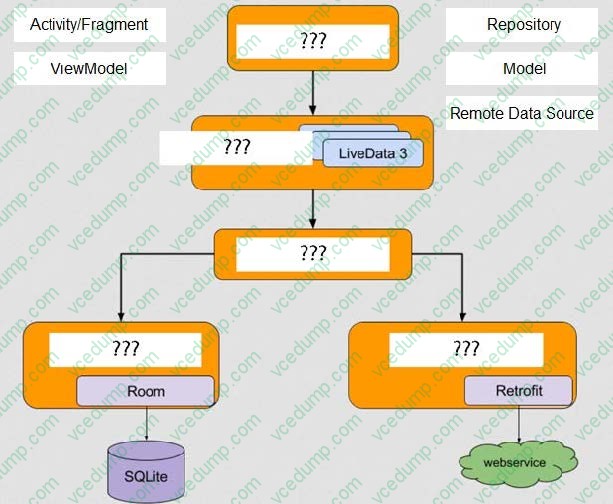
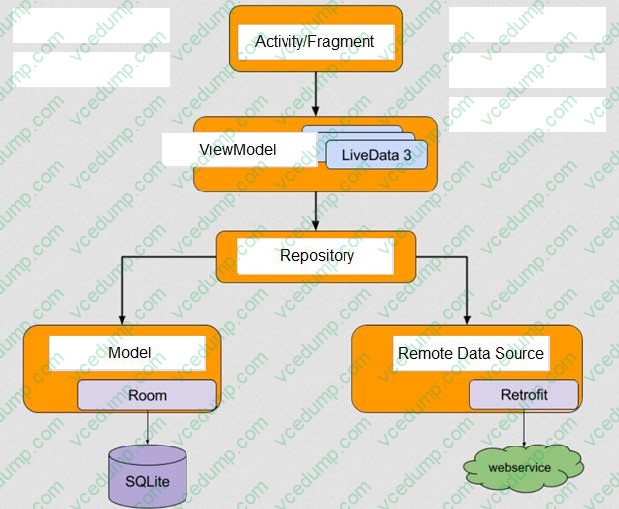
With recommended app architecture. Fill the following diagram, which shows how all the modules usually should interact with one another after designing the app (drag modules to correct places).
Select and Place:
-
Question 20:
Select four different types of app components. (Choose four.)
A. Application
B. Layouts
C. Activities
D. Services
E. AlarmManager
F. WorkManager
G. Broadcast receivers
H. Content providers
I. Fragments
Related Exams:
-
ADWORDS-DISPLAY
Google AdWords: Display Advertising -
ADWORDS-FUNDAMENTALS
Google AdWords: Fundamentals -
ADWORDS-MOBILE
Google AdWords: Mobile Advertising -
ADWORDS-REPORTING
Google AdWords: Reporting -
ADWORDS-SEARCH
Google AdWords: Search Advertising -
ADWORDS-SHOPPING
Google AdWords: Shopping Advertising -
ADWORDS-VIDEO
Google AdWords: Video Advertising -
APIGEE-API-ENGINEER
Apigee Certified API Engineer -
ASSOCIATE-ANDROID-DEVELOPER
Associate Android Developer (Kotlin and Java) -
ASSOCIATE-CLOUD-ENGINEER
Associate Cloud Engineer
Tips on How to Prepare for the Exams
Nowadays, the certification exams become more and more important and required by more and more enterprises when applying for a job. But how to prepare for the exam effectively? How to prepare for the exam in a short time with less efforts? How to get a ideal result and how to find the most reliable resources? Here on Vcedump.com, you will find all the answers. Vcedump.com provide not only Google exam questions, answers and explanations but also complete assistance on your exam preparation and certification application. If you are confused on your ASSOCIATE-ANDROID-DEVELOPER exam preparations and Google certification application, do not hesitate to visit our Vcedump.com to find your solutions here.