ASCP-MLT Exam Details
-
Exam Code
:ASCP-MLT -
Exam Name
:MEDICAL LABORATORY TECHNICIAN - MLT(ASCP) -
Certification
:ASCP Certifications -
Vendor
:ASCP -
Total Questions
:572 Q&As -
Last Updated
:Jul 14, 2026
ASCP ASCP-MLT Online Questions & Answers
-
Question 71:
FAB M5 is acute monoblastic leukemia FAB M1 is acute myeloblastic leukemia without maturation FAB M3 is acute promyelocytic leukemia FAB M4 is acute myelomonocytic leukemia Which FAB designation is called the "true" monocytic leukemia and is characterized by monoblasts, promonocytes, and monocytes?
A. FAB Ml
B. FAB M3
C. FAB M4
D. FAB M5 -
Question 72:
Each of the drugs/drug classes listed above have been known to cause drug-induced hemolytic anemia, although cephalosporins are the MOST COMMON cause. Cephalosporins can cause drug-induced hemolytic anemia when a patient produces antibodies to the particular cephalosporin drug in the presence of red blood cells. The drugs can alter the membrane appearance of the red blood cells, causing the body to mistake them as foreign. Complement becomes activated due to these antibodies; red cells are then destroyed causing hemolytic anemia. Dark urine, caused by intravascular hemolysis, is one of the most common symptoms associated with this condition.
Which one of the following drugs/drug classes is the MOST COMMON cause of drug- induced hemolytic anemia?
A. Levodopa
B. Quinidine
C. Cephalosporins
D. Levofloxacin
E. Nonsteroidal anti-inflammatory drugs (NSAIDs) -
Question 73:
The dematiaceous molds can be broadly separated into two major groups: the agents of chromomycosis that grow more slowly, maturing only after 7 days or more of incubation, and the more rapidly growing species that most commonly are clinically insignificant commensals or contaminants when recovered from clinical specimens, but in rare situations may cause opportunistic infections called phaeohyphomycosis.
Dematiaceous molds can be broadly separated into two major groups; the agents of chromomycosis and clinically insignificant commensals or contaminants. The agents of chromomycosis grow: more slowly than; more rapidly than; or generally at the same rate as the clinically insignificant commensals or contaminants?
A. more slowly than
B. more rapidly than
C. generally at the same rate as -
Question 74:
Monoclonal antibodies are monospecific antibodies that are the same because they are made by one type of immune cell which are all clones of a unique parent cell, also called a hybrid cell line, which usually arise from a hybridoma. The fusion of a specific antibody- producing lymphocyte with a myeloma cell will multiply to become a source of pure monoclonal antibody. This is often used in the manufacturing process for monoclonal antibody reagents.
Monoclonal antibodies are usually manufactured in vitro by using:
A. Cultured T cells
B. Human plasma cells
C. Hybridomas
D. Cytotoxic T cell -
Question 75:
Iron deficiency anemia, or IDA, is associated with an increased TIBC as there is less iron to bind to transferrin. Microcytic, hypochromic red cell morphology, a decreased serum iron level, a decreased serum ferritin level, and a decreased hemoglobin level are all characteristics associated with IDA.
All of the following are characteristic findings in patients with iron deficiency anemia EXCEPT:
A. microcytic, hypochromic red cell morphology
B. decreased serum iron level
C. decreased total iron-binding capacity (TIBC)
D. decreased ferritin
E. decreased hemoglobin -
Question 76:
Myoglobin rises typically within 2-4 hours after a myocardial infarction and stay elevated for days, with a peak at the 6-9-hour mark post-MI. After myoglobin, troponin is the next fastest to rise afer a mycardial infarction and can rise within 3-4
hours with a peak around 12 hours post-MI. LD (8-12 hours, 24-48 hour peak) and CK (4-6 hours with peak at 24-36 hours) will also rise after MI, but are not as fast to rise as myoglobin and troponin.
Chemistry
A patient is admitted to the hospital with acute chest pain, but which of the following cardiac markers will be elevated FIRST if the patient had an MI?
A. LD
B. CK
C. Myoglobin
D. Troponin -
Question 77:
Which of the following cardiac biomarkers rises within 30 minutes - 4 hours after chest pain, peaks in 2 - 12 hours, and is usually normal within 24 - 36 hours.
A. Cardiac troponins
B. CK-MB
C. Myoglobin -
Question 78:
Two CSF specimens were sent to the Lab with the following results:
Tube #1 = 11,200 rbc/μL
Tube #2 = 300 rbc/μL
The results on these CSF specimens are indicative of:
A. an infection
B. a recent subarachnoid hemorrhage
C. a traumatic tap
D. an old intracranial bleeding episode faulty lab equipment -
Question 79:
P. vivax characteristically displays Schuffner's dots and often enlarged RBCs along with brownish granules. P. vivax can also have 12-24 merozoies in each cell, actually filling the entire RBC. This parasite also has very irreglar shapes often referred to as "Ameboid".
P. falciparum and P. malariae do not display Shuffner's dots, therefore could not be the correct choice.
P. ovale does display Shuffner's dots in all stages, but characteristically has about 8-12 merozoites in rosettes or irregular clusters inside the RBC. Also, P. ovale characteristically shows enlarged, ovoid RBCs with fimbriated edges. Identify the parasite of a patient with suspected malaria who demonstrates the following findings on a blood smear:
-Enlarged RBCs, some with fine brownish granules
-> 15 parasites in some cells
-Ameboid structures
-
Schuffner's dots
A. Plasmodium falciparum
B. Plasmodium ovale
C. Plasmodium vivax
D. Plasmodium malariae -
Question 80:
Assuming an alpha hemolytic reaction (not well seen in the image), viridans streptococcus and S. pneumoniae are the two possible responses. However, these colonies are far too mucoid for viridans streptococci; therefore, S. pneumoniae is
the most likely choice. Also, the colonies are much too large and the hemolytic reaction is wrong for S. pyogenes or S.
agalactiae.
A patient was admitted to the hospital recently with an obvious infection. A sputum specimen was submitted and the microbiologist inoculated it to sheep blood agar. Based on the colony morphology and the alpha hemolysis seen in the image to the right, the most likely identification is:
A. Streptococcus pneumoniae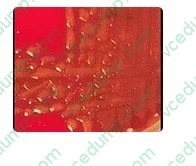
B. viridans streptococcus
C. Streptococcus pyogenes
D. Streptococcus agalactiae
Related Exams:
Tips on How to Prepare for the Exams
Nowadays, the certification exams become more and more important and required by more and more enterprises when applying for a job. But how to prepare for the exam effectively? How to prepare for the exam in a short time with less efforts? How to get a ideal result and how to find the most reliable resources? Here on Vcedump.com, you will find all the answers. Vcedump.com provide not only ASCP exam questions, answers and explanations but also complete assistance on your exam preparation and certification application. If you are confused on your ASCP-MLT exam preparations and ASCP certification application, do not hesitate to visit our Vcedump.com to find your solutions here.