ASCP-MLT Exam Details
-
Exam Code
:ASCP-MLT -
Exam Name
:MEDICAL LABORATORY TECHNICIAN - MLT(ASCP) -
Certification
:ASCP Certifications -
Vendor
:ASCP -
Total Questions
:572 Q&As -
Last Updated
:Jul 14, 2026
ASCP ASCP-MLT Online Questions & Answers
-
Question 421:
The personal protective equipment (PPE) that is used in the laboratory to protect the personnel when performing tests on patient blood samples is which of the following:
A. Gloves
B. Coat or gown
C. Goggles and mask
D. A and B only -
Question 422:
The structures involved in the production of semen include the prostate, the seminal vesicles, and the bulbourethral gland, along with the testes and epididymis.
Semen is produced as a combination of secretions from the different regions of the male reproductive tract. Each fraction differs in chemical composition and function.
Spermatozoa are produced in the testes. They mature in the epididymis. The testes also produce testosterone and inhibin.
Fluid from the seminal vesicles accounts for approximately 70% of semen volume. The seminal vesicles are the source of fructose in semen. Fructose is used by the spermatozoa as an energy source.
The prostate gland supplies about 20% of the volume of semen. Its fluids include acid phosphatase and proteolytic enzymes that lead to coagulation and subsequent liquefaction of semen. The prostate also contains most of the IgA found in
semen.
The bulbourethral gland produces mucoproteins that make up about 5% of the volume of semen.
The pituitary gland is not directly involved in the production of semen; instead hormones are released which stimulate the production of sperm. The urethra is not involved in the production of semen.
Which of the following are directly involved in the production of semen?
A. Prostate
B. Pituitary gland
C. Seminal vesicles
D. Bulbourethral gland
E. Urethra -
Question 423:
Standard precautions should be followed:
A. when a patient is known to have hepatitis B
B. when a patient is known to be HIV positive
C. with all patients, at all times
D. if a patient is in isolation -
Question 424:
Amniotic fluid bilirubin is increased in association with the severity of hemolytic diseases of the newborn. As red blood cells lyse during these conditions, bilirubin builds up as a byproduct of the red cell destruction. The more red blood cells that are being destroyed in the baby, the more increased the bilirubin level will become.
Which one of the following tests BEST correlates with the severity of hemolytic disease of the newborn (HDN).
A. Rh antibody titer of baby's blood
B. L/S ratio
C. amniotic fluid bilirubin
D. antibody titer of mother's blood -
Question 425:
In healthy individuals, procalcitonin is only synthesized by the thyroid C cells. In bacterial infections, PCT is synthesized in various extrathyroidal neuroendocrine tissues.
In healthy individuals, procalcitonin is synthesized by which cells in the body?
A. Hepatocytes
B. Leukocytes
C. Thyroid C cells
D. Red blood cells -
Question 426:
An automated method for measuring chloride which generates silver ions in the reaction is called:
A. Coulometry
B. Potentiometry
C. Chromatography
D. Polarography
E. Densitometry -
Question 427:
The laboratory employee with an 2-year associate degree who performs clinical testing is the: A. clinical laboratory scientist.
B. medical laboratory technician.
C. phlebotomist.
D. medical technologist. -
Question 428:
A negative glucose oxidase test and a positive test for reducing sugars in urine indicates the presence of a non-glucose reducing sugar such as galactose, fructose, glyceraldehyde, etc. This is the reason that certain patient populations require additional confirmatory sugar testing on their urine samples.
A negative glucose oxidase test and a positive test for reducing sugars in urine indicates:
A. True glycosuria
B. A false-negative glucose oxidation reaction
C. The presence of a non-glucose reducing sugar such as galactose -
Question 429:
Allergic reactions, bacterial/viral meningitis do not cause the presence of blasts to be noted in the CSF. Leukemia with CNS involvement will show immature cells, similarly to the peripheral blood smear.
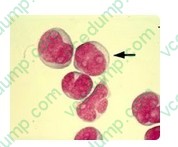
The image is a stained smear of cerebrospinal fluid. The cells present in this field may indicate what condition?
A. allergic reaction
B. bacterial meningitis
C. leukemia with CNS involvement
D. viral meningitis -
Question 430:
The A and B antigens are present on the red cells of an AB patient. H antigen is a precursor to the ABO antigens. An individual with type AB blood will demonstrate the complete absence of which of the following antigen sites?
A. A
B. B
C. H
D. None of the above
Related Exams:
Tips on How to Prepare for the Exams
Nowadays, the certification exams become more and more important and required by more and more enterprises when applying for a job. But how to prepare for the exam effectively? How to prepare for the exam in a short time with less efforts? How to get a ideal result and how to find the most reliable resources? Here on Vcedump.com, you will find all the answers. Vcedump.com provide not only ASCP exam questions, answers and explanations but also complete assistance on your exam preparation and certification application. If you are confused on your ASCP-MLT exam preparations and ASCP certification application, do not hesitate to visit our Vcedump.com to find your solutions here.