ASCP-MLT Exam Details
-
Exam Code
:ASCP-MLT -
Exam Name
:MEDICAL LABORATORY TECHNICIAN - MLT(ASCP) -
Certification
:ASCP Certifications -
Vendor
:ASCP -
Total Questions
:572 Q&As -
Last Updated
:Jul 14, 2026
ASCP ASCP-MLT Online Questions & Answers
-
Question 361:
In DIC, or disseminated intravascular coagulation, the prothrombin time is increased due to the consumption of the coagulation factors due to the tiny clots forming throughout the vasculature. This is also the reason that the fibrinogen levels and platelet levels are decreased. Finally FDP, or fibrin degredation products, are increased due to the formation and subsequent dissolving of many tiny clots in the vasculature. The FDPs are the pieces of fibrin that are left after the fibrinolytic processes take place.
Which of the following laboratory results would be seen in a patient with acute Disseminated Intravascular Coagulation (DIC)?
A. prolonged PT, elevated platelet count, decreased FDP
B. normal PT, decreased fibrinogen, decreased platelet count, decreased FDP
C. prolonged PT, decreased fibrinogen, decreased platelet count, increased FDP
D. normal PT, decreased platelet count, decreased FDP -
Question 362:
The cells are plasma cells. They are larger than normal small lymphocytes with more abundant cytoplasm. The cytoplasm is more basophilic than the cytoplasm of a normal lymphocyte and a well-defined perinuclear halo (clearing in the golgi
area) is noticeable. The nucleus is eccentrically placed. Plasma cells are counted in a separate category on a bone marrow differential.
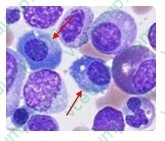
Hematogones are blast-like cells that are more mature than lymphoblasts. They are usually tallied with lymphocytes when performing a bone marrow differential. What are the cells that are indicated by the red arrows in the image on the right?
A. Normal lymphocytes
B. Hematogones
C. Plasma cells -
Question 363:
This scenario's answer can be calculated by first deciding what the total quality control labor costs are as well as what the total consumable costs are. In this case, if quality control is run 3 times per day, a total of 1095 quality control runs are performed each year. The direct labor cost of $2.63 multiplied by 1095 quality control runs equals $2879.85 per year in quality control direct labor. The hospital pays $354.00 per month on quality control consumables, which equals $4248.00 per year. The total quality control costs in a year are equal to $2879.85 + $4248.00 = $7127.85. If 76,000 new chemistry tests panels are peformed each year, the total quality control cost per new chemistry test panel will be $0.09. General Hospital is considering the addition of a new chemistry panel containing 12 tests. The laboratory is asked to calculate the total cost of quality control per new chemistry test panel. Quality control must be performed 3 times per day (every 8 hours). The labor cost per quality control test for this panel is $2.63. A month's worth of quality control reagent costs $354.00. What is the total quality control cost per new chemistry test panel if 76,000 of these new panels are performed each year?
A. $0.01
B. $0.09
C. $0.04
D. $1.70 -
Question 364:
The activities conducted in a laboratory with a certificate of registration include:
A. urinalysis only
B. moderate- or high-complexity lab testing until the lab is determined by survey to be in compliance
C. physicians to perform microscopy only
D. waived tests only -
Question 365:
IgE levels are often increased in patients with allergic disease. IgE binds to the membranes of mast cells and basophils, and if specific antigen is present to react with the IgE molecule, degranulation of these cells occurs, releasing histamines, and other substances into the blood or tissues.
Which of the following immunoglobulin classes is chiefly responsible for the degranulation of mast cells and basophils:
A. IgG
B. IgA
C. IgM
D. IgE -
Question 366:
Diagnosis of malaria may require thick smears as well as conventional thin blood smears.
A definitive diagnosis of malaria can be made by:
A. Serological testing
B. Culture techniques
C. Demonstration of the organisms in peripheral blood
D. Biochemical reactions -
Question 367:
Glucose positive, Maltose positive, Lactose negative and Sucrose negative is the correct answer since Neisseria meningitides causes Waterhouse-Friderichsen syndrome and it is positive only for glucose and maltose.
An autopsy of a 1-year-old female admitted to the emergency room 4 hours prior to her death revealed Waterhouse-Friderichsen syndrome. Blood and nasopharyngeal cultures taken prior to her death should reveal an oxidase-positive, Gram-negative diplococcus with the following biochemical reactions:
A. Glucose positive, Maltose positive, ONPG positive and DNase negative
B. Glucose positive, Maltose positive, Sucrose positive and Lactose negative
C. Glucose positive, Maltose positive, Lactose negative and Sucrose negative
D. Glucose positive, Maltose negative, Lactose negative and Sucrose negative -
Question 368:
Antidiuretic hormone, or ADH, has the important role of conserving body water by reducing the loss of water in urine by changing the water permeability of the distal tubule and collecting duct. An increase in ADH causes a concentrated urine since the water is retained and absorbed through the permeable membrane. An decrease in ADH causes the collecting ducts to retain very little water, instead it is excreted as urine.
Chemistry
Which of the following action describes the MAJOR property of antidiuretic hormone?
A. acts on proximal tubules.
B. changes distal tubule water permeability
C. Acts on Na/K/(H') pump
D. cannot be affected by diuretics
E. controls thirst -
Question 369:
The difference between plasma and serum is that:
A. serum is the cells of unclotted blood.
B. serum is obtained from a nonclotted specimen
C. plasma is from an unclotted specimen.
D. plasma is obtained from a clotted specimen. -
Question 370:
To obtain a serum sample for a stat test on a patient receiving anticoagulant therapy, the recommended tube is: Question options:
A. yellow/gray or orange
B. red
C. light green
D. red/gray or gold
Related Exams:
Tips on How to Prepare for the Exams
Nowadays, the certification exams become more and more important and required by more and more enterprises when applying for a job. But how to prepare for the exam effectively? How to prepare for the exam in a short time with less efforts? How to get a ideal result and how to find the most reliable resources? Here on Vcedump.com, you will find all the answers. Vcedump.com provide not only ASCP exam questions, answers and explanations but also complete assistance on your exam preparation and certification application. If you are confused on your ASCP-MLT exam preparations and ASCP certification application, do not hesitate to visit our Vcedump.com to find your solutions here.