AIF-C01 Exam Details
-
Exam Code
:AIF-C01 -
Exam Name
:Amazon AWS Certified AI Practitioner (AIF-C01) -
Certification
:Amazon Certifications -
Vendor
:Amazon -
Total Questions
:481 Q&As -
Last Updated
:Jul 09, 2026
Amazon AIF-C01 Online Questions & Answers
-
Question 71:
A company has developed an ML model for image classification. The company wants to deploy the model to production so that a web application can use the model.
The company needs to implement a solution to host the model and serve predictions without managing any of the underlying infrastructure.
Which solution will meet these requirements?
A. Use Amazon SageMaker Serverless Inference to deploy the model.
B. Use Amazon CloudFront to deploy the model.
C. Use Amazon API Gateway to host the model and serve predictions.
D. Use AWS Batch to host the model and serve predictions. -
Question 72:
A company has developed an ML model to approve or reject loan applications. The model's decision- making process must be transparent and explainable to comply with regulatory requirements. The company must document the decision-making process for audit purposes. Which solution will meet these requirements?
A. Amazon Textract
B. Amazon SageMaker Model Card
C. AWS Cloud Formation
D. Amazon Comprehend -
Question 73:
A company is building a mobile app for users who have a visual impairment. The app must be able to hear what users say and provide voice responses. Which solution will meet these requirements?
A. Use a deep learning neural network to perform speech recognition.
B. Build ML models to search for patterns in numeric data.
C. Use generative AI summarization to generate human-like text.
D. Build custom models for image classification and recognition. -
Question 74:
A company is developing a product recommendation application by using a generative AI model. The company must minimize the application's environmental impact.
Which solution will meet these requirements?
A. Optimize the deployed model architecture to prioritize computational efficiency during model inference.
B. Adopt a distributed inference approach by using multiple smaller models across multiple Availability Zones.
C. Adopt a hybrid strategy by deploying the model on premises and storing the data on AWS.
D. Deploy multiple models and use a dynamic model selection mechanism that queries different models randomly. -
Question 75:
A company is building a chatbot to improve user experience. The company is using a large language model (LLM) from Amazon Bedrock for intent detection. The company wants to use few-shot learning to improve intent detection accuracy.
Which additional data does the company need to meet these requirements?
A. Pairs of chatbot responses and correct user intents
B. Pairs of user messages and correct chatbot responses
C. Pairs of user messages and correct user intents
D. Pairs of user intents and correct chatbot responses -
Question 76:
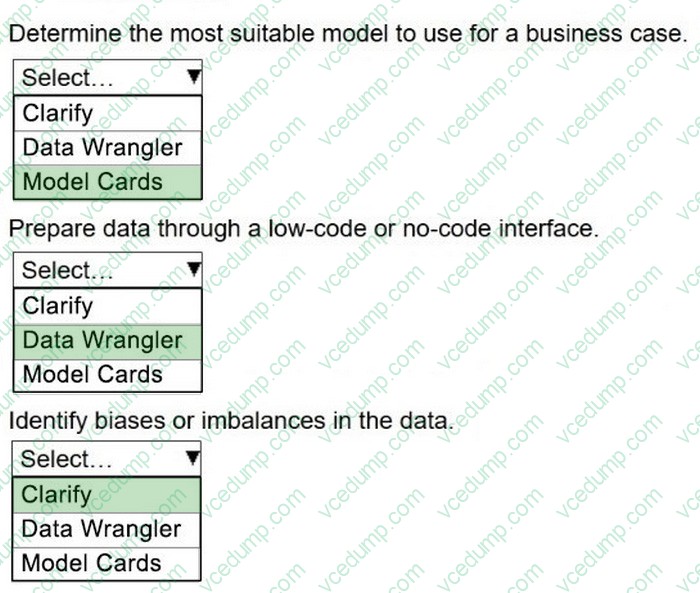
HOTSPOT
A company is building an AI solution by using Amazon SageMaker AI. The company wants to use SageMaker AI features to facilitate application development.
Select the correct SageMaker AI feature from the following list for each use case. Select each feature one time.

-
Question 77:
A company deploys a foundation model (FM). The company notices that the FM is producing answers to user-submitted questions about politics. The company wants to ensure that the model does not send answers to political questions to users.
Which AWS solution will meet this requirement?
A. Amazon Bedrock Guardrails
B. Amazon Bedrock Agents
C. Amazon SageMaker Clarify
D. Amazon SageMaker Model Monitor -
Question 78:
A company's employees provide product descriptions and recommendations to customers when customers call the customer service center. These recommendations are based on where the customers are located. The company wants to use foundation models (FMs) to automate this process. Which AWS service meets these requirements?
A. Amazon Macie
B. Amazon Transcribe
C. Amazon Bedrock
D. Amazon Textract -
Question 79:
A financial company uses an ML model to detect potentially fraudulent transactions. The company needs to ensure that some types of predictions receive review by human analysts before the company acts upon the predictions.
Which AWS solution will meet this requirement?
A. Amazon SageMaker Clarify
B. Amazon SageMaker Ground Truth
C. Amazon Augmented AI (Amazon A2I)
D. Amazon SageMaker Model Monitor -
Question 80:
A company notices that its foundation model (FM) generates images that are unrelated to the prompts. The company wants to modify the prompt techniques to decrease unrelated images. Which solution meets these requirements?
A. Use zero-shot prompts.
B. Use negative prompts.
C. Use positive prompts.
D. Use ambiguous prompts.
Related Exams:
-
AIF-C01
Amazon AWS Certified AI Practitioner (AIF-C01) -
AIP-C01
AWS Certified Generative AI Developer - Professional -
ANS-C00
AWS Certified Advanced Networking - Specialty (ANS-C00) -
ANS-C01
AWS Certified Advanced Networking - Specialty (ANS-C01) -
AXS-C01
AWS Certified Alexa Skill Builder - Specialty (AXS-C01) -
BDS-C00
AWS Certified Big Data - Speciality (BDS-C00) -
CLF-C02
AWS Certified Cloud Practitioner (CLF-C02) -
DAS-C01
AWS Certified Data Analytics - Specialty (DAS-C01) -
DATA-ENGINEER-ASSOCIATE
AWS Certified Data Engineer - Associate (DEA-C01) -
DBS-C01
AWS Certified Database - Specialty (DBS-C01)
Tips on How to Prepare for the Exams
Nowadays, the certification exams become more and more important and required by more and more enterprises when applying for a job. But how to prepare for the exam effectively? How to prepare for the exam in a short time with less efforts? How to get a ideal result and how to find the most reliable resources? Here on Vcedump.com, you will find all the answers. Vcedump.com provide not only Amazon exam questions, answers and explanations but also complete assistance on your exam preparation and certification application. If you are confused on your AIF-C01 exam preparations and Amazon certification application, do not hesitate to visit our Vcedump.com to find your solutions here.