AD0-E134 Exam Details
-
Exam Code
:AD0-E134 -
Exam Name
:Adobe Experience Manager Developer Exam -
Certification
:Adobe Certifications -
Vendor
:Adobe -
Total Questions
:72 Q&As -
Last Updated
:Jul 12, 2026
Adobe AD0-E134 Online Questions & Answers
-
Question 61:
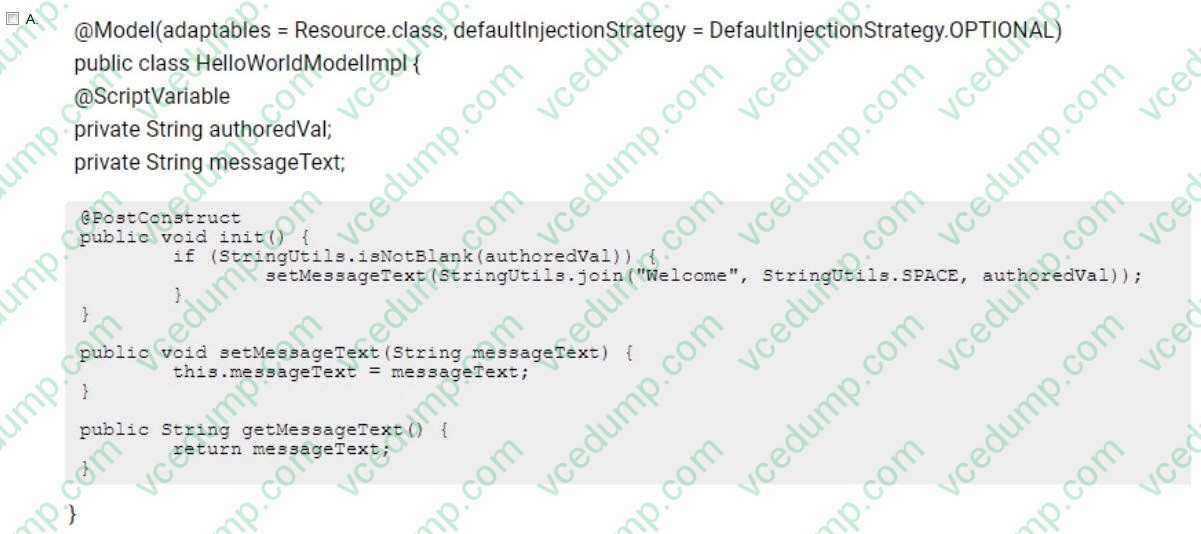
A custom component has one dialog field:

The developer needs to implement a Sling Model to perform a business logic on the authored value. The developer writes the following HTL snippet.

Which two implementations will support this HTL snippet? (Choose two.)
A. Option A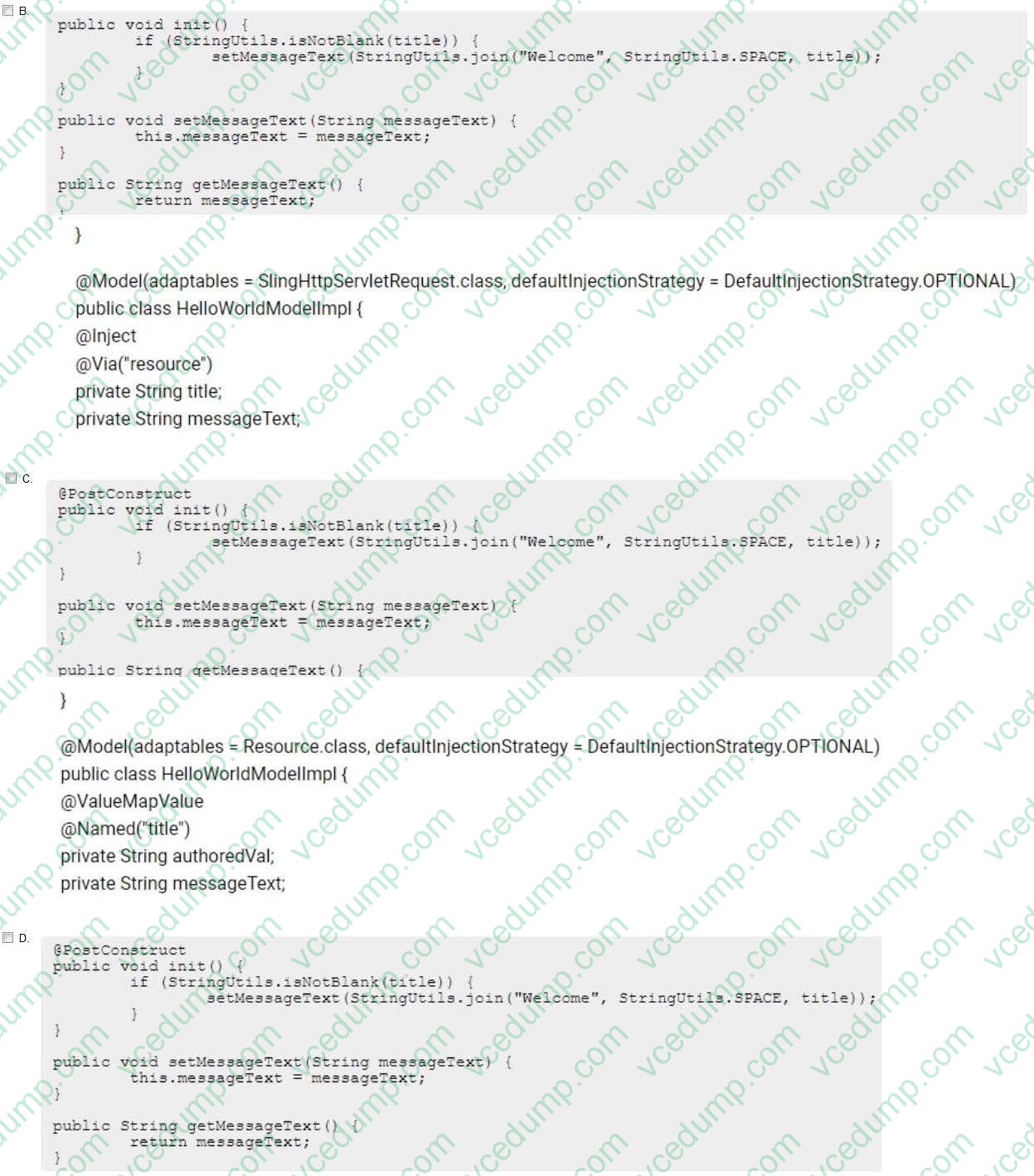
B. Option B
C. Option C
D. Option D -
Question 62:
Which AEM dependency provides APIs for all AEM environments?
A. Option A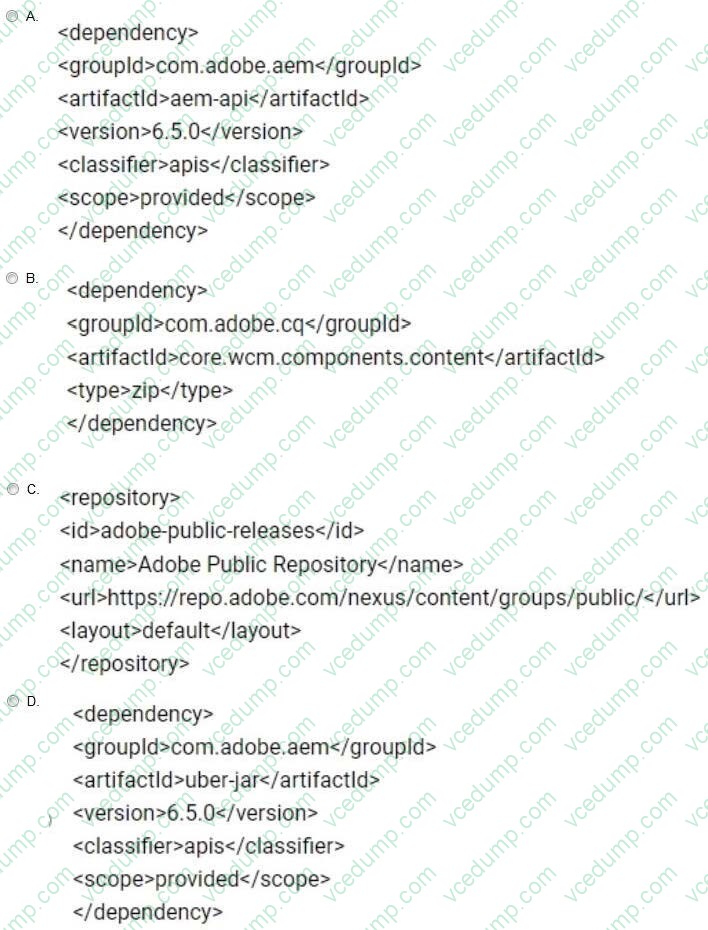
B. Option B
C. Option C
D. Option D -
Question 63:
A project requires sharing information between SPA components. What is the least complex approach to achieve that objective?
A. Utilize model props to drill down and access or set the state on desired components.
B. Customize and extend the container component to leverage the object hierarchy.
C. Implement a state library in order to share component states.
D. Centralize the logic and broadcast to the necessary components. -
Question 64:
A snippet throws an exception at runtime:
@Model(adaptables = {Resource.class}) public class MyCustomModel {
(SSIingObject
private Resource resource;
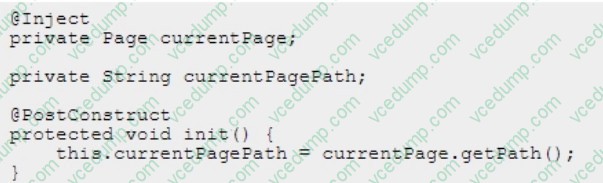
What should the developer add to fix it?
A. defaultlnjectionStrategy = DefaultlnjectionStrategy property to @Model Class annotation
B. (ptional annotation to page field
C. throws Exception at the end of the init method declaration
D. SlingHttpServletRequest.class to adaptables property of odel Class annotation -
Question 65:
A developer needs to create a new Title component. The requirements are:
1.
The layout must be the same as the Title core component
2.
The text property must have the page title as prefix (e.g., Page Title -
) 3.
The component must be reusable
Which approach is recommended?
A. 1. Create a Proxy Component of Title core component 2. Create a Custom Sling Model that overrides the default behavior 3. Customize the component template
B. 1. Create a custom component from scratch 2. Create a Custom Sling Model for the component that follows the requirement 3. Create a Model Exporter
C. 1. Create a Proxy Component from Title core component 2. Create a Custom Sling Model that overrides the default behavior -
Question 66:
Which configuration must be applied to enable re-fetching of cached items based on Cache Headers sent by AEM?
A. /autolnvalidate true
B. /autolnvalidate "1"
C. /enableTTLtrue
D. /enableTTL "1" -
Question 67:
An AEM application has a Header and Footer authored on every page.
The customer asks for the following:
1.
A centralized Header and Footer
2.
The ability to create a variation for both the Header and Footer
3.
Change the Header and Footer for specific time periods
4.
The ability to restore a previous version for both the Header and Footer
What should the developer use to meet the requirements?
A. Custom component
B. Content fragment
C. Static template
D. Experience fragment -
Question 68:
A developer is using sling context-aware configuration trying to get the configuration resource using:
@Reference
private ConfigurationResourceResolver cfgResourceResolver;
cfgResource = cfgResourceResolver.getResource(resource, BUCKET_NAME, CONFIG_NAME);
This works as intended in author and in publish when logged in to publish as admin. However, this gives a null when run as anonymous.
Which method is going to fix the issue?
A. Applying read permissions to anonymous user for /content directory
B. Applying write permissions to anonymous user for/conf directory.
C. Applying read permissions to anonymous user for /etc directory.
D. Applying read permissions to anonymous user for /cont directory -
Question 69:
In a non-optimized website, the final HTML generated for a typical page by publish instance includes a relatively large number of