AD0-E117 Exam Details
-
Exam Code
:AD0-E117 -
Exam Name
:Adobe Experience Manager Architect Master -
Certification
:Adobe Certifications -
Vendor
:Adobe -
Total Questions
:50 Q&As -
Last Updated
:Jul 08, 2026
Adobe AD0-E117 Online Questions & Answers
-
Question 1:
A customer has an international presence and a strong brand image. The customer considers the exceptional quality images used for both print and on the website to be essential for its business, The customer uses AEM 6.5 managed services with a configuration of 2 dispatchers, 2 publishers, and 1 author.
The original images can weigh up to 500Mb with videos weighing even more. Renditions are generated after files are uploaded to AEM DAM by the Design team so the Authoring team can use them on the website.
The teams report issues with platform stability and slowness. Visitors report that images look pixelated on some screens and pages are very slow to load.
Which two actions should the Architect take to resolve these issues? (Choose two.)
A. Train the design team to upload smaller assets and save the originals elsewhere
B. Allocate more memory to ImageMagick and FFmpeg
C. Optimize renditions for the different viewports used by the visitors
D. Split AEM Assets and Sites in two different stacks and use Connected Assets
E. Add more dispatchers and publishers to the AEM configuration -
Question 2:
A customer's photo gallery site uses query parameters to filter photo search results. The site experiences high AEM Publish server load when users filter photos on the site. The customer would like to identify the cause of this issue.
What should the Architect investigate first?
A. ignoreUrlParams configuration in dispatcher.any
B. Dispatcher load balancing configuration
C. Cache-Control Headers in dispatcher.any
D. Volume of assets being loaded at a time -
Question 3:
A large AEM enterprise site is implementing authentication and requires a true optimal load balancing across the site's multi AEM publish instances. Which approach should an Architect take to meet this requirement?
A. Configure Sticky Connections
B. Configure the Dispatcher to run with a Dedicated System Usei
C. Enable Encapsulated Token Option
D. Enable Round Robin processing in Dispatcher configuration -
Question 4:
A client designs a new experience for one of their brand sites with the following parameters:
1.
The new experience should behave like a desktop application ?There is a lot of dynamic content in the app
2.
SEO and initial page load are a top concern for the client
3.
The client's marketing team needs to be able to author the content with a WYSIWYG editor Which approach should the Architect use to meet these requirements?
A. Use AEM as a headless CMS
B. Use the traditional server side components on the website
C. Use the SPA Editor SDK with Server Side Rendering
D. Create a set of API-driven components -
Question 5:
A large retail customer is building their ecommerce platform on AEM. Several third-party vendors sell products through their site. Those vendors need to review and verify the content close to production before the content goes live and the customer wants to provide them a restricted environment.
Which approach should the Architect recommend?
A. Give third-party vendors access to the Author Server
B. Use the Preview Capabilities of AEM Author Server
C. Export content as PDF and share with the vendors
D. Add a Publish (preview) Server and provide access -
Question 6:
An AEM Sites implementation is migrating from on-premise to AEM as a Cloud Service. Previously, the application was deployed in a single package for both code and access policy nodes. After initial deployment and testing in the new infrastructure, it is reported that user permissions are not working as expected.
What change should the Architect make to address this issue?
A. Update package metadata to use MergePreserve for handling access policy nodes
B. Move access policy nodes to a dedicated package and install manually
C. Refactor access policy nodes to Apache Sling JCR Repoinit scripts in the same package
D. Document permissions and request the Customer Success Engineer to configure -
Question 7:
A customer has a requirement to allow authors to access AEM with single sign-on. To achieve this an Architect needs to integrate AEM with the customer's identity management system.
Which two actions could an Architect take to meet this requirement? (Choose two.)
A. Implement the generic SSO Authentication Handler interface
B. Configure the Sling Authentication Requirements for the OSGi HTTP Service
C. Configure the SAML Authentication Handler
D. Configure the generic SSO Authentication Handler
E. Implement a custom JAAS Login Module -
Question 8:
Refer to the exhibit.
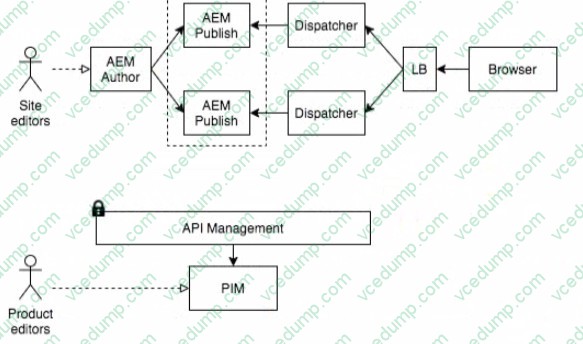
A customer with an existing AEM implementation wants to enrich product pages with technical data coming from their PIM system. The PIM system sits behind an API Management solution that publicly exposes the PIM API's as RESTful web services with basic authentication as the security mechanism. Data consistency with the PIM and secure access to the APIs are key elements of the integration.
How should the Architect set up the integration between AEM and the PIM?
A. Integrate the AEM Publishers directly with the API Management solution
B. Use a client-side integration with AJAX from the browser to the API Management
C. Import the technical data into the AEM Author and replicate to Publishers
D. Convert the technical data to Content Fragments and expose using Content Services -
Question 9:
An AEM Architect is moving existing content from an on-premise AEM to an AEM Cloud Service instance using the Content Transfer Tool. As part of the initial source preparation, the Architect is going to run the offline compaction on the onpremise AEM.
What other two actions should the Architect do to the on-premise AEM before proceeding with the extraction phase? (Choose two.)
A. Validate that all replication agents are disabled
B. Verify that wipe mode is enabled
C. Stop all bundles using the AEM Web Console
D. Verify that free disk space is at least 1.5x the JCR size
E. Run datastore consistency check via oak-run -
Question 10:
A retail customer with an international presence and both in-store and online sales needs a new assets platform. The customer decides to use Aassets. The customer's sites will continue to run on their proprietary CMS for websites. The customer wants to be able to scale the platform for spikes in user traffic such as on local sales or online marketing campaigns. Under some circumstances, the customer also has a higher load of editors for a certain period of time. Which architecture should an Architect use for this business case?
A. An AEM Publish instance on Adobe Managed Services with auto scaling
B. An AEM as a Cloud Service Sites with Dynamic Media
C. An AEM Assets setup on Adobe Managed Services with Cloud Manager
D. An AEM as a Cloud Service Assets setup using the combined CDN for delivery
Related Exams:
-
9A0-019
Adobe Photoshop 6.0 Product Proficiency -
9A0-042
Acrobat 7.0 Prowith Adobe LiveCycle Designer ACE Exam -
9A0-043
Adobe Illustrator CS 2 ACE -
9A0-044
Adobe Photoshop CS 2 ACE Exam -
9A0-045
Adobe InDesign CS 2 ACE Exam -
9A0-046
Adobe GoLive CS2 ACE Exam -
9A0-055
Adobe InDesign CS3 ACE Exam -
9A0-056
Adobe Dreamweaver CS3 ACE Exam -
9A0-057
Adobe Illustrator CS3 ACE Exam -
9A0-058
Adobe Flash CS3 ACE Exam
Tips on How to Prepare for the Exams
Nowadays, the certification exams become more and more important and required by more and more enterprises when applying for a job. But how to prepare for the exam effectively? How to prepare for the exam in a short time with less efforts? How to get a ideal result and how to find the most reliable resources? Here on Vcedump.com, you will find all the answers. Vcedump.com provide not only Adobe exam questions, answers and explanations but also complete assistance on your exam preparation and certification application. If you are confused on your AD0-E117 exam preparations and Adobe certification application, do not hesitate to visit our Vcedump.com to find your solutions here.