AD0-E103 Exam Details
-
Exam Code
:AD0-E103 -
Exam Name
:Adobe Experience Manager Developer -
Certification
:Adobe Certifications -
Vendor
:Adobe -
Total Questions
:92 Q&As -
Last Updated
:Jul 08, 2026
Adobe AD0-E103 Online Questions & Answers
-
Question 61:
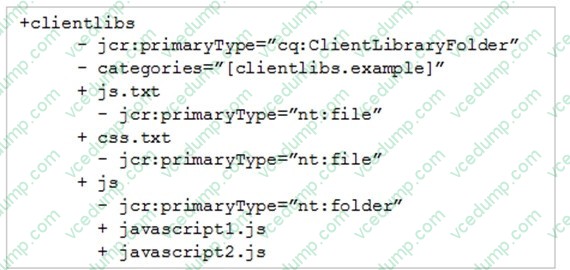
Refer to the following Client Library node structure.
The js.txt looks like
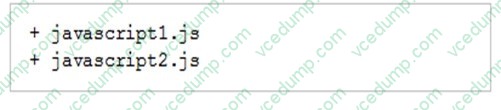
The JavaScript is NOT present in the Client Library when it is loaded. What should a developer do to resolve this issue?
A. Add #base=js as the first line in the js.txt file.
B. Change the js folder to a Client Library node and add the property categories="[clientlibs.example]".
C. Split the js and css into 2 Client Libraries since they can't be in the same Client Library.
D. Change the js folder to a Client Library node and embed it on the clientlibs node. -
Question 62:
What is the artifact ID of the maven dependency that contains all core AEM APIs?
A. core-jar
B. api-jar
C. aem-jar
D. uber-jar -
Question 63:
A developer running a local AEM instance and working on an AEM project needs to change a large number of files locally in the filesystem. The developer needs to get the changes uploaded to the local AEM instance to verify changes almost immediately in the browser?
What action should the developer take to most efficiency meet these requirements?
A. Access CRXDE and upload the files through the interface.
B. Make the changes in CRXDE create a content package, download it, and expand it into the working directory after each change.
C. Install FileVault bundle in the AEM instance and register the local working directory for synchronization.
D. Build a Content Package using maven and deploy it after each change. -
Question 64:
A developer needs to implement a service component that should be manually configured by operations to react on operational circumstances. The service component should NOT be active by default. The service has the properties
myservice.name (one string value) and myservice.stringValues (a list of the string values) to be configured.
The developer needs to use OSGi Metatype annotations to make those properties configurable in the Apache Felix Web Console.
Which set of steps should the developer take to meet these requirements?
A. 1. For the class fields myserviceName and myserviceStringValues, add a @AttributeDefinition annotation each with names set to myservice.name and myservice.stringValues respectively. 2. Use the @Component annotation with configurationFactory = true on the service component class. 3. Use the @Service service component class. 4. Use the activate method of the service component class to get the configuration annotation interface class injected.
B. 1. Create an annotation interface as inner class of the service component and annotate it with @ObjectClassDefinition. 2. Apply @AttributeDefinition for the methods myservice.name and myservice.stringValues. 3. Use the @Component annotation with configurationPolicy = ConfigurationPolicy.REQUIRE on the service component. 4. Use the @Designate annotation to link the service component to the created configuration annotation interface. 5. Use the activate method of the service component class to get the configuration annotation interface class injected.
C. 1. Create an annotation interface as inner class of the service component and annotate it with @ObjectClassDefinition. 2. Apply @AttributeDefinition for the methods myservice_name and myservice_stringValues. 3. Use the @Component annotation with configurationPolicy = ConfigurationPolicy.REQUIRE on the service component. 4. Use the @Designate annotation to link the service component to the created configuration annotation interface. 5. Use the activate method of the service component class to get the configuration annotation interface class injected.
D. 1. For the class fields myserviceName and myserviceStringValues, add a @Property annotation each with names set to myservice.name and myservice.stringValues respectively. 2. Use the @Component annotation with configurationFactory = true on the service component class. 3. Use the @Service service component class. 4. The configuration is automatically injected into the field by the service component runtime. -
Question 65:
An application contains an OSGi configuration that contains a password.
How should a developer prevent this sensitive information from being stored in plain text in JCR?
A. 1. Use console at /system/console/crypto to encrypt the value. 2. Either create an encrypted value for each AEM instance and use runmodes to apply the different values or make sure relevant instances share the same master key. 3. When loading the value in the code, call CryptoSupport.unprotect(...) before using the value.
B. 1. Use console at /system/console/configMgr and tick the checkbox "encrypt" before saving a configuration. 2. Use encrypted values work across all instances. 3. When loading the value in the code, call CryptoSupport.unprotect(...) before using the value.
C. 1. Use console at /system/console/ configMgr and tick the checkbox "encrypt" before saving a configuration. 2. Either create an encrypted value for each AEM instance and use runmodes to apply the different values or make sure relevant instances share the same master key. 3. Sensitive information is automatically decrypted using the CryptoSupport OSGi service before the value is returned.
D. 1. Use console at /system/console/crypto to encrypt the value. 2. Either create an encrypted value for each AEM instance and use runmodes to apply the different values or make sure relevant instances share the same master key. 3. Sensitive information is automatically decrypted using the CryptoSupport OSGi service before the value is returned. -
Question 66:
A developer needs to change the label "Sites" in the navigation of AEM author to "Websites". Which action should the developer take to achieve this?
A. Modify the node /libs/cq/core/content/nav/sites by updating the icr:title property value.
B. Change the code of /libs/granite/ui/components/shell/clientlibs/shell/js/globalnav.js to display the new value.
C. Create a new node /apps/cq/core/content/nav/sites and update the property icr:title.
D. Modify the code of /libs/granite/ui/components/shell/globalnav/overlay/overlay.jsp to display the new value. -
Question 67:
A developer needs an existing workflow to run only when pages are created under a certain folder? What should the developer create to achieve this?
A. A Launcher with the field exclude that has the value !jcr:nodetype==cq:Page.
B. A Launcher with the field path pointing to the folder and nodetype field have the value cq:Page.
C. A Launcher with the field path pointing to the folder and condition field and have the value jcr:content/jcr:primaryType==cq:Page.
D. A Launcher with the field condition that has the value jcr:content/page. -
Question 68:
Refer to the following four Client Library Folders.
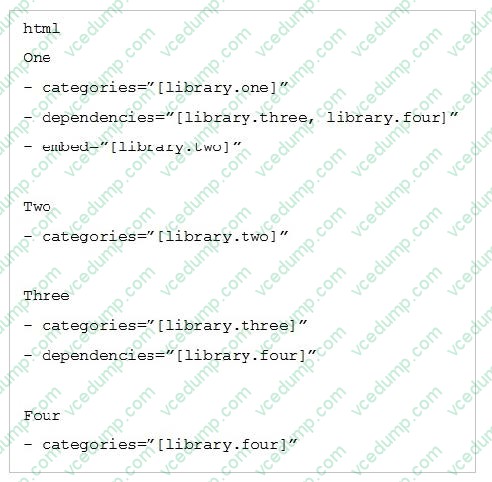
A developer uses the following:

What is the resulting HTML?
A. Option A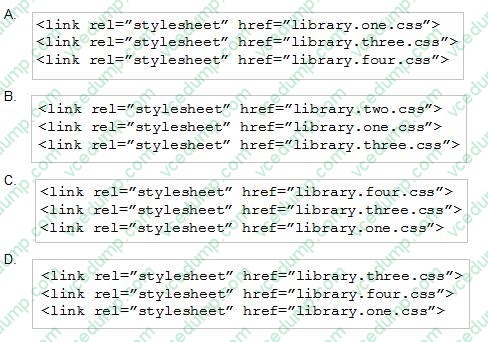
B. Option B
C. Option C
D. Option D -
Question 69:
A developer must create a workflow step that assigns a `WorkItem' to the appropriate person based on who has the least amount work to do. The group that must perform the action is configured into the workflow.
Which non-deprecated interface should the Java implementation class use to perform the assignment?
A. com.adobe.granite.workflow.exec.ParticipantStepChooser
B. com.day.cq.workflow.exec.ParticipantChooser
C. com.day.cq.workflow.exec.WorkItem
D. com.adobe.granite.workflow.exec.WorkflowData -
Question 70:
Which maven plugin is required to install a content package on a local AEM environment using maven?
A. Maven Install Plugin
B. FileVault Package Maven Plugin
C. Content Package Maven Plugin
D. Maven Bundle Plugin
Related Exams:
-
9A0-019
Adobe Photoshop 6.0 Product Proficiency -
9A0-042
Acrobat 7.0 Prowith Adobe LiveCycle Designer ACE Exam -
9A0-043
Adobe Illustrator CS 2 ACE -
9A0-044
Adobe Photoshop CS 2 ACE Exam -
9A0-045
Adobe InDesign CS 2 ACE Exam -
9A0-046
Adobe GoLive CS2 ACE Exam -
9A0-055
Adobe InDesign CS3 ACE Exam -
9A0-056
Adobe Dreamweaver CS3 ACE Exam -
9A0-057
Adobe Illustrator CS3 ACE Exam -
9A0-058
Adobe Flash CS3 ACE Exam
Tips on How to Prepare for the Exams
Nowadays, the certification exams become more and more important and required by more and more enterprises when applying for a job. But how to prepare for the exam effectively? How to prepare for the exam in a short time with less efforts? How to get a ideal result and how to find the most reliable resources? Here on Vcedump.com, you will find all the answers. Vcedump.com provide not only Adobe exam questions, answers and explanations but also complete assistance on your exam preparation and certification application. If you are confused on your AD0-E103 exam preparations and Adobe certification application, do not hesitate to visit our Vcedump.com to find your solutions here.