Appian ACD200 Online Practice
Questions and Exam Preparation
ACD200 Exam Details
Exam Code
:ACD200
Exam Name
:Appian Certified Senior Developer
Certification
:Appian Certifications
Vendor
:Appian
Total Questions
:77 Q&As
Last Updated
:Jul 15, 2026
Appian ACD200 Online Questions &
Answers
Question 31:
You are designing a repeating step in a process.
What is the default limit for maximum number of node executions?
A. 50 B. 2000 C. 1000 D. 500
C. 1000
Explanation/Reference:
The question is about the default limit for maximum number of node executions in a repeating step in a process. The default limit is 1000, as it is the value of the system property conf.bpm.maxNodeExecutionsPerInstance, which controls how many times a node can be executed in a single process instance. This limit is intended to prevent infinite loops or excessive node executions that could affect the performance or stability of Appian. The other options are not correct, as they are either too high or too low. References: Repeating Steps in Processes System Properties Reference
Question 32:
HOTSPOT
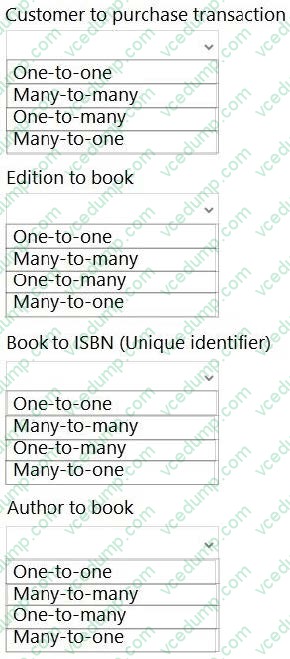
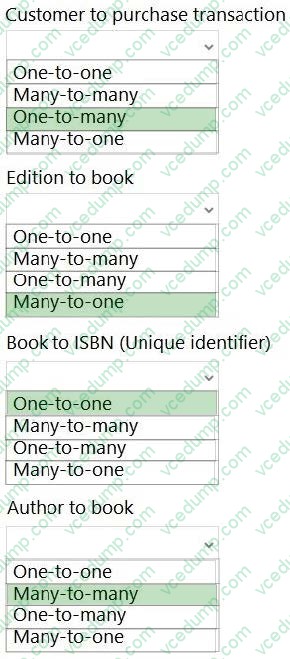
You need to create and design an ERD that represents the client's bookstore inventory.
Match the entity descriptions to the most appropriate relationship. Each relationship type will be used once.
Hot Area:
Explanation/Reference:
Question 33:
A lead designer receives this requirement:
Every time a record is modified, the data changed must be stored for audit.
Which design is the most efficient and has the least impact on the Appian application? (Choose the best answer.)
A. Create a custom plugin that can write an audit trail to a log file. B. Create a trigger on the database table to capture the audit trail to a table. C. Create an Appian process to capture the change history and write the audit trail to the database. D. Create a web API call to an audit history system and write the audit trail to file.
B. Create a trigger on the database table to capture the audit trail to a table.
Explanation/Reference:
Creating a trigger on the database table to capture the audit trail to a table is the most efficient and has the least impact on the Appian application, because it avoids adding extra logic or calls to the Appian application, which could affect its performance and scalability. A trigger is a database object that automatically executes when a specified event occurs on a table or view. A trigger can be used to insert, update, or delete data from another table based on the changes made to the original table. References: [Triggers], [Audit Trail]
Question 34:
You need to create a plug-in to perform a job in the background. The plug-in should not be available under an expression rule, connected system, or the process model.
What type of plug-in should you create? (Choose the best answer.)
A. Servlet B. Function C. Connected systems D. Smart service
A. Servlet
Explanation/Reference:
The type of plug-in that should be created to perform a job in the background and not be available under an expression rule, connected system, or the process model is a servlet plug-in. A servlet plug-in is a plug-in that allows you to create custom servlets that can be accessed through a URL. Servlets are Java classes that run on a web server and handle requests and responses. Servlet plug-ins can be used to perform background tasks, such as sending notifications, logging events, or integrating with external systems, without exposing them to the end users or developers. References: Servlet Plug-ins, Appian Suite Plug-ins
Question 35:
You are creating a table to store book information for a library. The boot has a reference number (ISBN_ID), as well as a unique identifier (BOOK_ID).
For the CDT to be created, which data type should you choose for the BOOK_ID? (Choose the best answer.)
A. Number (Integer) B. Number (Decimal) C. Date D. Boolean
A. Number (Integer)
Explanation/Reference:
The Number (Integer) data type should be chosen for the BOOK_ID, because it is a unique identifier for each book record. The Number (Integer) data type is used to store whole numbers without decimals, such as IDs, counts, or ordinal values. The Number (Integer) data type can also be used as a primary key for a CDT or a foreign key for referencing another CDT. References: [Number (Integer) Data Type], [CDT Primary Keys]
Question 36:
During the design review, you identified slow-operating expression rules querying a specific data store.
Which metric from the data_store_details.csv file will help you understand the "number of operations against data store?" (Choose the best answer.)
A. Transform Count B. Query Count C. Total Count D. Execute Count
C. Total Count
Explanation/Reference:
The metric from the data_store_details.csv file that will help you understand the number of operations against data store is Total Count. This metric represents the total number of queries, inserts, updates, deletes, and executes performed against the data store during the specified time period. You can use this metric to identify which data stores are heavily used and may need performance tuning or scaling. References: [Data Store Details Report], [Data Store Metrics]
Question 37:
You want to generate an email body which varies from one Appian environment to another. For instance, between DEV and TEST.
According to Appian best practices, how should you define the environment name? (Choose the best answer.)
A. Create an expression rule and update its value post-deployment. B. Create an environment-specific constant. C. Create a constant and update its value post-deployment. D. Create a stored procedure.
B. Create an environment-specific constant.
Explanation/Reference:
According to Appian best practices, environment-specific constants should be used to define values that vary from one Appian environment to another. For example, if you want to generate an email body that contains the environment name, you can create a constant named ENVIRONMENT_NAME and assign it different values for DEV and TEST environments. This way, you can avoid hard-coding values in your expressions or rules, and simplify your deployment process by using automatic constant value mapping.
Question 38:
You need to show joined data from 5 tables. Each table contains a large number of rows and could generate a large result set after executing the Joins.
The business is not expecting live data, and a 2-hour refresh is acceptable. Performance is a top priority.
What should you use? (Choose the best answer.)
A. Table B. View C. Stored procedure D. Materialized view
D. Materialized view
Explanation/Reference:
A materialized view is the best option to show joined data from 5 tables that contain a large number of rows and could generate a large result set after executing the joins. A materialized view is a physical table that holds the results of the SQL that a view would normally be constructed from and can be generated periodically. A materialized view can improve performance by reducing the execution time of complex queries that involve multiple joins, aggregations, or calculations. A materialized view can also reduce the load on the database server by storing the query results in advance. A materialized view can be refreshed at regular intervals or on demand to reflect the changes in the underlying tables. References: [Materialized Views], [View Performance]
Question 39:
You need to create a service account for a consumer to access the Appian Web API.
Which user type should be created?
A. Initiator B. System Administrator C. Basic User D. Editor
C. Basic User
Explanation/Reference:
The requirement is to create a service account for a consumer to access the Appian Web API. A basic user is the user type that should be created for this purpose, as it has the minimum permissions needed to invoke web APIs and does not consume a license. A basic user can also be assigned to specific groups or roles to control the access to web APIs. The other options are not suitable for this purpose, as they either have more permissions than needed or consume a license. References: User Types Web API Security
Question 40:
You are investigating a slow-performing expression rule and want to analyze this rule's historical performance.
Which performance log should you look at to see the mean evaluation time of this rule every hour?
A. expressions_details.csv B. expressions_metrics.csv C. expressions_summary.csv D. expressions_trace.csv
A. expressions_details.csv
Explanation/Reference:
The performance log that should be used to see the mean evaluation time of a slow-performing expression rule every hour is expressions_details.csv. This log records information about how expression rules are performing in the system,
such as the number of evaluations, the total time, the mean total time, and the standard deviation of the total time. The log is written to once every hour, and it provides fine-grain aggregation by type of expression rule. The mean total time
column shows the average time it took to evaluate an expression rule in milliseconds. Therefore, the correct answer is A.
Nowadays, the certification exams become more and more important and required by more and more
enterprises when applying for a job. But how to prepare for the exam effectively? How to prepare
for the exam in a short time with less efforts? How to get a ideal result and how to find the
most reliable resources? Here on Vcedump.com, you will find all the answers.
Vcedump.com provide not only Appian exam questions,
answers and explanations but also complete assistance on your exam preparation and certification
application. If you are confused on your ACD200 exam preparations
and Appian certification application, do not hesitate to visit our
Vcedump.com to find your solutions here.