AAPC-CPC Exam Details
-
Exam Code
:AAPC-CPC -
Exam Name
:Certified Professional Coder (CPC) -
Certification
:AAPC Certifications -
Vendor
:AAPC -
Total Questions
:475 Q&As -
Last Updated
:Jul 13, 2026
AAPC AAPC-CPC Online Questions & Answers
-
Question 451:
A suppression study includes five glucose tests and five growth hormone tests.
What CPT(R) coding is reported?
A. 82947 x5, 83003 x5
B. 80430, 82947, 83003
C. 80430, 82947 x5, 83003 x5
D. 80430, 82947 x2, 83003 -
Question 452:
The patient came in with an inflamed seborrheic keratosis on her nose for a shave removal. After applying local anesthesia, a 0.7 cm dermal lesion was removed using an #11 blade.
What CPT(R) and ICD-10-CM codes are reported?
A. 11401, L82.1
B. 11421, L82.0
C. 11311, L82.0
D. 11306, L82.1 -
Question 453:
Which statement accurately reflects CPT(R) parenthetical guidance for codes 69209 and 69210?
A. Report codes 69209 and 69210 when both are performed on the same ear.
B. The cerumen must be stated as impacted to report either 69209 or 69210.
C. When 69209 or 69210 is performed on both ears report the codetwice.
D. Report an E/M code and either 69209 or 69210 when the cerumen is impacted. -
Question 454:
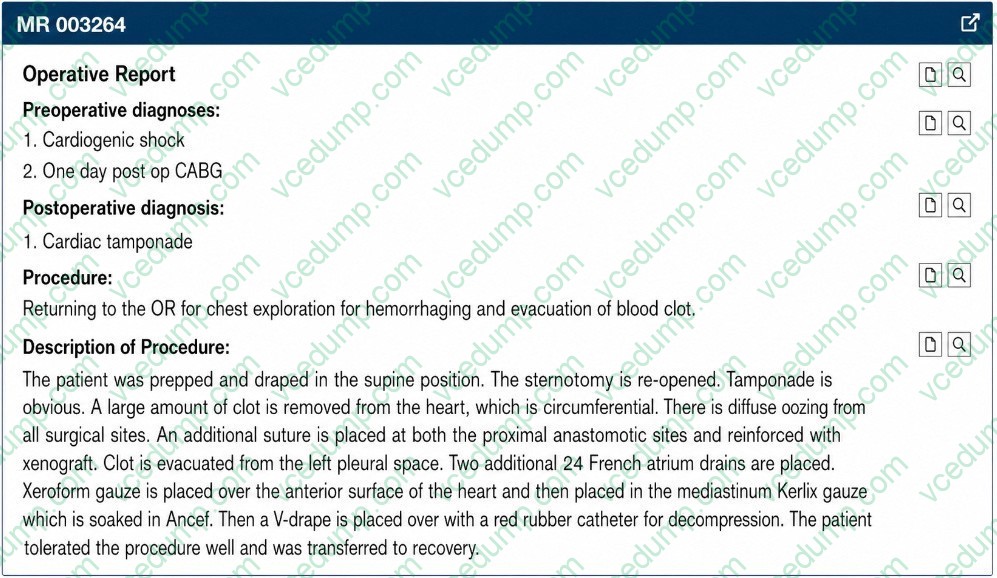
Refer to the supplemental information when answering this question: View MR 003264.
What is the procedural coding?
A. 33020-58
B. 35820-78
C. 32658-78
D. 32120-58 -
Question 455:
A 7-year-old boy was brought to the ED by his mother after he had been playing with small beads and one got lodged in his right external ear canal. After examination, the physician decided to remove the foreign body from the external auditory canal using alligator forceps without anesthesia.
What CPT(R) code is reported?
A. 69110
B. 69105
C. 69200
D. 69205 -
Question 456:
Preoperative diagnosis: Right thigh benign congenital hairy nevus.
Postoperative diagnosis: Right thigh benign congenital hairy nevus.
Operation performed: Excision of right thigh benign congenital nevus, excision size with margins 4.5 cm and closure size 5 cm.
Anesthesia: General.
Intraoperative antibiotics: Ancef.
Indications: The patient is a 5-year-old girl who presented with her parents for evaluation of her right thigh congenital nevus. It has been followed by pediatrics and thought to have changed over the past year.
Family requested excision. They understood the risks involved, which included but were not limited to risks of general anesthesia, infection, bleeding, wound dehiscence, and poor scar formation. They understood the scar would likely widen as the child grows because of the location of it and because of the age of the patient. They consented to proceed.
Description of procedure: The patient was seen preoperatively in the holding area, identified, and then brought to the operating room. Once adequate general anesthesia had been induced, the patient's right thigh was prepped and draped in standard surgical fashion. An elliptical excision measuring 6 x 1.8 cm had been marked. This was injected with Lidocaine with epinephrine, total of 6 cc of 1% with 1:100,000. After
an adequate amount of time, a #15 blade was used to sharply excise this full thickness. This was passed
to pathology for review. The wound required limited undermining in the deep subcutaneous plane on both sides for approximately 1.5 cm in order to allow mobilization of the skin for closure. The skin was then closed in a layered fashion using 3-0 Vicryl on the dermis and then 4-0 Monocryl running subcuticular in the skin. The wound was cleaned and dressed with Dermabond and Steri-Strips.
The patient was then cleaned and turned over to anesthesia for extubation. She was extubated successfully in the operating room and taken to the recovery room in stable condition. There were no complications.
What CPT(R) codes are reported?
A. 12002, 11406-51
B. 12002, 11606-51
C. 12032, 11406-51
D. 12032, 11606-51 -
Question 457:
What does the suffix -graph mean?
A. Instrument for recording data
B. Instrument used for Z-plasty
C. Surgical repair by suture
D. Surgical binding by fusion -
Question 458:
View MR 005398
MR 005398
Operative Report
Preoperative Diagnosis: Nonfunctioning right kidney with ureteral stricture.
Postoperative Diagnosis: Nonfunctioning right kidney with ureteral stricture.
Procedure: Right nephrectomy with partial ureterectomy.
Findings and Procedure: Under satisfactory general anesthesia, the patient was placed in the right flank position. Right flank and abdomen were prepared and draped out of the sterile field. Skin incision was made between the 11th and 12th ribs laterally. The incision was carried down through the underlying subcutaneous tissues, muscles, and fascia. The right retroperitoneal space was entered. Using blunt and sharp dissection, the right kidney was freed circumferentially. The right artery, vein, and ureter were identified. The ureter was dissected downward where it is completely obstructed in its distal extent. The ureter was clipped and divided distally. The right renal artery was then isolated and divided between 0 silk suture ligatures. The right renal vein was also ligated with suture ligatures and 0 silk ties. The right kidney and ureter were then submitted for pathologic evaluation. The operative field was inspected, and there was no residual bleeding noted, and then it was carefully irrigated with sterile water. Wound closure was then undertaken using 0 Vicryl for the fascial layers, 0 Vicryl for the muscular layers, 2-0 chromic for subcutaneous tissue, and clips for the skin. A Penrose drain was brought out through the dependent aspect of the incision. The patient lost minimal blood and tolerated the procedure well.
What CPT coding is reported for this case?
A. 50234
B. 50220
C. 50230
D. 50240 -
Question 459:
Which statement is FALSE in reporting a personal history ICD-10-CM code?
A. A personal history code is acceptable on any medical record regardless of the reason for the visit.
B. A personal history code can be reported with follow-up codes.
C. A personal history code can be reported as a first-listed code when the reason for encounter is for a screening.
D. A personal history code is reported when the patient's condition is no longer present or being treated. -
Question 460:
A 47-year-old female presents to the operating room for a partial corpectomy on one upper thoracic vertebral body, T3. Two surgeons are performing the surgery. One surgeon performs the transthoracic approach and excises the damaged portion of the vertebral body. The second surgeon inserts a bone graft into the vertebral gap, closing the gap, and inserts a metal plate. Both surgeons work together, each as a primary surgeon.
How does each surgeon report their portion of the surgery?
A. 63090-66, 63091-66
B. 63087-62, 63088-62
C. 63090-80, 63091-80
D. 63085-62, 63086-62
Tips on How to Prepare for the Exams
Nowadays, the certification exams become more and more important and required by more and more enterprises when applying for a job. But how to prepare for the exam effectively? How to prepare for the exam in a short time with less efforts? How to get a ideal result and how to find the most reliable resources? Here on Vcedump.com, you will find all the answers. Vcedump.com provide not only AAPC exam questions, answers and explanations but also complete assistance on your exam preparation and certification application. If you are confused on your AAPC-CPC exam preparations and AAPC certification application, do not hesitate to visit our Vcedump.com to find your solutions here.