OMG-OCSMP-MBA400 Exam Details
-
Exam Code
:OMG-OCSMP-MBA400 -
Exam Name
:OMG-Certified Systems Modeling Professional - Model Builder - Advanced -
Certification
:OMG Certifications -
Vendor
:OMG -
Total Questions
:90 Q&As -
Last Updated
:Jan 06, 2026
OMG OMG-OCSMP-MBA400 Online Questions & Answers
-
Question 1:
Choose the correct answer
Modehca solvers can produce large volumes of time-based results (such as time-based power usage), but requirements are often based on scalar values such as "maximum peak power" and 'average power usage".
Which of the following is generally the most effective way to verify such requirements?
A. Import the Modelica time-based power usage results into SysML Then use SysML parametncs to calculate these scalar values, and compare them to the requirements
B. ave the Modelica solver also compute these scalar values from its time-based power usage results Then import the resulting scalar values into SysML. and compare them to the requirements.
C. Use the SysML4Modelica profile to transform the Modelica time-based power usage results into these scalar values Then import the resulting scalar values into SysML, and compare them to the requirements.
D. Modelica models can only produce time-based results and thus cannot support scalar results like these, which must either be calculated using a different tool or measured on physical prototypes Then enter the resulting scalar values into SysML, and compare them to the requirements -
Question 2:
Choose the correct answer
An engineer wants to place formal pre-conditions and post-conditions on an activity diagram.
Which language is suitable and most compatible with SysML?
A. BPMN
B. English
C. OCL
D. OWL
E. VSL
F. XMI
G. XML -
Question 3:
Choose the correct answer.
How should stereotypes be grouped to facilitate re-use in later projects?
A. in profiles
B. in packages
C. in metamodels
D. in sub-models -
Question 4:
Choose the correct answer.
A model is being built using constructs defined in a Quality profile Project requirements state that the model must only be built using the constructs defined In the Quality profile - no other metaclasses may be used.
Which diagram fragment correctly expresses this requirement?
A. Option A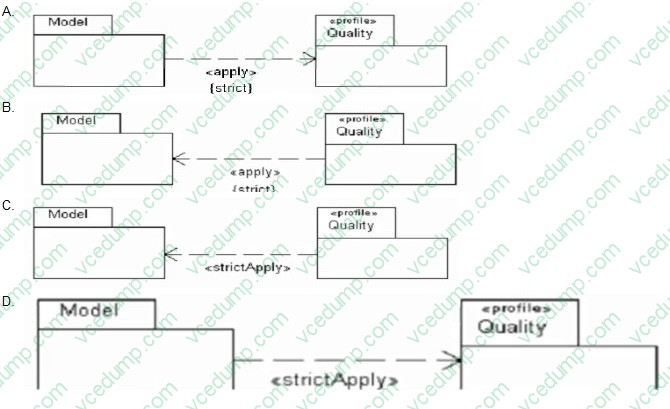
B. Option B
C. Option C
D. Option D -
Question 5:
Choose the correct answer.
What is one of the most common reasons to utilize a SysML-Modehca integration?
A. to solve and analyze system advanced statistics models
B. to solve and analyze system dynamics models
C. to execute and analyze system activity models
D. to execute and analyze system state machine models -
Question 6:
Choose the correct answer
For a system with stringent real-time requirements and power-consumption constraints, which concern would lead the designer to employ the MARTE profile?
A. ensuring traceability between structure and behavior
B. ensuring traceability between requirements and structure
C. ensuring that the structure could be precisely modeled and that analysis was supported
D. ensuring that the relationship between system response time and power consumption could be captured in a parametric diagram -
Question 7:
Choose the correct answer
The lead systems engineer on a project has identified a set of Key Performance Parameters (KPPs) that need to be evaluated both on a periodic basis during development, and during acceptance for everydesign change. Many of these KPPs are expressed In complex, interrelated differential equations The analysis team has identified appropriate numerical techniques for solving these equations and expressed them in a popular analysis tool.
The lead system modeler and methodologist must ensure that the architecture and design captured in the SysML system model are continuously and accurately reflected In the KPP calculations.
Which strategy is likely to be most successful in accomplishing this?
A. Task the analysis learn with recasting each of the KPP equations as constraint blocks and parametric models directly in SysML and linking the resulting parameters to value properties of current system model elements Keeping all information in the same model is the only way to guarantee the consistency the lead engineer has asked for
B. List the parameters used to evaluate the KPPs in a spreadsheet file. Use the SysML modeling tool's inherent capability to link appropriate value properties to cells in this spreadsheet Task the analysis team with modifying their analysis routines to accept parameters as an input vector from this spreadsheet. Ensure that the spreadsheet is updated from the system model prior to each update of the KPP calculations
C. Work with the analysis team to partition the KPP evaluation model into manageable, reusable subroutines Develop constraint blocks within the SysML model to represent these subroutines, exposing their parameters. Use these new constraint blocks to build a parametric model that ties the KPP evaluation directly to system model element value properties. Leverage available bridging software to link this parametric model to the evaluation subroutines executing in the external analysis tool, and re-evaluate the KPPs on an as-needed basis
D. Use activity and/or state models to accurately model the flow of data to numerically solve the KPP evaluation equations Ensure that the analysis team validates these behavior models Bind each relevant value property within the system model to an activity parameter or state variable such that the KPP evaluation model accurately reflects how the KPPs are derived. Next, use code generation capability inherent in the SysML tool to generate and compile the KPP evaluation routines Recompile and run these routines as needed to update KPP estimates -
Question 8:
Choose the correct answer
Which feature needs to be added to the systems development environment to conduct a performance simulation?
A. numerical solver
B. object constraints
C. parametric diagrams
D. high-level architecture -
Question 9:
Choose the correct answer
A small project has chosen a widely-used SysML-based development method, and plans to tailor the method over the life of the project.
What Is(are) the most important consideration(s) for selecting a tool to support the project? \
Choose the option that gives the project the most flexibility
A. ability to interface with other tools that support the method
B. built-in support for the method, including documentation and context-specific help
C. built-m support for the method, mechanisms for user-defined extensions to the tool
D. built-in support for the method: vendor commitment to provide tool tailoring for the project -
Question 10:
Choose the correct answer
The director of field support for a company just found out that one of the company's systems engineers is a Model Based Systems Engineering expert, and wants to discuss how MBSE might impact how the company's products are supported In the field What is the most important aspect of system development methodologies the engineer Is likely to discuss?
A. how field support operations can be modeled using MBSE methods
B. how software design patterns can be used to suggest Pre Planned Product Improvement (P3I) opportunities
C. how the system model can be used to facilitate change proposals, support plans, and training in the operational environment
D. how operational evaluation (OPEVAL) plans can be developed and cross-checked In a system modeling environment, using DoDAF operational views
Related Exams:
-
OMG-OCEB2-FUND100
OMG-Certified Expert in BPM 2 - Fundamental -
OMG-OCSMP-MBA400
OMG-Certified Systems Modeling Professional - Model Builder - Advanced -
OMG-OCSMP-MBI300
OMG-Certified Systems Modeling Professional - Model Builder - Intermediate -
OMG-OCUP-100
OMG-Certified UML Professional Fundamental -
OMG-OCUP-200
OMG-Certified UML Professional Intermediate -
OMG-OCUP-300
OMG-Certified UML Professional - Advanced -
OMG-OCUP2-ADV300
OMG Certified UML Professional 2 (OCUP 2) - Advanced Level -
OMG-OCUP2-FOUND100
OMG Certified UML Professional 2 (OCUP 2) - Foundation Level -
OMG-OCUP2-INT200
OMG Certified UML Professional 2 (OCUP 2) - Intermediate Level
Tips on How to Prepare for the Exams
Nowadays, the certification exams become more and more important and required by more and more enterprises when applying for a job. But how to prepare for the exam effectively? How to prepare for the exam in a short time with less efforts? How to get a ideal result and how to find the most reliable resources? Here on Vcedump.com, you will find all the answers. Vcedump.com provide not only OMG exam questions, answers and explanations but also complete assistance on your exam preparation and certification application. If you are confused on your OMG-OCSMP-MBA400 exam preparations and OMG certification application, do not hesitate to visit our Vcedump.com to find your solutions here.