98-366 Exam Details
-
Exam Code
:98-366 -
Exam Name
:Networking Fundamentals -
Certification
:Microsoft Certifications -
Vendor
:Microsoft -
Total Questions
:197 Q&As -
Last Updated
:Jul 08, 2026
Microsoft 98-366 Online Questions & Answers
-
Question 31:
What is the maximum cable length for a single Cat5 UTP cable run?
A. 285 feet/86.87 meters
B. 328 feet/99.97 meters
C. 432 feet/131.67 meters
D. 600 feet/182.88 meters -
Question 32:
Which of the following represents a Media Access Control (MAC) address?
A. GV:ZC:KK:DK:FZ:CA
B. 255.255.255.0
C. 05:35:AB:6E:Al:25
D. 127.0.0.1 -
Question 33:
Drag and Drop
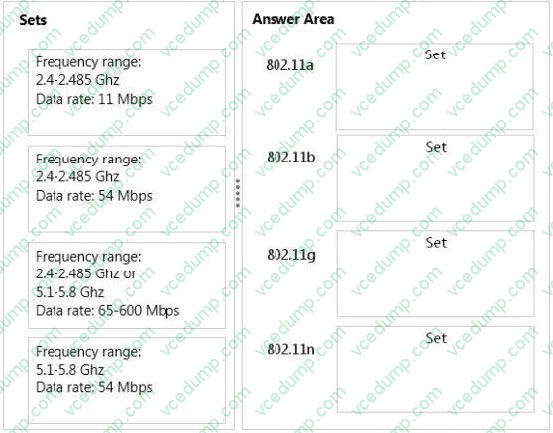
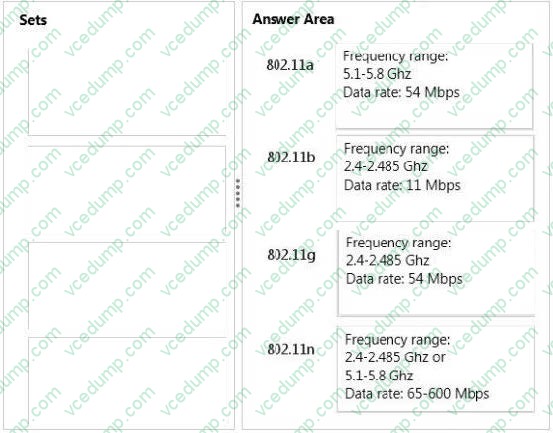
Match each set of characteristics to the corresponding 802.11 standard.
To answer, drag the appropriate set of characteristics from the column on the left to its 802.11 standard on the right. Each set may be used once, more than once, or not at all. Each correct match is worth one point.
Select and Place:
-
Question 34:
Drag and Drop
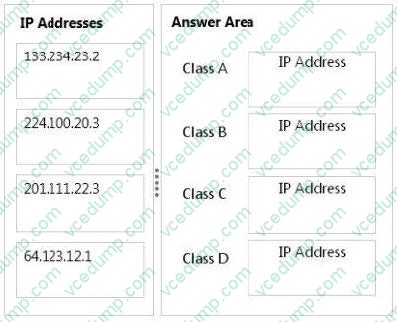
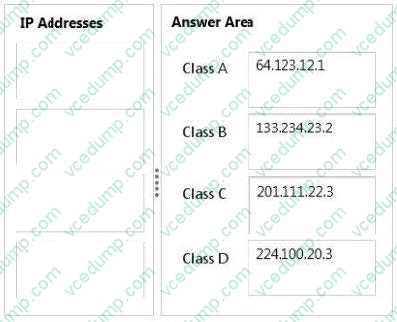
Match each IP address to its corresponding IPv4 address class.
To answer, drag the appropriate IP address from the column on the left to its IPv4 address class on the right. Each IP address may be used once, more than once, or not at all. Each correct match is worth one point.
Select and Place:
-
Question 35:
In addition to switching, multilayer switches also:
A. Provide Layer 3 routing functions.
B. Interface with CAT3, CATS, CAT5e, and fiber optics.
C. Support 10 MB, 100 MB, and 1 GB local area network (LAN) ports.
D. Operate by using only Layer 1 and 2 protocols. -
Question 36:
In a physical star topology, the central device is referred to as a:
A. Bridge
B. Server
C. segmenter
D. Hub -
Question 37:
One advantage of dynamic routing is that it:
A. Automatically maintains routing tables.
B. Limits traffic derived from routing protocols.
C. Reduces broadcast traffic.
D. Automatically enables DHCP. -
Question 38:
Which two are published IEEE 802.11 wireless transmission standards? (Choose two.)
A. 802.1 If
B. 802.11g
C. 802.11k
D. 802.11m
E. 802.11n -
Question 39:
If an 802.llg Internet connection has connectivity problems, what may be the cause?
A. A cordless phone
B. A cellular phone
C. Incandescent lights
D. Electromagnetic interference (EMI) -
Question 40:
A node within a local area network (LAN) must have a network interface device and a:
A. Network account
B. Table of all network nodes
C. Host address
D. Resource to share
Related Exams:
-
62-193
Technology Literacy for Educators -
70-243
Administering and Deploying System Center 2012 Configuration Manager -
70-355
Universal Windows Platform – App Data, Services, and Coding Patterns -
77-420
Excel 2013 -
77-427
Excel 2013 Expert Part One -
77-725
Word 2016 Core Document Creation, Collaboration and Communication -
77-726
Word 2016 Expert Creating Documents for Effective Communication -
77-727
Excel 2016 Core Data Analysis, Manipulation, and Presentation -
77-728
Excel 2016 Expert: Interpreting Data for Insights -
77-731
Outlook 2016 Core Communication, Collaboration and Email Skills
Tips on How to Prepare for the Exams
Nowadays, the certification exams become more and more important and required by more and more enterprises when applying for a job. But how to prepare for the exam effectively? How to prepare for the exam in a short time with less efforts? How to get a ideal result and how to find the most reliable resources? Here on Vcedump.com, you will find all the answers. Vcedump.com provide not only Microsoft exam questions, answers and explanations but also complete assistance on your exam preparation and certification application. If you are confused on your 98-366 exam preparations and Microsoft certification application, do not hesitate to visit our Vcedump.com to find your solutions here.