72200X Exam Details
-
Exam Code
:72200X -
Exam Name
:Avaya Aura Core Components Support Certified -
Certification
:Avaya Certifications -
Vendor
:Avaya -
Total Questions
:98 Q&As -
Last Updated
:Jul 08, 2026
Avaya 72200X Online Questions & Answers
-
Question 1:
You are configuring Shared Bandwidth Management for Call Admission Control (CAC) between Communication Manager (CM) and Session Manager (SM). Which two tasks must you perform to achieve this? (Choose two.)
A. Specify the shared bandwidth limit on the Communication Manager (SIP) Entity screen
B. Create Network Region Groups (NRG) in Communication Manager
C. Create Locations in Session Manager
D. Create a Bandwidth Share Group in SM
E. Match the Network Region used for the SIP users with the Domain in SM -
Question 2:
Refer to the Exhibit.
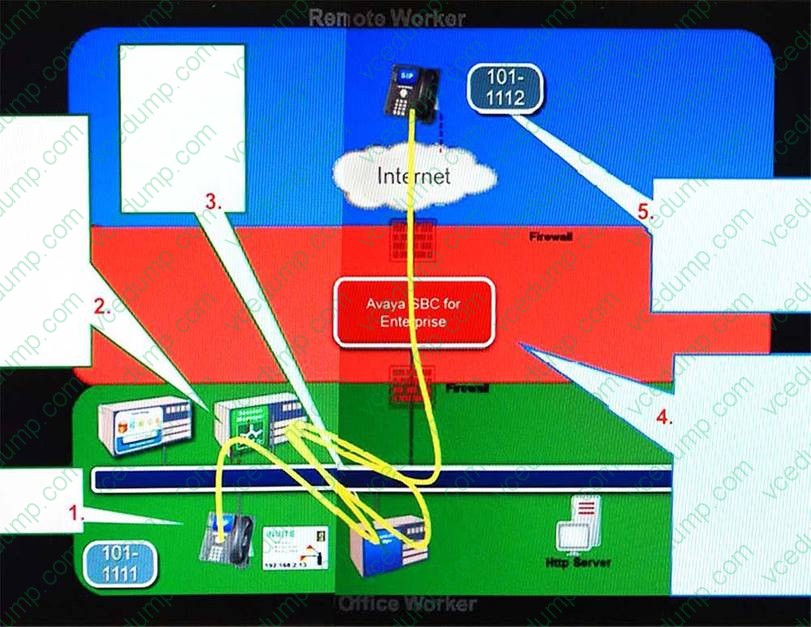
Which two statements about a call from AST 1011111 to Remote Worker AST 1011112 are true? (Choose two.)
A. Avaya Session Border Controller for Enterprise (SBCE) periodically sends SIP Options to 1011112 looking for a 200 ok response to check it is reachable.
B. SIP Signaling traverses the Avaya Session Border Controller for Enterprise (SBCE) and the Media must bypass the SBCE.
C. As far as Avaya Aura@ Session Manager (SM) is concerned, all Remote Worker phones are registering from an IP address equal to the Avaya Session Border Controller for Enterprise (SBCE) Remote Worker Private IP address.
D. Avaya Session Border Controller for Enterprise (SBCE) needs to be built as a trusted SIP Entity and Entity link for remote workers.
E. The configuration of a Remote Worker AST is the same as an Office Worker AST in the Avaya Aura@ System Manager (SMGR) user profiles. -
Question 3:
When does Communication Manager insert the shortcut flag during call processing?
A. during the origination phase (imsorig) of call processing
B. during the termination phase (imsterm) of call processing
C. during the initialization phase (imsinit) of call processing
D. during the dialing analysis phase (imsdialana) of call processing -
Question 4:
When viewing Avaya Aura@ Communication Manager (CM) trusted certificates, you notice that the installed certificates are marked with either A, C, W, or R. What do these letters stand for?
A. Accepted, Confirmed, Whitelisted and Rejected
B. Accumulated, Compressed, Write and Read
C. Authentication, Authorization and Accounting Services, Communication Manager, WEB Server and Remote Logging.
D. Authentication, Access and Accounting Services, Communication Manager, Web Server and Remote logging. -
Question 5:
How can you view the entire contents of the current Avaya Aura@ Communication Manager (CM) call processing log file?
A. by using the CM SAT to enter the list callp log all commands
B. by using the Linux cd to /var/log/Avaya and cat ecs.log commands
C. by using the Linux cd to /var/log/esc and ls -l commands to find current ; cat
D. by using the CM SAT to enter the display callproc log all command
E. by using the Linux cd to /var/log/Avaya and cat callproc.log commands -
Question 6:
How can you check to see if the Avaya Aura@ Session Manager (SM) application processes are running?
A. Execute the SM CLI statapp command.
B. On the SM dashboard select Status Applications from the Shutdown System pull-down menu.
C. On the SM dashboard select Status Applications from the Service State pull-down menu.
D. Execute the SM status all command. -
Question 7:
Which two SIP requests are used to allow an AST endpoint to use features provided by an Avaya Aura ?Communication Manager (CM)? (Chose two).
A. INVITE
B. OPTIONS
C. REGISTER
D. SUBSCRIBE
E. NOTIFY -
Question 8:
A customer called Avaya Support after their telecom administrator was unable to add 50 new telephones for new hires. Avaya support determined that the number of telephones exceeded the capacity the system could support.
Which pre-implementation step was omitted?
A. Accessing support.avaya.com to verify customer systems compatibility.
B. Testing all third-party equipment and software.
C. Verifying that the version installed is compatible with existing versions.
D. Providing accurate licensing specification. -
Question 9:
Which two statements are true regarding Full and Half call model processing? (Choose two.)
A. Avaya Aura@ Session Manager (SM) always performs Half call model processing.
B. Avaya Aura@ Communication Manager (CM) configured as a Feature Server performs Full call model processing.
C. Avaya Aura@ Communication Manager (CM) configured as an Evolution Server performs Full call model processing.
D. Avaya Aura@ Session Manager (SM) always performs Full call model processing. -
Question 10:
Which statement describes the steps to save the traceSM log file?
A. While traceSM is running, type 'w' and a filename; the file is written to the user's current directory.
B. Export all logs from the Avaya Aura@ System Manager (SMGR) log viewer.
C. While traceSM is running, type 'w' and a filename; the file is written to the /tmp directory.
D. Execute traceSM -w .
Related Exams:
-
3002
Avaya IP Office™ Platform Configuration and Maintenance Exam -
3100
Avaya Aura Contact Recording and Avaya Aura Quality Monitoring Implementation Exam -
3101
Avaya Aura® Communication Manager and CM Messaging - Embedded Maintenance and Troubleshooting Exam -
3102
Avaya IP Office Implementation -
3104
Avaya one-X UC Soft Clients Implementation and Maintenance -
3107
Avaya Session Border Controller Enterprise Implementation and Maintenance -
3108
Avaya Scopia® Solution Implementation and Maintenance Exam -
31860X
Avaya IX Calling Design -
3202
Avaya Aura® Conferencing (R7.x) Implementation and Maintenance -
3203
Avaya Aura Messaging Implementation and Maintenance Exam
Tips on How to Prepare for the Exams
Nowadays, the certification exams become more and more important and required by more and more enterprises when applying for a job. But how to prepare for the exam effectively? How to prepare for the exam in a short time with less efforts? How to get a ideal result and how to find the most reliable resources? Here on Vcedump.com, you will find all the answers. Vcedump.com provide not only Avaya exam questions, answers and explanations but also complete assistance on your exam preparation and certification application. If you are confused on your 72200X exam preparations and Avaya certification application, do not hesitate to visit our Vcedump.com to find your solutions here.