70-774 Exam Details
-
Exam Code
:70-774 -
Exam Name
:Perform Cloud Data Science with Azure Machine Learning -
Certification
:Microsoft Certifications -
Vendor
:Microsoft -
Total Questions
:64 Q&As -
Last Updated
:Dec 09, 2021
Microsoft 70-774 Online Questions & Answers
-
Question 31:
Note: This question is part of a series of questions that use the same scenario. For your convenience, the scenario is repeated in each question. Each question presents a different goal and answer choices, but the text of the scenario is
exactly the same in each question in this series.
A travel agency named Margie's Travel sells airline tickets to customers in the United States.
Margie's Travel wants you to provide insights and predictions on flight delays. The agency is considering implementing a system that will communicate to its customers as the flight departure nears about possible delays due to weather
conditions. The flight data contains the following attributes:
The weather data contains the following attributes: AirportID, ReadingDate (YYYY/MM/DD HH), SkyConditionVisibility, WeatherType, WindSpeed, StationPressure, PressureChange, and HourlyPrecip.
You have an untrained Azure Machine Learning model that you plan to train to predict flight delays.
You need to assess the variability of the dataset and the reliability of the predictions from the model.
Which module should you use?
A. Cross-Validate Model
B. Evaluate Model
C. Tune Model Hyperparameters
D. Train Model
E. Score Model -
Question 32:
HOTSPOT
Note: This question is part of a series of questions that use the same scenario. For your convenience, the scenario is repeated in each question. Each question presents a different goal and answer choices, but the text of the scenario is
exactly the same in each question in this series.
Start of repeated scenario
You plan to use Azure platform tools to detect and analyze food items in smart refrigerators. To provide families with an integrated experience for grocery shopping and cooking, the refrigerators will connect to other smart appliances, such as
stoves and microwave ovens, on a LAN.
You plan to build an object recognition model by using the Microsoft Cognitive Toolkit. The object recognition model will receive input from the connected devices and send results to applications.
The training data will be derived from more than 10 TB of images. You will convert the raw images to the sparse format.
End of repeated scenario.
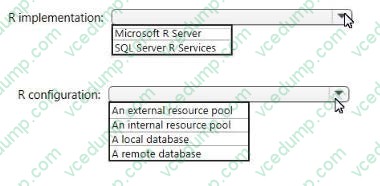
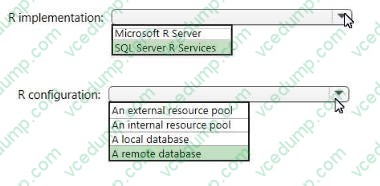
The image files to train the object recognition model are stored in a Microsoft SQL Server 2016 Standard edition database on an Azure virtual machine (VM).
You need to support R packages that can use full parallel threading and processing for RevoScaleR.
How should you implement R? To answer, select the appropriate options in the answer area. NOTE: Each correct selection is worth one point.
Hot Area:
-
Question 33:
DRAG DROP
Note: This question is part of a series of questions that use the same scenario. For your convenience, the scenario is repeated in each question. Each question presents a different goal and answer choices, but the text of the scenario is
exactly the same in each question in this series.
You plan to create a predictive analytics solution for credit risk assessment and fraud prediction in Azure Machine Learning. The Machine Learning workspace for the solution will be shared with other users in your organization. You will add
assets to projects and conduct experiments in the workspace.
The experiments will be used for training models that will be published to provide scoring from web services.
The experiment for fraud prediction will use Machine Learning modules and APIs to train the models and will predict probabilities in an Apache Hadoop ecosystem.
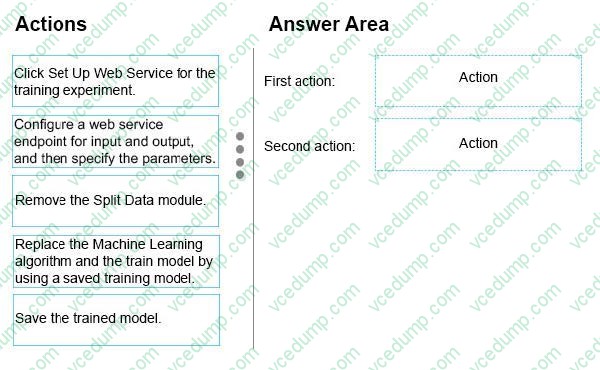
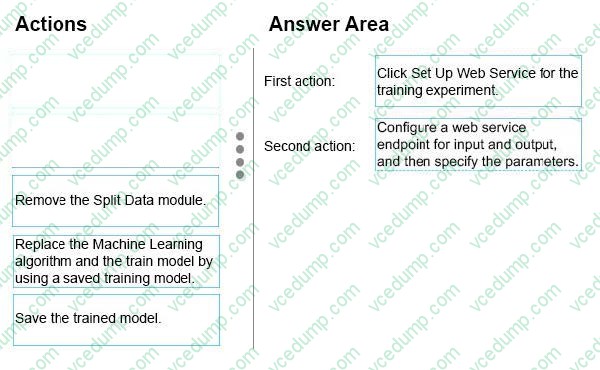
You finish training the model and are ready to publish a predictive web service that will provide the users with the ability to specify the data source and the save location of the results. The model includes a Split Data module.
Which two actions should you perform to convert the Machine Learning experiment to a predictive web service? To answer, drag the appropriate actions to the correct targets.
Each action may be used once, more than once, or not at all. You may need to drag the split bar between panes or scroll to view content.
NOTE: Each correct selection is worth one point.
Select and Place:
-
Question 34:
DRAG DROP
You work for a company that has retail department stores.
You are developing an Azure Machine Learning experiment to predict seasonal sales.
You need to address a model overfitting issue by using the following two solutions:
Solution 1: Controls the penalty for complexity, which, when successful, prevents overfittingSolution 2: Separates model selection from testing, causing a more conservative estimate of generalization
Which method should you use for each solution? To answer, drag the appropriate methods to the correct solutions. Each method may be used once, more than once, or not at all. You may need to drag the split bar between panes or scroll to view content.
NOTE: Each correct selection is worth one point.
Select and Place:

-
Question 35:
Note: This question is part of a series of questions that use the same or similar answer choices. An answer choice may be correct for more than one question in the series. Each question is independent of the other questions in this series.
Information and details provided in a question apply only to that question.
You have a dataset that contains a column named Column1. Some of the values in Column1 are empty.
You need to replace the empty values by using probabilistic Principal Component Analysis (PCA). The solution must use a native module.
Which module should you use?
A. Execute Python Script
B. Clean Missing Data
C. Select Columns in Dataset
D. Import Data
E. Normalize Data
F. Edit Metadata
G. Tune Model Hyperparameters -
Question 36:
Note: This question is part of a series of questions that present the same scenario. Each question in the series contains a unique solution that might meet the stated goals. Some question sets might have more than one correct solution, while
others might not have a correct solution.
After you answer a question in this sections, you will NOT be able to return to it. As a result, these questions will not appear in the review screen.
You are working on an Azure Machine Learning experiment.
You have the dataset configured as shown in the following table.

You need to ensure that you can compare the performance of the models and add annotations to the results.
Solution: You connect the Score Model modules from each trained model as inputs for the Evaluate Model module, and use the Execute R Script module.
Does this meet the goal?
A. Yes
B. No -
Question 37:
You are building an Azure Machine Learning experiment.
You need to transform a string column into a label column for a Multiclass Decision Jungle module.
Which module should you use?
A. Select Columns Transform
B. Group Categorical Values
C. Convert to Indicator Values
D. Edit Metadata -
Question 38:
DRAG DROP
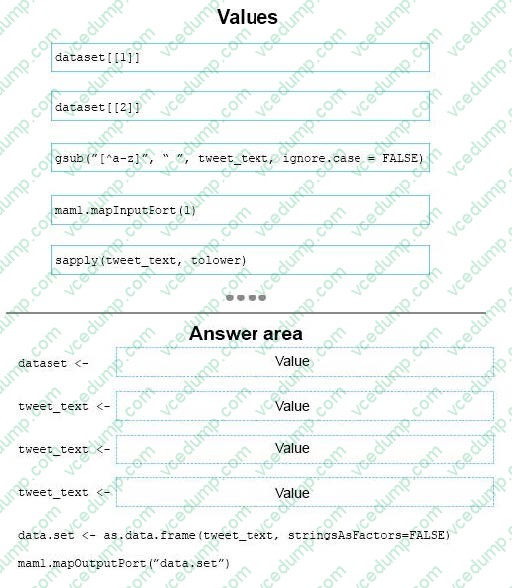
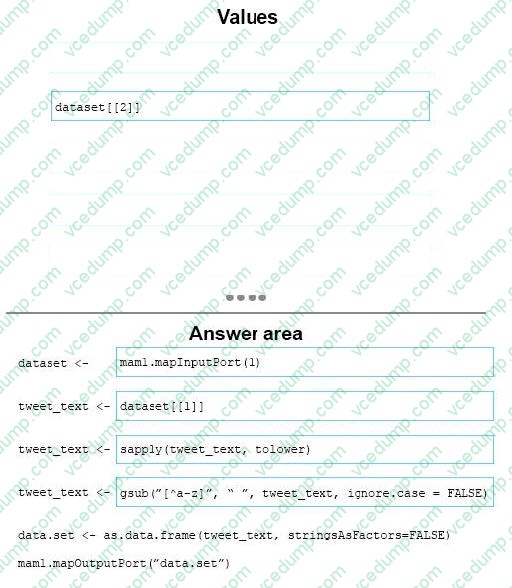
You have an Execute R Script module that has one input from either a Partition and Sample module or a Web service input module.
You need to preprocess tweets by using R. The solution must meet the following requirements:
How should you complete the R code? To answer, drag the appropriate values to the correct targets. Each value may be used once, more than once, or not at all. You may need to drag the split bar panes or scroll to view content.
NOTE: Each correct selection is worth one point.
Select and Place:
-
Question 39:
Note: This question is part of a series of questions that present the same scenario. Each question in the series contains a unique solution that might meet the stated goals. Some question sets might have more than one correct solution, while
others might not have a correct solution.
After you answer a question in this sections, you will NOT be able to return to it. As a result, these questions will not appear in the review screen.
You are designing an Azure Machine Learning workflow.
You have a dataset that contains two million large digital photographs.
You plan to detect the presence of trees in the photographs.
You need to ensure that your model supports the following:
Solution: You create an Azure notebook that supports the Microsoft Cognitive Toolkit.
Does this meet the goal?
A. Yes
B. No -
Question 40:
Note: This question is part of a series of questions that present the same scenario. Each question in the series contains a unique solution that might meet the stated goals. Some question sets might have more than one correct solution, while
others might not have a correct solution.
After you answer a question in this sections, you will NOT be able to return to it. As a result, these questions will not appear in the review screen.
You are working on an Azure Machine Learning experiment.
You have the dataset configured as shown in the following table.
You need to ensure that you can compare the performance of the models and add annotations to the results.
Solution: You connect the Score Model modules from each trained model as inputs for the Evaluate Model module, and then save the results as a dataset.
Does this meet the goal?
A. Yes
B. No

Related Exams:
-
62-193
Technology Literacy for Educators -
70-243
Administering and Deploying System Center 2012 Configuration Manager -
70-355
Universal Windows Platform – App Data, Services, and Coding Patterns -
77-420
Excel 2013 -
77-427
Excel 2013 Expert Part One -
77-725
Word 2016 Core Document Creation, Collaboration and Communication -
77-726
Word 2016 Expert Creating Documents for Effective Communication -
77-727
Excel 2016 Core Data Analysis, Manipulation, and Presentation -
77-728
Excel 2016 Expert: Interpreting Data for Insights -
77-731
Outlook 2016 Core Communication, Collaboration and Email Skills
Tips on How to Prepare for the Exams
Nowadays, the certification exams become more and more important and required by more and more enterprises when applying for a job. But how to prepare for the exam effectively? How to prepare for the exam in a short time with less efforts? How to get a ideal result and how to find the most reliable resources? Here on Vcedump.com, you will find all the answers. Vcedump.com provide not only Microsoft exam questions, answers and explanations but also complete assistance on your exam preparation and certification application. If you are confused on your 70-774 exam preparations and Microsoft certification application, do not hesitate to visit our Vcedump.com to find your solutions here.