70-767 Exam Details
-
Exam Code
:70-767 -
Exam Name
:Implementing a SQL Data Warehouse -
Certification
:Microsoft Certifications -
Vendor
:Microsoft -
Total Questions
:402 Q&As -
Last Updated
:Jan 28, 2022
Microsoft 70-767 Online Questions & Answers
-
Question 271:
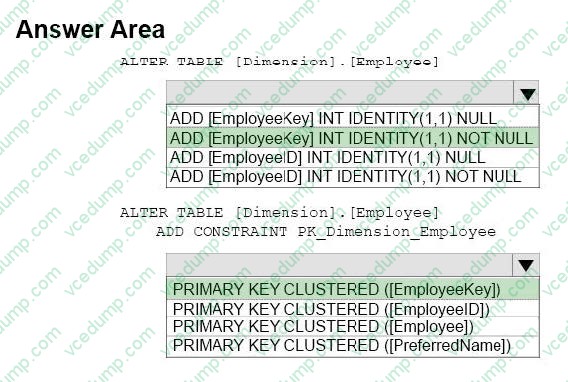
Your company has a Microsoft SQL Server data warehouse instance. The human resources department assigns all employees a unique identifier. You plan to store this identifier in a new table named Employee.
You create a new dimension to store information about employees by running the following Transact-SQL statement:
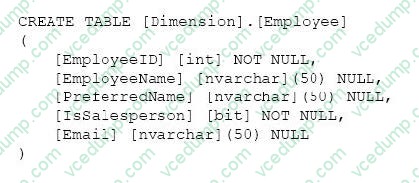
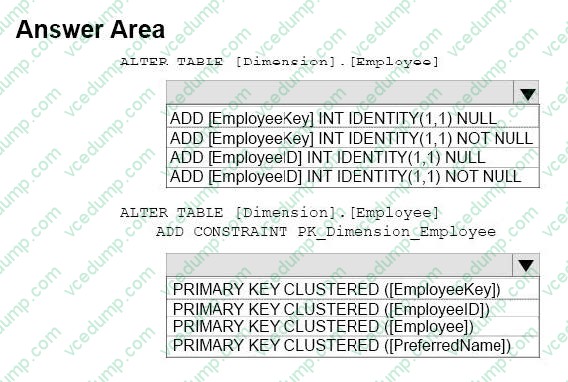
You have not added data to the dimension yet. You need to modify the dimension to implement a new column named [EmployeeKey]. The new column must use unique values. How should you complete the Transact-SQL statements? To answer, select the appropriate Transact-SQL segments in the answer area.
Hot Area:
-
Question 272:
HOTSPOT
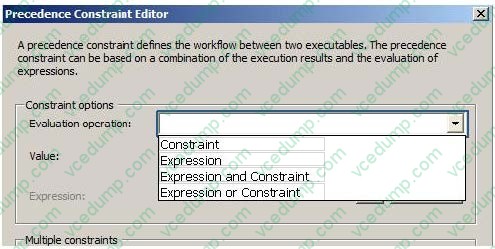
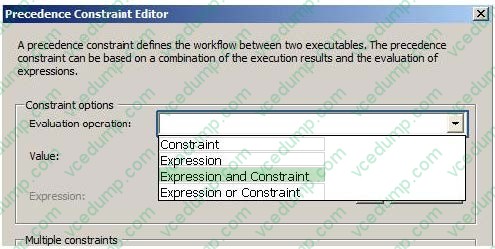
You are developing a SQL Server Integration Services (SSIS) package. An Execute SQL task in the package checks product stock levels and sets a package variable named InStock to TRUE or FALSE depending on the stock level found.
After the successful execution of the Execute SQL task, one of two data flow tasks must run, depending on the value of the InStock variable.
You need to set the precedence constraints.
Which value for the evaluation operation should you use? (To answer, select the appropriate option for the evaluation operation in the answer area.)
Hot Area:
-
Question 273:
You are a data warehouse developer.
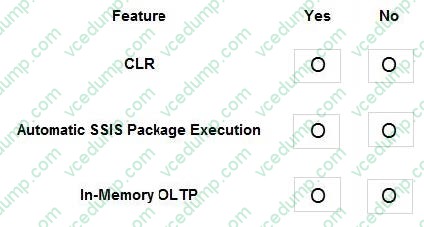
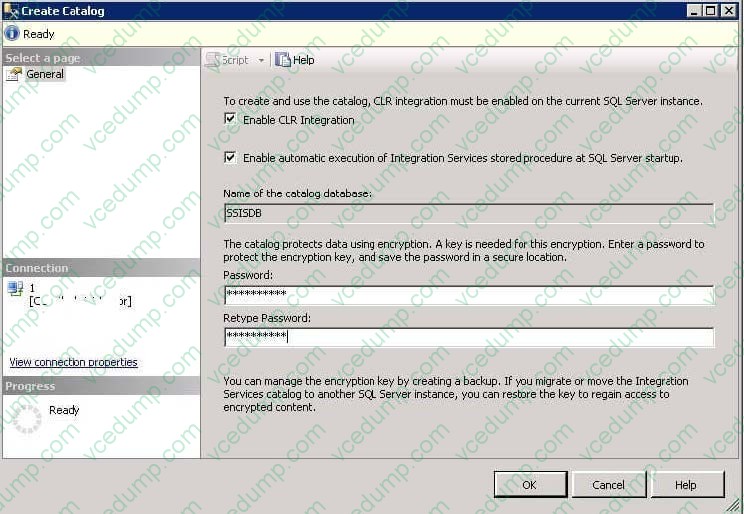
You need to create a Microsoft SQL Server Integration Services (SSIS) catalog on a production SQL Server instance.
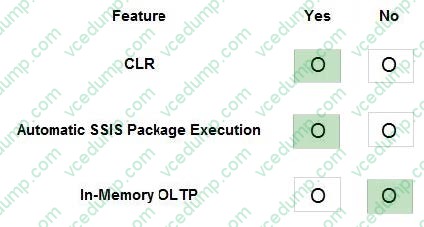
Which features are needed? To answer, select the appropriate options in the answer area.
Hot Area:
-
Question 274:
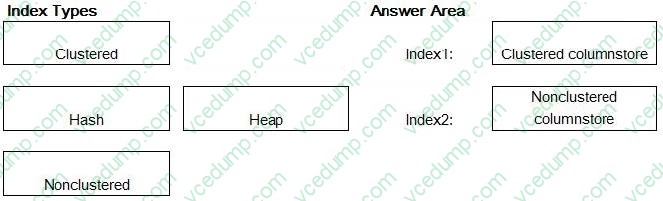
You are designing an indexing strategy for a data warehouse. The data warehouse contains a table named Table1. Data is bulk inserted into Table1. You plan to create the indexes configured as shown in the following table.
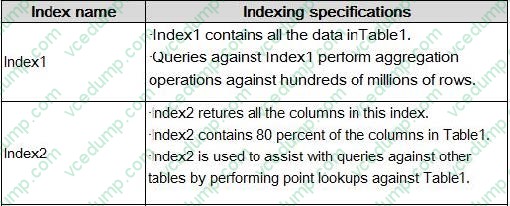
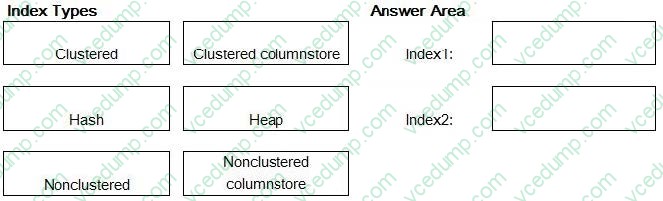
Which type of index should you use to minimize the query times of each index? To answer, drag the appropriate index types to the correct indexes. Each index type may be used once, more than once, or not at all. You may need to drag the split bar between panes or scroll to view content.
Select and Place:
-
Question 275:
Note: This question is part of a series of questions that present the same scenario. Each question in the series contains a unique solution that might meet the stated goals. Some question sets might have more than one correct solution, while
others might not have a correct solution.
After you answer a question in this section, you will NOT be able to return to it. As a result, these questions will not appear in the review screen.
You configure a new matching policy Master Data Services (MDS) as shown in the following exhibit.
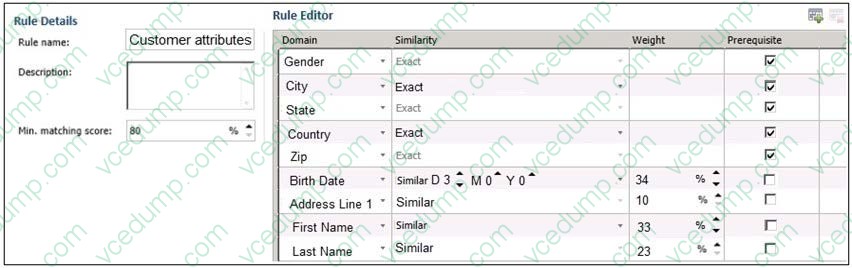
You review the Matching Results of the policy and find that the number of new values matches the new values.
You verify that the data contains multiple records that have similar address values, and you expect some of the records to match.
You need to increase the likelihood that the records will match when they have similar address values.
Solution: You decrease the minimum matching score of the matching policy.
Does this meet the goal?
A. Yes
B. No -
Question 276:
Note: This question is part of a series of questions that present the same scenario. Each question in the series contains a unique solution that might meet the stated goals. Some question sets might have more than one correct solution, while
others might not have a correct solution.
After you answer a question in this section, you will NOT be able to return to it. As a result, these questions will not appear in the review screen.
You configure a new matching policy Master Data Services (MDS) as shown in the following exhibit.
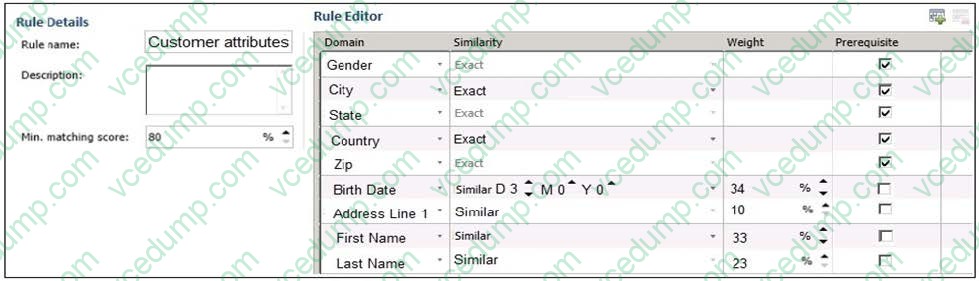
You review the Matching Results of the policy and find that the number of new values matches the new values.
You verify that the data contains multiple records that have similar address values, and you expect some of the records to match.
You need to increase the likelihood that the records will match when they have similar address values.
Solution: You increase the relative weights for Address Line 1 of the matching policy.
Does this meet the goal?
A. Yes
B. No -
Question 277:
You are designing a data warehouse with two fact tables. The first table contains sales per month and the second table contains orders per day.
Referential integrity must be enforced declaratively.
You need to design a solution that can join a single time dimension to both fact tables.
What should you do?
A. Join the two fact tables.
B. Merge the fact tables.
C. Create a time dimension that can join to both fact tables at their respective granularity.
D. Create a surrogate key for the time dimension. -
Question 278:
DRAG DROP
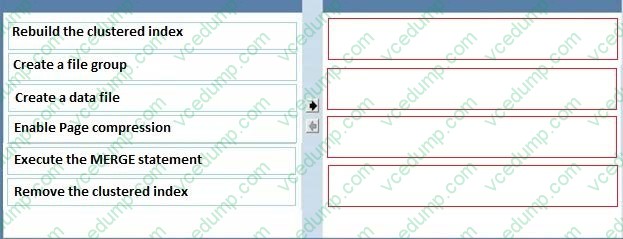
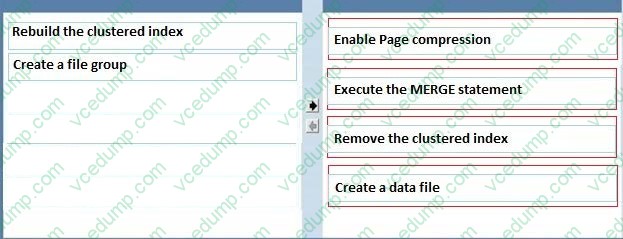
You have a SQL Server data warehouse that contains all of the customer data for your company. You plan to deploy an archiving solution.
You need to move a table named OLDCUSTOMERS to a new storage device.
OLDCUSTOMERS contains a clustered index.
Which four actions should you perform in sequence?
Select and Place:
-
Question 279:
You are developing a SQL Server Integration Services (SSIS) package that imports data into a data warehouse hosted on SQL Azure.
The package uses a Foreach container to process text files found in a folder. The package must be deployed to a single server by using the Project Deployment model. Multiple SQL Server Agent jobs call the package. Each job is executed
on a different schedule.
Each job passes a different folder path to the package.
You need to configure the package to accept the folder path from each job.
Which package configuration should you use?
A. Parent Package Variable
B. XML Configuration File
C. Environment Variable
D. .dtsConfig file
E. Registry Entry -
Question 280:
Note: This question is part of a series of questions that use the same scenario. For your convenience, the scenario is repeated in each question. Each question presents a different goal and answer choices, but the text of the scenario is
exactly the same in each question in this series.
You have a Microsoft SQL Server data warehouse instance that supports several client applications.
The data warehouse includes the following tables: Dimension.SalesTerritory, Dimension.Customer, Dimension.Date, Fact.Ticket, and Fact.Order. The Dimension.SalesTerritory and Dimension.Customer tables are frequently updated. The
Fact.Order table is optimized for weekly reporting, but the company wants to change it daily. The Fact.Order table is loaded by using an ETL process. Indexes have been added to the table over time, but the presence of these indexes slows
data loading.
All data in the data warehouse is stored on a shared SAN. All tables are in a database named DB1. You have a second database named DB2 that contains copies of production data for a development environment. The data warehouse has
grown and the cost of storage has increased. Data older than one year is accessed infrequently and is considered historical.
You have the following requirements:
Implement table partitioning to improve the manageability of the data warehouse and to avoid the need to repopulate all transactional data each night. Use a partitioning strategy that is as granular as possible.
Partition the Fact.Order table and retain a total of seven years of data.
Partition the Fact.Ticket table and retain seven years of data. At the end of each month, the partition structure must apply a sliding window strategy to ensure that a new partition is available for the upcoming month, and that the oldest month of data is archived and removed.
Optimize data loading for the Dimension.SalesTerritory, Dimension.Customer, and Dimension.Date tables.
Incrementally load all tables in the database and ensure that all incremental changes are processed.
Maximize the performance during the data loading process for the Fact.Order partition.
Ensure that historical data remains online and available for querying.
Reduce ongoing storage costs while maintaining query performance for current data.
You are not permitted to make changes to the client applications.
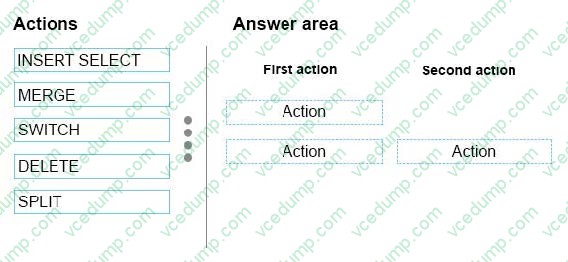
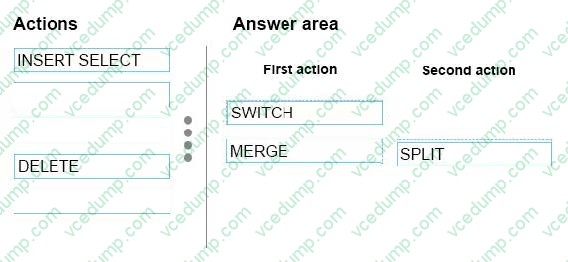
You need to implement partitioning for the Fact.Ticket table.
Which three actions should you perform in sequence? To answer, drag the appropriate actions to the correct locations. Each action may be used once, more than once or not at all. You may need to drag the split bar between panes or scroll
to view content.
NOTE: More than one combination of answer choices is correct. You will receive credit for any of the correct combinations you select.
Select and Place:
Related Exams:
-
62-193
Technology Literacy for Educators -
70-243
Administering and Deploying System Center 2012 Configuration Manager -
70-355
Universal Windows Platform – App Data, Services, and Coding Patterns -
77-420
Excel 2013 -
77-427
Excel 2013 Expert Part One -
77-725
Word 2016 Core Document Creation, Collaboration and Communication -
77-726
Word 2016 Expert Creating Documents for Effective Communication -
77-727
Excel 2016 Core Data Analysis, Manipulation, and Presentation -
77-728
Excel 2016 Expert: Interpreting Data for Insights -
77-731
Outlook 2016 Core Communication, Collaboration and Email Skills
Tips on How to Prepare for the Exams
Nowadays, the certification exams become more and more important and required by more and more enterprises when applying for a job. But how to prepare for the exam effectively? How to prepare for the exam in a short time with less efforts? How to get a ideal result and how to find the most reliable resources? Here on Vcedump.com, you will find all the answers. Vcedump.com provide not only Microsoft exam questions, answers and explanations but also complete assistance on your exam preparation and certification application. If you are confused on your 70-767 exam preparations and Microsoft certification application, do not hesitate to visit our Vcedump.com to find your solutions here.