70-767 Exam Details
-
Exam Code
:70-767 -
Exam Name
:Implementing a SQL Data Warehouse -
Certification
:Microsoft Certifications -
Vendor
:Microsoft -
Total Questions
:402 Q&As -
Last Updated
:Jan 28, 2022
Microsoft 70-767 Online Questions & Answers
-
Question 221:
Note: This question is part of a series of questions that present the same scenario. Each question in the series contains a unique solution that might meet the stated goals. Some question sets might have more than one correct solution, while
others might not have a correct solution.
After you answer a question in this sections, you will NOT be able to return to it. As a result, these questions will not appear in the review screen.
You are developing a Microsoft SQL Server Integration Services (SSIS) projects. The project consists of several packages that load data warehouse tables.
You need to extend the control flow design for each package to use the following control flow while minimizing development efforts and maintenance:
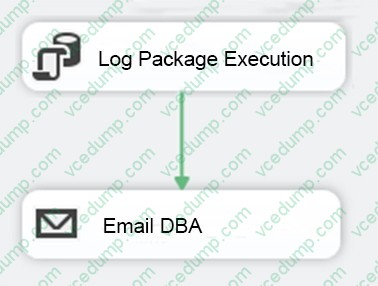
Solution: You add the control flow to an ASP.NET assembly. You add a script task that references this assembly to each data warehouse load package. Does the solution meet the goal?
A. Yes
B. No -
Question 222:
You manage a data warehouse in a Microsoft SQL Server instance. Company employee information is imported from the human resources system to a table named Employee in the data warehouse instance. The Employee table was created by running the query shown in the Employee Schema exhibit. (Click the Exhibit button.)
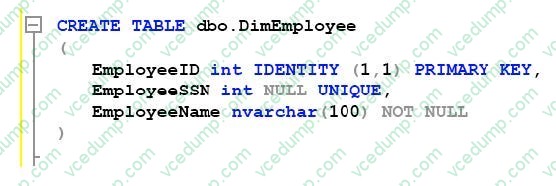
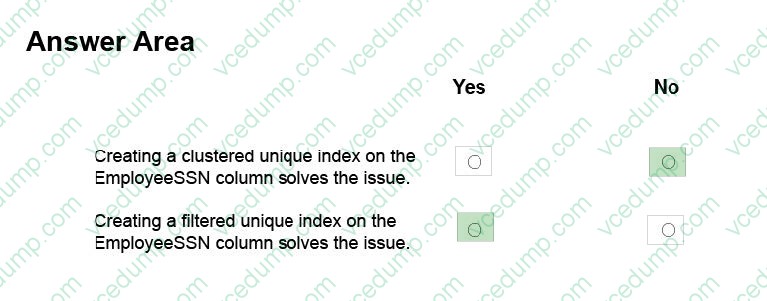
The personal identification number is stored in a column named EmployeeSSN. All values in the EmployeeSSN column must be unique. When importing employee data, you receive the error message shown in the SQL Error exhibit. (Click the Exhibit button.).
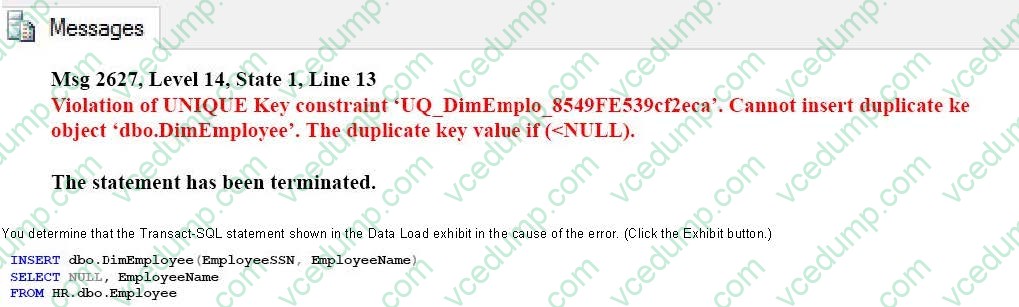
You determine that the Transact-SQL statement shown in the Data Load exhibit in the cause of the error. (Click the Exhibit button.)
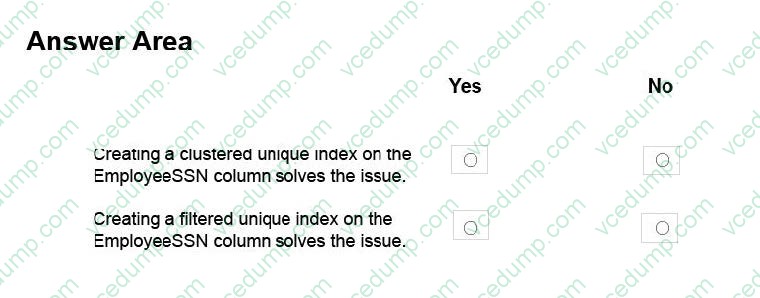
You remove the constraint on the EmployeeSSN column. You need to ensure that values in the EmployeeSSN column are unique.
For each of the following statements, select Yes if the statement is true. Otherwise, select No.
NOTE: Each correct selection is worth one point.
Hot Area:
-
Question 223:
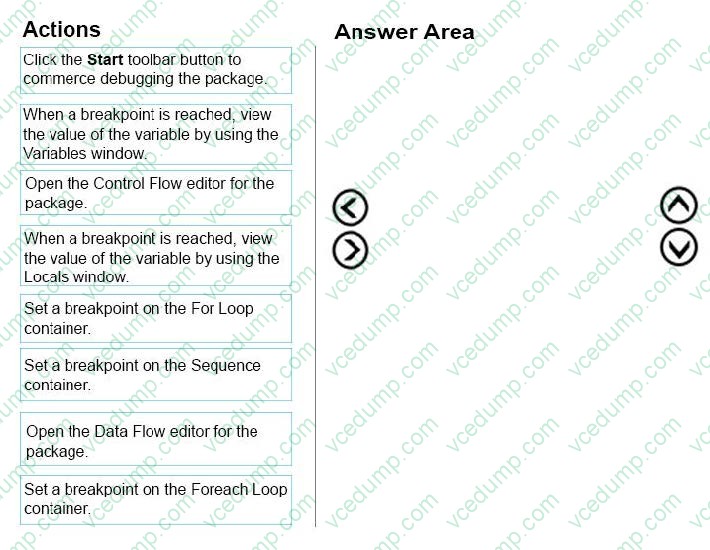
You have a Microsoft SQL Server Integration Services (SSIS) package that loads data into a data warehouse each night from a transactional system. The package also loads data from a set of Comma-Separated Values (CSV) files that are
provided by your company's finance department.
The SSIS package processes each CSV file in a folder. The package reads the file name for the current file into a variable and uses that value to write a log entry to a database table.
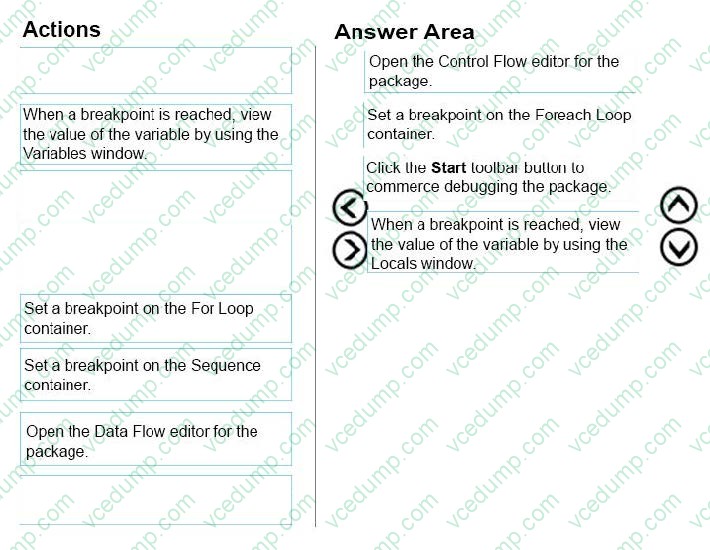
You need to debug the package and determine the value of the variable before each file is processed.
Which four actions should you perform in sequence? To answer, move the appropriate actions from the list of actions to the answer area and arrange them in the correct order.
Select and Place:
-
Question 224:
You are developing a SQL Server Integration Services (SSIS) project by using the Project Deployment Model. All packages in the project must log custom messages.
You need to produce reports that combine the custom log messages with the system- generated log messages. What should you do?
A. Use an event handler for OnError for the package.
B. Use an event handler for OnError for each data flow task.
C. Use an event handler for OnTaskFailed for the package.
D. View the job history for the SQL Server Agent job.
E. View the All Messages subsection of the All Executions report for the package.
F. Store the System::SourceID variable in the custom log table.
G. Store the System::ServerExecutionID variable in the custom log table.
H. Store the System::ExecutionInstanceGUID variable in the custom log table.
I. Enable the SSIS log provider for SQL Server for OnError in the package control flow.
J. Enable the SSIS log provider for SQL Server for OnTaskFailed in the package control flow, -
Question 225:
You are completing the installation of the Data Quality Server component of SQL Server Data Quality Services (DQS).
You need to complete the post-installation configuration.
What should you do?
A. Run the DQSInstaller.exe command.
B. Install the data providers that are used for data refresh.
C. Install ADOMD.NET.
D. Run the dbimpexp.exe command. -
Question 226:
You install a SQL Server 2016 database engine instance on a production server. A month later, you install SQL Server 2016 Integration Services (SSIS).
You must develop an SSIS project and deploy it to the server by using the Project Deployment model.
Operations Log records that are outside the configured retention period must be cleaned automatically.
You need to create the SSIS catalog on the production server.
What should you do? (Each correct answer presents part of the solution. Choose all that apply.)
A. Enable XP Command Shell.
B. Enable CLR Integration.
C. Enable OLE Automation.
D. Start the SQL Server Browser service.
E. Enable Cross Database Ownership Chaining
F. Start the SQL Server Agent service
G. Enable Ad Hoc Remote Queries. -
Question 227:
You are adding a new capability to several dozen SQL Server Integration Services (SSIS) packages.
The new capability is not available as an SSIS task. Each package must be extended with the same new capability.
You need to add the new capability to all the packages without copying the code between packages. What should you do?
A. Use the Expression task.
B. Use the Script task.
C. Develop a custom task.
D. Use the Script component,
E. Develop a custom component. -
Question 228:
Note: This question is part of a series of questions that present the same scenario. Each question in the series contains a unique solution that might meet the stated goals. Some question sets might have more than one correct solution, while
others might not have a correct solution.
After you answer a question in this sections, you will NOT be able to return to it. As a result, these questions will not appear in the review screen.
You have the following line-of-business solutions:
If a change is made to the ReferenceNr column in any of the sources, set the value of IsDisabled to True and create a new row in the Products table. If a row is deleted in any of the sources, set the value of IsDisabled to True in the data
warehouse.
One or more Microsoft SQL Server instances support each solution. Each solution has its own product catalog. You have an additional server that hosts SQL Server Integration Services (SSIS) and a data warehouse. You populate the data
warehouse with data from each of the line-of-business solutions. The data warehouse does not store primary key values from the individual source tables.
The database for each solution has a table named Products that stored product information. The Products table in each database uses a separate and unique key for product records. Each table shares a column named ReferenceNr between
the databases. This column is used to create queries that involve more than once solution.
You need to load data from the individual solutions into the data warehouse nightly. The following requirements must be met:
Enable the Change Tracking for the Product table in the source databases. Query the cdc.fn_cdc_get_all_changes_capture_dbo_products function from the sources for updated rows.
Set the IsDisabled column to True for rows with the old ReferenceNr value. Create a new row in the data warehouse Products table with the new ReferenceNr value.
Solution: Perform the following actions:
Does the solution meet the goal?
A. Yes
B. No -
Question 229:
You are designing a SQL Server Integration Services (SS1S) package that uploads a file to a table named Orders in a SQL Azure database.
The company's auditing policies have the following requirements:
A. OnProgress
B. Onlnformation
C. OnPostExecute
D. OnComplete -
Question 230:
Note: This question is part of a series of questions that present the same scenario. Each question in the series contains a unique solution that might meet the stated goals. Some question sets might have more than one correct solution, while others might not have a correct solution.
After you answer a question in this section, you will NOT be able to return to it. As a result, these questions will not appear in the review screen.
You have an on-premises Microsoft SQL Server instance and a Microsoft Azure SQL Data Warehouse instance. You move data from the on-premises database to the data warehouse once each day by using a SQL Server Integration
Services (SSIS) package.
You observe that the package no longer completes within the allotted time.
You need to determine which tasks are taking a long time to complete.
Solution: You alter the package to log the start and completion times for a task to a table in the on-premises SQL Server instance.
Does the solution meet the goal?
A. Yes
B. No
Related Exams:
-
62-193
Technology Literacy for Educators -
70-243
Administering and Deploying System Center 2012 Configuration Manager -
70-355
Universal Windows Platform – App Data, Services, and Coding Patterns -
77-420
Excel 2013 -
77-427
Excel 2013 Expert Part One -
77-725
Word 2016 Core Document Creation, Collaboration and Communication -
77-726
Word 2016 Expert Creating Documents for Effective Communication -
77-727
Excel 2016 Core Data Analysis, Manipulation, and Presentation -
77-728
Excel 2016 Expert: Interpreting Data for Insights -
77-731
Outlook 2016 Core Communication, Collaboration and Email Skills
Tips on How to Prepare for the Exams
Nowadays, the certification exams become more and more important and required by more and more enterprises when applying for a job. But how to prepare for the exam effectively? How to prepare for the exam in a short time with less efforts? How to get a ideal result and how to find the most reliable resources? Here on Vcedump.com, you will find all the answers. Vcedump.com provide not only Microsoft exam questions, answers and explanations but also complete assistance on your exam preparation and certification application. If you are confused on your 70-767 exam preparations and Microsoft certification application, do not hesitate to visit our Vcedump.com to find your solutions here.