70-744 Exam Details
-
Exam Code
:70-744 -
Exam Name
:Securing Windows Server 2016 -
Certification
:Microsoft Certifications -
Vendor
:Microsoft -
Total Questions
:258 Q&As -
Last Updated
:Feb 16, 2021
Microsoft 70-744 Online Questions & Answers
-
Question 171:
You have a server named Server1 that runs Windows Server 2016.
You configure Just Enough Administration (JEA) on Server1.
You need to view a list of commands that will be available to a user named User1 when User1 establishes a JEA session to Server1.
Which cmdlet should you use?
A. Trace-Command
B. Get-PSSessionCapability
C. Get-PSSessionConfiguration
D. Show-Command -
Question 172:
Your network contains an Active Directory domain named contoso.com. The domain contains a server named Server1. You implement the Local Administrator Password Solution (LAPS) in the domain. You enable auditing for LAPS. You need to identify any users who read the password for Server1. Which log should you review?
A. Windows Logs\System on Server1
B. Windows Logs\Security on the domain controllers
C. Applications and Services Logs\Directory Service on the domain controllers
D. Windows Logs\Application on Server1 -
Question 173:
You have a Hyper-V host named Server1 that runs Windows Server 2016. Server1 has a generation 2 virtual machine named VM1 that runs Windows 10.
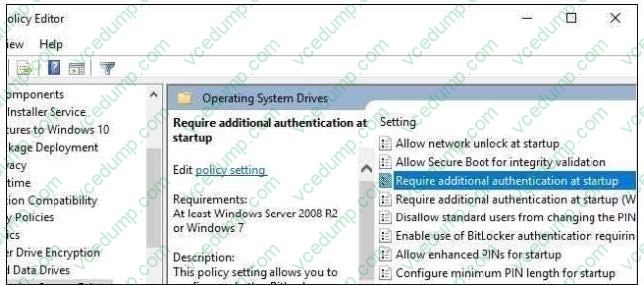
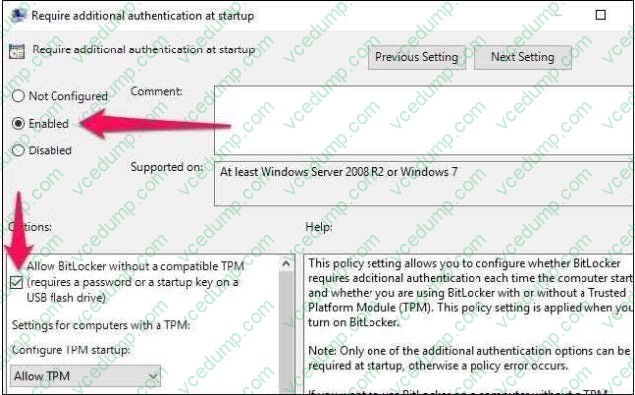
You need to ensure that you can turn on BitLocker Drive Encryption (BitLocker) for drive C: on VM1. What should you do?
A. From Server1, install the BitLocker feature.
B. From Server1, enable nested virtualization for VM1.
C. From VM1, configure the Require additional authentication at startup Group Policy setting.
D. From VM1, configure the Enforce drive encryption type on fixed data drives Group Policy setting. -
Question 174:
Your network contains an Active Directory domain named contoso.com. All domain controllers run Windows Server 2016.
The domain contains a server named Server1 that has Microsoft Security Compliance Manager (SCM) 4.0 installed.
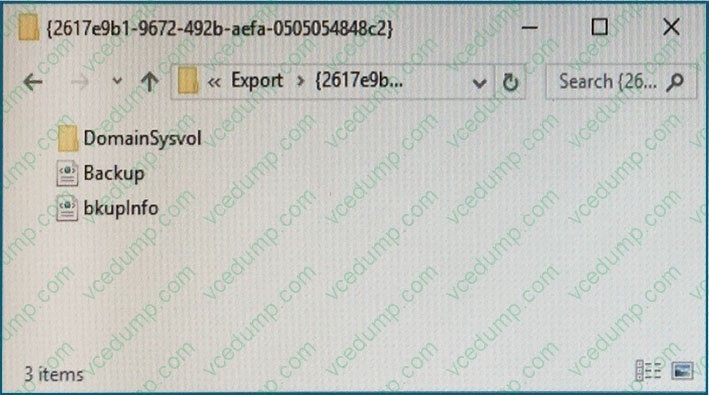
You export the baseline shown in the following exhibit.
You have a server named Server2 that is a member of a workgroup.
You copy the {2617e9b1-9672-492b-aefa-0505054848c2} folder to Server2.
You need to deploy the baseline settings to Server2.
What should you do?
A. Download, install, and then fun the Lgpo.exe command.
B. From Group Policy Management import a Group Policy object (GPO).
C. From Windows PowerShell, run the Restore-GPO cmdlet.
D. From Windows PowerShell, run the Import-GPO cmdlet.
E. From a command prompt run the secedit.exe command and specify the /import parameter. -
Question 175:
The Job Title attribute for a domain user named User1 has a value of Sales Manager. User1 runs whoami /claims and receives the following output:
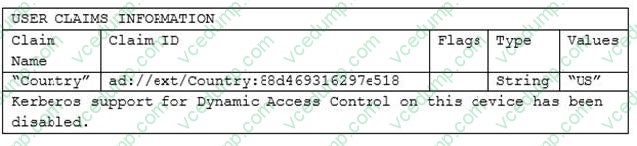
Kerberos support for Dynamic Access Control on this device has been disabled.
You need to ensure that the security token of User1 has a claim for Job Title. What should you do?
A. From Windows PowerShell, run the New-ADClaimTransformPolicy cmdlet and specify the -Name parameter
B. From Active Directory Users and Computers, modify the properties of the User1 account.
C. From Active Directory Administrative Center, add a claim type.
D. From a Group Policy object (GPO), configure KDC support for claims, compound authentication, and Kerberos armoring. -
Question 176:
DRAG DROP
Your network contains an Active Directory domain named contoso.com. The domain functional level is Windows Server 2016. The domain contains a member server named Server1.
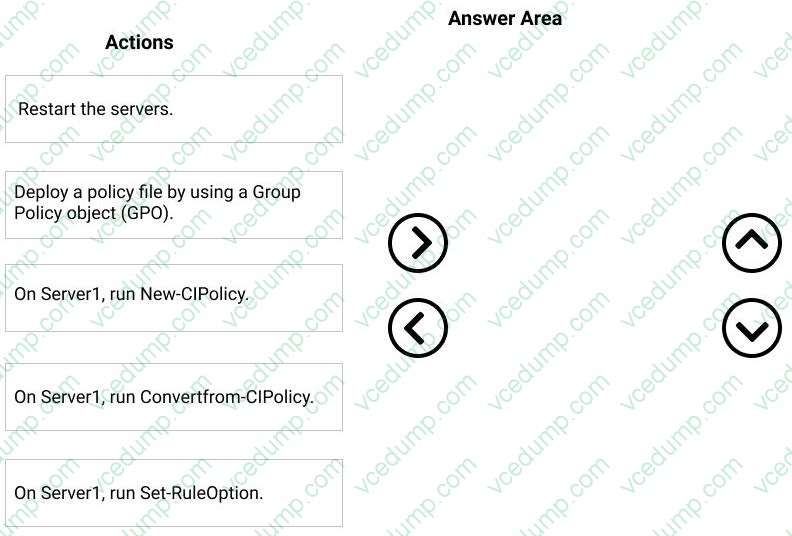
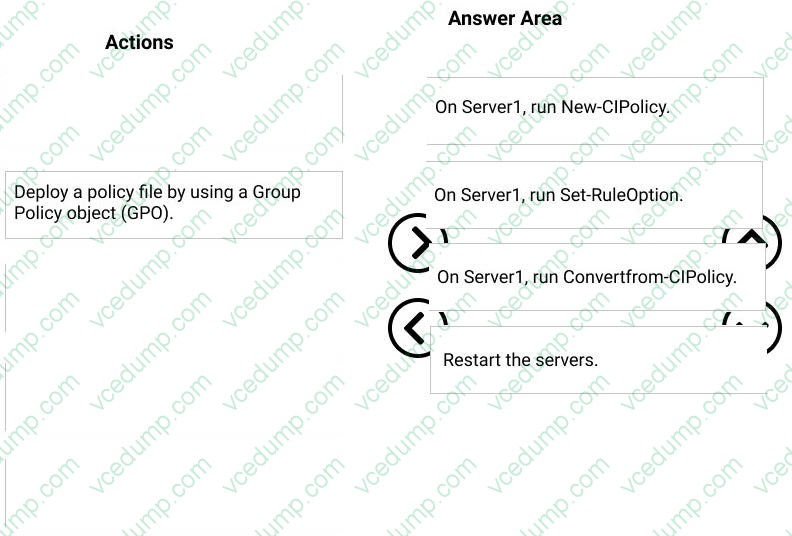
You test Code Integrity on Server1 in audit mode.
You need to enforce the Code Integrity levels on all the Windows Server 2016 servers in the domain.
Which four actions should you perform in sequence? To answer, move the appropriate actions from the list of actions to the answer area and arrange them in the correct order.
Select and Place:
-
Question 177:
Your network contains an Active Directory domain.
You install Security Compliance Manager (SCM) 4.0 on a server that runs Windows Server 2016.
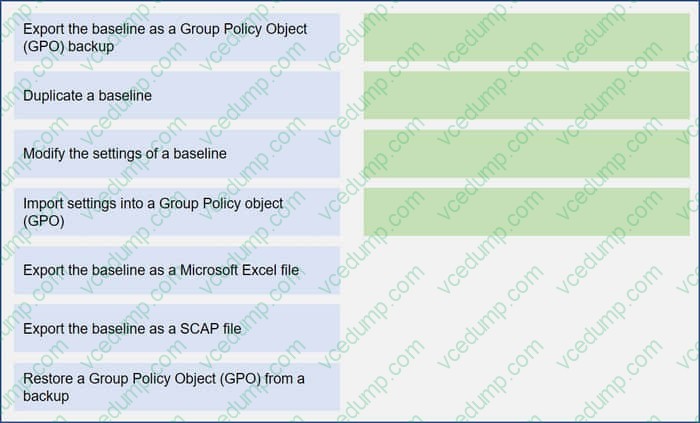
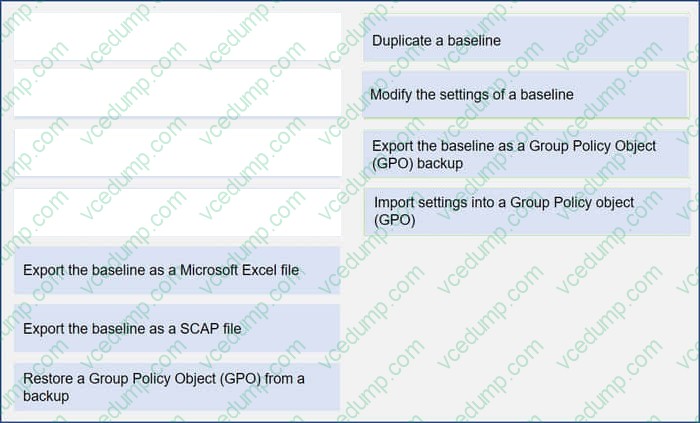
You need to modify a baseline, and then make the baseline available as a domain policy.
Which four actions should you perform in sequence?
Select and Place:
-
Question 178:
You deploy the Host Guardian Service (HGS).
You have several Hyper-V hosts that have older hardware and Trusted Platform Modules (TPMs) version 1.2.
You discover that the Hyper-V hosts cannot start shielded virtual machines.
You need to configure HGS to ensure that the older Hyper-V hosts can host shielded virtual machines. What should you do?
A. Run the Set-HgsServer cmdlet and specify the -TrustTpm parameter.
B. Run the Set-HgsServer cmdlet and specify the -TrustActiveDirectory parameter.
C. Run the Clear-HgsServer cmdlet and specify the -Clustername parameter
D. Run the Clear-HgsServer cmdlet and specify the -Force parameter.
E. It is not possible to enable older Hyper-V hosts to run Shielded virtual machines -
Question 179:
Your network contains an Active Directory forest named contoso.com. The forest functional level is Windows Server 2012.
The forest contains 20 member servers that are configured as file servers. All domain controllers run Windows Server 2016.
You create a new forest named contosoadmin.com.
You need to use the Enhanced Security Administrative Environment (ESAE) approach for the administration of the resources in contoso.com.
Which two actions should you perform? Each correct answer presents part of the solution.
A. From the properties of the trust, enable selective authentication.
B. Configure contosoadmin.com to trust contoso.com.
C. Configure contoso.com to trust contosoadmin.com.
D. From the properties of the trust, enable forest-wide authentication.
E. Configure a two-way trust between both forests. -
Question 180:
Your network contains an Active Directory domain named contoso.com. The domain contains a server named Server1 that runs Windows Server 2016.
You deploy Advanced Threat Analytics (ATA) to Server1.
You need to move the ATA database to a different folder.
Which configuration file should you modify?
A. Config.json
B. Web.config
C. Config.xml
D. Mongod.cfg
Related Exams:
-
62-193
Technology Literacy for Educators -
70-243
Administering and Deploying System Center 2012 Configuration Manager -
70-355
Universal Windows Platform – App Data, Services, and Coding Patterns -
77-420
Excel 2013 -
77-427
Excel 2013 Expert Part One -
77-725
Word 2016 Core Document Creation, Collaboration and Communication -
77-726
Word 2016 Expert Creating Documents for Effective Communication -
77-727
Excel 2016 Core Data Analysis, Manipulation, and Presentation -
77-728
Excel 2016 Expert: Interpreting Data for Insights -
77-731
Outlook 2016 Core Communication, Collaboration and Email Skills
Tips on How to Prepare for the Exams
Nowadays, the certification exams become more and more important and required by more and more enterprises when applying for a job. But how to prepare for the exam effectively? How to prepare for the exam in a short time with less efforts? How to get a ideal result and how to find the most reliable resources? Here on Vcedump.com, you will find all the answers. Vcedump.com provide not only Microsoft exam questions, answers and explanations but also complete assistance on your exam preparation and certification application. If you are confused on your 70-744 exam preparations and Microsoft certification application, do not hesitate to visit our Vcedump.com to find your solutions here.