70-742 Exam Details
-
Exam Code
:70-742 -
Exam Name
:Identity with Windows Server 2016 -
Certification
:Microsoft Certifications -
Vendor
:Microsoft -
Total Questions
:289 Q&As -
Last Updated
:Feb 07, 2022
Microsoft 70-742 Online Questions & Answers
-
Question 121:
Note: This question is part of a series of questions that use the same scenario. For your convenience, the scenario is repeated in each question. Each question presents a different goal and answer choices, but the text of the scenario is
exactly the same in each question in this series.
Start of repeated scenario.
Your network contains an Active Directory domain named contoso.com. The domain contains a single site named Site1. All computers are in Site1.
The Group Policy objects (GPOs) for the domain are configured as shown in the exhibit. (Click the Exhibit button.)
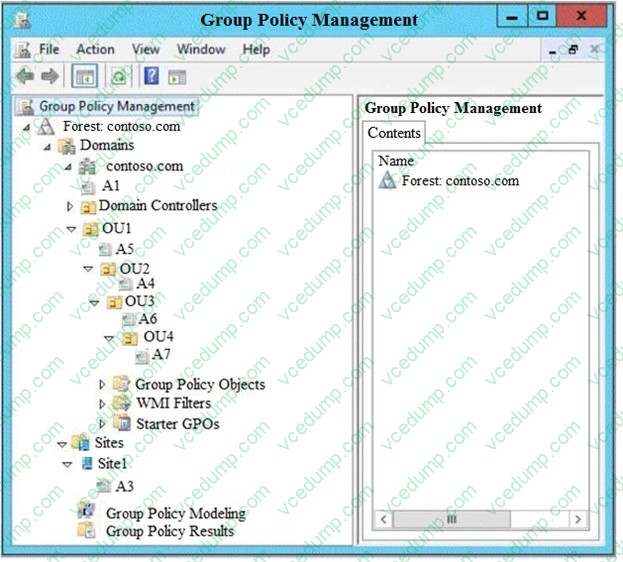
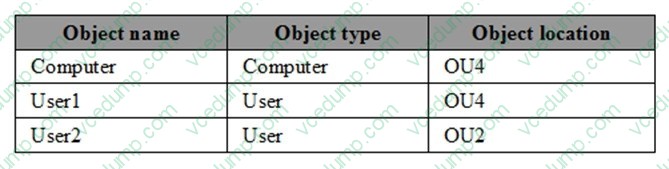
The relevant users and client computer in the domain are configured as shown in the following table.
End of repeated scenario.
You are evaluating what will occur when you set user Group Policy loopback processing mode to Replace in A4.
Which GPO or GPOs will apply to User2 when the user signs in to Computer1 after loopback processing is configured?
A. A1, A5, A6 and A4
B. A3, A1, A4, and A7
C. A3, A1, A5 and A4
D. A4 only -
Question 122:
Note: This question is part of a series of questions that present the same scenario. Each question in the series contains a unique solution that might meet the stated goals. Some question sets might have more than one correct solution, while
others might not have a correct solution.
After you answer a question in this section, you will NOT be able to return to it. As a result, these questions will not appear in the review screen.
Your network contains an Active Directory forest named contoso.com. The forest contains a member server named Server1 that runs Windows Server 2016. All domain controllers run Windows Server 2012 R2.
Contoso.com has the following configuration.
PS C:\> (Get-ADForest).ForestMode
Windows2008R2Forest
PS C:\> (Get-ADDomain).DomainMode Windows2008R2Domain PS C:\>
You plan to deploy an Active Directory Federation Services (AD FS) farm on Server1 and to configure device registration.
You need to configure Active Directory to support the planned deployment.
Solution: You run adprep.exe from the Windows Server 2016 installation media.
Does this meet the goal?
A. Yes
B. No -
Question 123:
Note: This question is part of a series of questions that use the same scenario. For you convenience, the scenario is repeated in each question. Each question presents a different goal and answer choices, but the text of the scenario is
exactly the same in each question in this series.
Start of repeated scenario.
You work for a company named Contoso, Ltd.
The network contains an Active Directory forest named contoso.com. A forest trust exists between contoso.com and an Active Directory forest named adatum.com. The contoso.com forest contains the objects configured as shown in the following table.
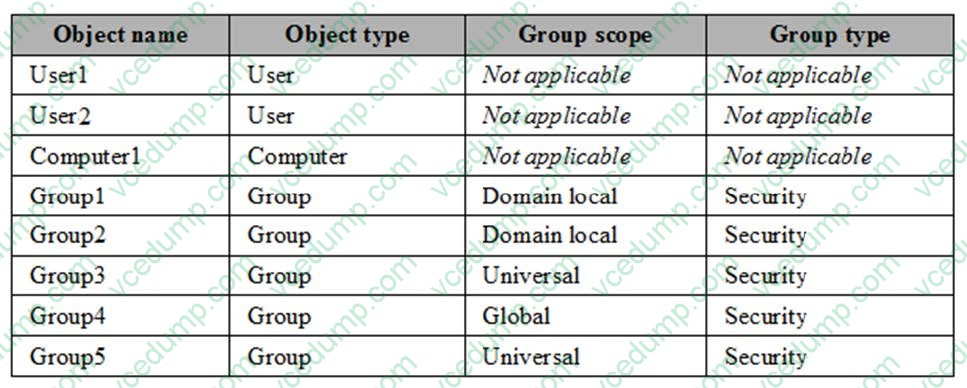
Group1 and Group2 contain only user accounts.
Contoso hires a new remote user named User3. User3 will work from home and will use a computer named Computer3 that runs Windows 10. Computer3 is currently in a workgroup.
An administrator named Admin1 is a member of the Domain Admins group in the contoso.com domain.
From Active Directory Users and Computers, you create an organizational unit (OU) named OU1 in the contoso.com domain, and then you create a contact named Contact1 in OU1.
An administrator of the adatum.com domain runs the Set-ADUser cmdlet to configure a user named User1 to have a user logon name of [email protected].
End or repeated scenario.
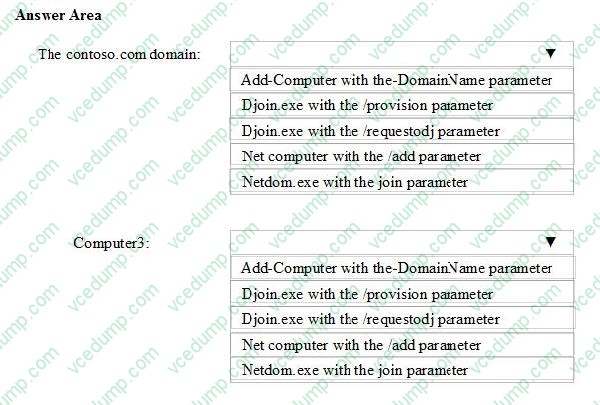
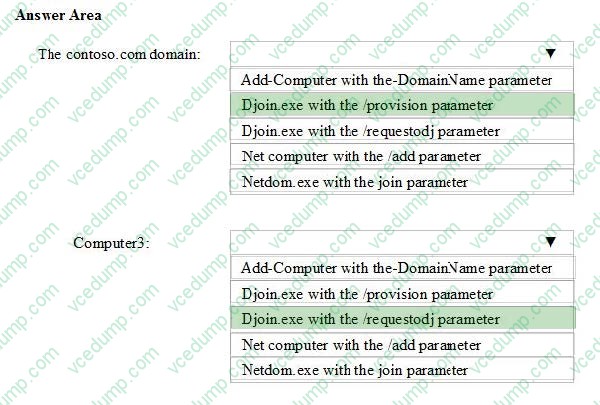
You need to join Computer3 to the contoso.com domain by using offline domain join.
Which command should you use in the contoso.com domain and on Computer3? To answer, select the appropriate options in the answer area.
Hot Area:
-
Question 124:
Your network contains an Active Directory domain named contoso.com. The domain contains a web application that uses Kerberos authentication.
You change the domain name of the web application.
You need to ensure that the service principal name (SPN) for the application is registered.
Which tool should you use?
A. Internet Information Services (IIS) Manager
B. Netsh
C. Repladmin
D. Setspn -
Question 125:
Your company uses Active Directory Rights Management Services (AD RMS).
You need to ensure that only users who use AD RMS client version 2.1 or newer can obtain a rights account certificate from the AD RMS cluster.
What should you enable first?
A. decommissioning
B. user exclusion
C. lockbox exclusion
D. Application Exclusion -
Question 126:
Note: This question is part of a series of questions that use the same or similar answer choices. An answer choice may be correct for more than one question in the series. Each question is independent of the other questions in this series.
Information and details provided in a question apply only to that question.
Your network contains an Active Directory domain named contoso.com. The domain contains 5,000 user accounts.
You have a Group Policy object (GPO) named DomainPolicy that is linked to the domain and a GPO named DCPolicy that is linked to the Domain Controllers organizational unit (OU).
You need to ensure that all of the client computers on the network automatically download and install Windows updates.
What should you do?
A. From the Computer Configuration node of DCPolicy, modify Security Settings.
B. From the Computer Configuration node of DomainPolicy, modify Security Settings.
C. From the Computer Configuration node of DomainPolicy, modify Administrative Templates.
D. From the User Configuration node of DCPolicy, modify Security Settings.
E. From the User Configuration node of DomainPolicy, modify Folder Redirection.
F. From user Configuration node of DomainPolicy, modify Administrative Templates.
G. From Preferences in the User Configuration node of DomainPolicy, modify Windows Settings.
H. From Preferences in the Computer Configuration node of DomainPolicy, modify Windows Settings. -
Question 127:
Note: This question is part of a series of questions that present the same scenario. Each question in the series contains a unique solution that might meet the stated goals. Some question sets might have more than one correct solution, while
others might not have a correct solution.
After you answer a question in this section, you will NOT be able to return to it. As a result, these questions will not appear in the review screen.
Your network contains an Active Directory forest. The forest contains a domain named contoso.com. The domain contains three domain controllers.
A domain controller named lon-dc1 fails. You are unable to repair lon-dc1.
You need to prevent the other domain controllers from attempting to replicate to lon-dc1.
Solution: From Active Directory Sites and Services, you remove the object of lon-dc1.
Does this meet the goal?
A. Yes
B. No -
Question 128:
Your network contains an Active Directory forest named contoso.com. The forest contains 10 domains. The root domain contains a global catalog server named DC1.
You remove the global catalog server role from DC1.
You need to decrease the size of the Active Directory database on DC1.
Solution: You restart DC1 in Directory Services Repair Mode. You run compact.exe, and then restart DC1.
Does this meet the goal?
A. Yes
B. No -
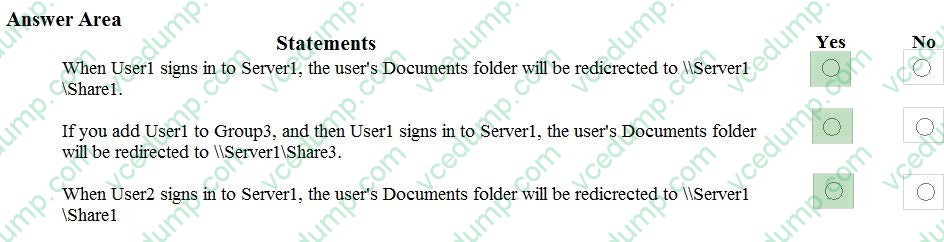
Question 129:
HOTSPOT
Your network contains an Active Directory domain named contoso.com. The relevant objects in the domain are configured as shown in the following table.
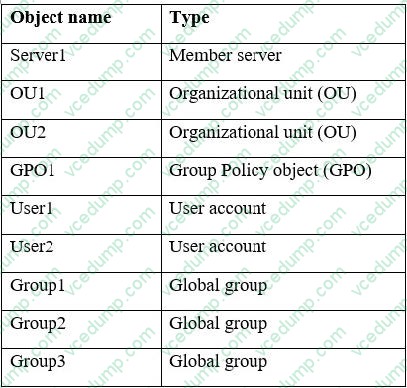
You have the following configurations:
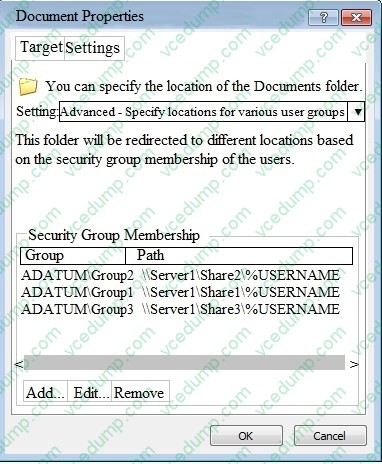
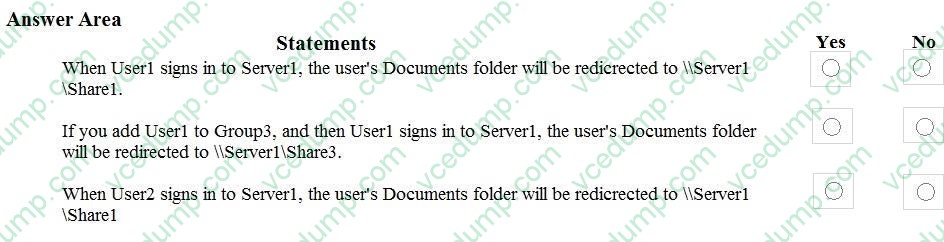
User1 is in OU1 and is a member of Group1 and Group2 User2 is in OU2 and is a member of Group1 and Group3 GPO1 is linked to OU1.
Server1 has three shares named Share1, Share2, and Share3. The Domain Users group permissions to all three shares.
GPO1 is configured as shown in the exhibit. (Click the Exhibit button.)
For each of the following statements, select Yes if the statement is true. Otherwise, select No. NOTE: Each correct selection is worth one point.
Hot Area:
-
Question 130:
Your network contains an Active Directory domain named contoso.com. The domain contains a username User1, a group named Group1, and an organizational unit (OU) named OU1.
You need to enable User1 to link Group Policies to OU1.
Solution: From Active Directory Administrative Center, you add User1 to Group1. From Group Policy Management, you click the Group Policy Objects container. From the Delegation tab, you add Group1.
Does this meet the goal?
A. Yes
B. No
Related Exams:
-
62-193
Technology Literacy for Educators -
70-243
Administering and Deploying System Center 2012 Configuration Manager -
70-355
Universal Windows Platform – App Data, Services, and Coding Patterns -
77-420
Excel 2013 -
77-427
Excel 2013 Expert Part One -
77-725
Word 2016 Core Document Creation, Collaboration and Communication -
77-726
Word 2016 Expert Creating Documents for Effective Communication -
77-727
Excel 2016 Core Data Analysis, Manipulation, and Presentation -
77-728
Excel 2016 Expert: Interpreting Data for Insights -
77-731
Outlook 2016 Core Communication, Collaboration and Email Skills
Tips on How to Prepare for the Exams
Nowadays, the certification exams become more and more important and required by more and more enterprises when applying for a job. But how to prepare for the exam effectively? How to prepare for the exam in a short time with less efforts? How to get a ideal result and how to find the most reliable resources? Here on Vcedump.com, you will find all the answers. Vcedump.com provide not only Microsoft exam questions, answers and explanations but also complete assistance on your exam preparation and certification application. If you are confused on your 70-742 exam preparations and Microsoft certification application, do not hesitate to visit our Vcedump.com to find your solutions here.