70-513 Exam Details
-
Exam Code
:70-513 -
Exam Name
:TS: Windows Communication Foundation velopment with Microsoft .NET Framework 4 -
Certification
:Microsoft Certifications -
Vendor
:Microsoft -
Total Questions
:323 Q&As -
Last Updated
:Nov 06, 2025
Microsoft 70-513 Online Questions & Answers
-
Question 271:
You want to debug the Windows Communication Foundation (WCF) client and server interaction through message and application tracing.
You need to correlate traces generated on the client and the server.
Which XML segment should you add to the system. diagnostics configuration element in the client and server application configuration file?
-
Question 272:
You develop a Windows Communication Foundation (WCF) service. You enable all performance counters and run multiple calls to the service.
The service must isolate session data for each user.
You need to monitor the instancing behavior used in the service.
Which performance counter should you monitor?
A. ServiceModelService 4.0.0.0\Calls
B. ServiceModelService 4.0.0.0\Instances
C. ASP.NET State Service\State Server Sessions Active
D. ASP.NET State Service\State Server Sessions Total -
Question 273:
You have a self-hosted Windows Communication Foundation (WCF) service.
You need to configure the service to provide an X.509 certificate during authentication What should you use to configure the service?
A. the Certificate property of the X509CertificatelnitiatorServiceCredential class
B. the SetCertificate method of the X509CertificatelnitiatorServiceCredential class
C. the SetCertificate method of the X5O9CertificateRecipientServiceCredential class
D. the TrustedStoreLocation property of the X5O9CertificateRecipientServiceCredential class -
Question 274:
You are creating a Windows Communication Foundation (WCF) service that implements operations in a RESTful manner. You need to add a delete operation.
You implement the delete method as follows.
Sub DeleteItems (ByVol id As String) You need to configure WCF to call this method when the client calls the service with the HTTP DELETE operation.
What should you do?
A. Add the WebInvoke(UriTemplate: = "/Items/{id>", Method: = "DELETE") attribute to the operation.
B. Add the HttpDelete attribute to the operation.
C. Replace the string parameter with a RemovedActivityAction parameter.
D. Change the Sub statement to Function and specify RemovedActivityAction as the return type. -
Question 275:
You are developing a Windows Communication Foundation (WCF) service that contains the following operation contract.
[OperationContract]
CustomerNames GetCustomerNames();
The operation returns customer names.
You need to develop a definition for the operation contract that produces XML with the following structure.
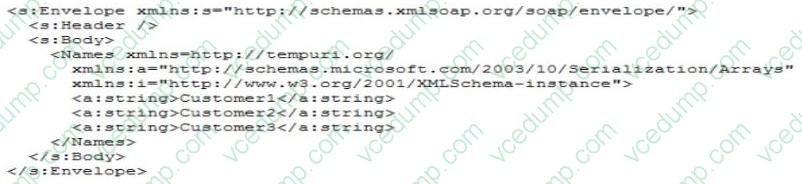
Which code segment should you use?
A. [MessageContract(IsWrapped = false)] public class CustomerNames { [MessageBodyMember] public string[] Names; }
B. [MessageContract(WrapperName = "")] public class CustomerNames {
C. [MessageBodyMember] public string[] Names; }
D. [DataContract] public class CustomerNames { [DataMember] public string[] Names; }
E. [DataContract] public class CustomerNames {
F. [DataMember(IsRequired = false)] public string[] Names; } -
Question 276:
A Windows Communication Foundation (WCF) service handles online order processing for your company.
You discover that many requests are being made with invalid account numbers. You create a class named AccountNumberValidator that has a method named Validate.
Before the message is processed, you need to validate account numbers with AccountNumberValidator and reject messages with invalid account numbers. You create a new class that implements the IParameterInspector interface. Which code segment should you use in this class?
A. Public Sub AfterCall( ByVal operationName As String, ByVal outputs() As Object, ByVal returnValue As Object, ByVal correlationState As Object) _ Implements IParameterInspector.AfterCall Dim accountNumber As String = GetAccountNumber(outputs) Dim validator As AccountNumberValidator = New AccountNumberValidator() If (Not validator.Validate(accountNumber)) Then Throw New FaultException() End If End Sub Public Function BeforeCall( ByVal operationName As String, ByVal inputs() As Object) As Object _ Implements IParameterInspector.BeforeCall Return Nothing End Function
B. Public Sub AfterCall( ByVal operationName As String, ByVal outputs() As Object, ByVal returnValue As Object, ByVal correlationState As Object) _ Implements IParameterInspector.AfterCall Return End Sub Public Function BeforeCall( ByVal operationName As String, ByVal inputs() As Object) As Object _ Implements IParameterInspector.BeforeCall Dim accountNumber As String = GetAccountNumber(inputs) Dim validator As AccountNumberValidator = New AccountNumberValidator() If (Not validator.Validate(accountNumber)) Then Throw New FaultException() End If Return Nothing End Function
C. Public Sub AfterCall( ByVal operationName As String, ByVal outputs() As Object, ByVal returnValue As Object, ByVal correlationState As Object) _ Implements IParameterInspector.AfterCall Dim accountNumber As String = GetAccountNumber(outputs) Dim validator As AccountNumberValidator = New AccountNumberValidator() If (Not validator.Validate(accountNumber)) Then returnValue = New FaultException() End If End Sub Public Function BeforeCall( ByVal operationName As String, ByVal inputs() As Object) As Object _ Implements IParameterInspector.BeforeCall Return Nothing End Function
D. Public Sub AfterCall( ByVal operationName As String, ByVal outputs() As Object, ByVal returnValue As Object, ByVal correlationState As Object) _ Implements IParameterInspector.AfterCall Return End Sub Public Function BeforeCall( ByVal operationName As String, ByVal inputs() As Object) As Object _ Implements IParameterInspector.BeforeCall Dim accountNumber As String = GetAccountNumber(inputs) Dim validator As AccountNumberValidator = New AccountNumberValidator() If (Not validator.Validate(accountNumber)) Then Return New FaultException() End If End Function -
Question 277:
A Windows Communication Foundation (WCF) service implements the following contract.
[ServiceContract| public interface IHelloService { [OperationContract] [VVebGet(UriTemplate =
"hello?namee{name}")] string SayHello(string name);
}
The implementation is as follows.
public class HelloService: IHelloService { public string SayHello(string name)
{ return "Hello ".+ name;
} }
The senvice is self-hosted, and the hosting code is as follows.
WebServiceHost svcHost = CreateHoseO;
svcHost.OpenO;
Console. ReadLineO;
SrvHost.CloseO;
You need to implement CreateHost so that the senvice has a single endpoint hosted at
http://localhost:8000/HelloService which code segment should you use?
A. WebServiceHost svcHost new WebServiceHost(typeof(HelloService)); svcHost.AddServiceEndpoint(typeof(lHelloService), new WebHttpBinding(WebHttpSecurityMode None), "http://localhost:8000/HelloService"); return svcHost;
B. Ur baseAddress = new Urit'http:I/localhost:800O1");r WebServiceHost svc Host new WebServiceHost(typeof(HelloService), baseAddress); svcHostAddServiceEndpoint(typeof(lHelloService), new WebHttpBinding(WebHttpSecurityMode. None), "HelloService"); return svc Host;
C. WebServiceHost svcHost = new Web Service Host(new HelloServiceO); svcHost AddServiceEndpoint(typeof(lHelloService), new WebHttpBinding(WebHttpSecurityMode. None), "http://Iocalhost: 8000/HelloService"); return svcHost
D. Ur baseAddress new Uri('http //Iocalhost 8000/"); WebServiceHost svc Host = new WebServiceHost(new HelloService0, baseAddress), svc Host.AddServiceEndpoint(typeof(IHelloService), new WebHttpBinding(WebHttpSec urityMode None), "HelloService"); retumn svc Host; -
Question 278:
You need to modify a client application that consumes a Windows Communication Foundation (WCF) service.
The service metadata is no longer available.
You need to modify the previously generated proxy to include asynchronous calls to the service.
What should you do?
A. Update the service reference with the Generate asynchronous operations option.
B. Create a partial class for the previously generated proxy and include the new asynchronous methods.
C. Create a class with the same name as the previously generated proxy and add the new asynchronous methods. Add the new class to a namespace that is different from the original proxy.
D. Create a class with the same name as the previously generated proxy and add the new asynchronous methods as partial methods. Add the new class to a namespace that is different from the original proxy. -
Question 279:
You are creating a client application and configuring it to call a Windows Communication Foundation (WCF) service. When the application is deployed, it will be configured to send all messages to a WCF routing service.
You need to ensure that the application can consume the target service after the application is deployed.
What should you do?
A. In the client application, add a service reference to the router service. In the client binding configuration, specify the address of the router service.
B. In the client application, add a service reference to the target service. In the client binding configuration, specify the address of the target service.
C. In the client application, add a service reference to the router service. In the client binding configuration, specify the address of the target service.
D. In the client application, add a service reference to the target service. In the client binding configuration, specify the address of the router service. -
Question 280:
You develop a Windows Communication Foundation (WCF) service to generate reports. Client applications call the service to initiate report generation but do not wait for the reports to be generated. The service does not provide any status to the client applications.
The service class is defined as follows. (Line numbers are included for reference only.)
01
You need to ensure that client applications can initiate reports without waiting for status.
Which two actions should you perform (Each correct answer presents part of the solution. Choose two.)
A. Insert the following code at line 03.
B. Insert the following code at line 03.
C. At line 04, change the GenerateReports method from Private to Public.
D. Remove line 06. At line 04, change the type of GenerateReports method to Sub. Remove the code As Integer from the method definition.
Related Exams:
-
62-193
Technology Literacy for Educators -
70-243
Administering and Deploying System Center 2012 Configuration Manager -
70-355
Universal Windows Platform – App Data, Services, and Coding Patterns -
77-420
Excel 2013 -
77-427
Excel 2013 Expert Part One -
77-725
Word 2016 Core Document Creation, Collaboration and Communication -
77-726
Word 2016 Expert Creating Documents for Effective Communication -
77-727
Excel 2016 Core Data Analysis, Manipulation, and Presentation -
77-728
Excel 2016 Expert: Interpreting Data for Insights -
77-731
Outlook 2016 Core Communication, Collaboration and Email Skills
Tips on How to Prepare for the Exams
Nowadays, the certification exams become more and more important and required by more and more enterprises when applying for a job. But how to prepare for the exam effectively? How to prepare for the exam in a short time with less efforts? How to get a ideal result and how to find the most reliable resources? Here on Vcedump.com, you will find all the answers. Vcedump.com provide not only Microsoft exam questions, answers and explanations but also complete assistance on your exam preparation and certification application. If you are confused on your 70-513 exam preparations and Microsoft certification application, do not hesitate to visit our Vcedump.com to find your solutions here.