70-461 Exam Details
-
Exam Code
:70-461 -
Exam Name
:Querying Microsoft SQL Server 2012/2014 -
Certification
:Microsoft Certifications -
Vendor
:Microsoft -
Total Questions
:446 Q&As -
Last Updated
:Jan 17, 2022
Microsoft 70-461 Online Questions & Answers
-
Question 261:
You administer a Microsoft SQL Server 2012 database named ContosoDb. The database contains a table named Suppliers and a column named IsActive in the Purchases schema. You create a new user named ContosoUser in ContosoDb.
ContosoUser has no permissions to the Suppliers table. You need to ensure that ContosoUser can delete rows that are not active from Suppliers. You also need to grant ContosoUser only the minimum required permissions.
Which Transact-SQL statement should you use?
A. GRANT DELETE ON Purchases.Suppliers TO ContosoUser
B. CREATE PROCEDURE Purchases.PurgeInactiveSu ppliers WITH EXECUTE AS USER = 'dbo' AS DELETE FROM Purchases.Suppliers WHERE IsActive = 0 GO GRANT EXECUTE ON Purchases.PurgelnactiveSu ppliers TO ContosoUser
C. GRANT SELECT ON Purchases.Suppliers TO ContosoUser
D. CREATE PROCEDURE Purchases.PurgeInactiveSu ppliers AS DELETE FROM Purchases.Suppliers WHERE IsActive = 0 GO GRANT EXECUTE ON Purchases.PurgeInactiveSu ppliers TO ContosoUser -
Question 262:
Which of the following are not allowed in the PIVOT operator's specification? (Chooseall that apply.)
A. Specifying a computation as input to the aggregate function
B. Specifying a computation as the spreading element
C. Specifying a subquery in the IN clause
D. Specifying multiple aggregate functions -
Question 263:
Which directive of the FOR XML clause should you use to produce element-centric XML?
A. ATTRIBUTES
B. ROOT
C. ELEMENTS
D. XMLSCHEMA -
Question 264:
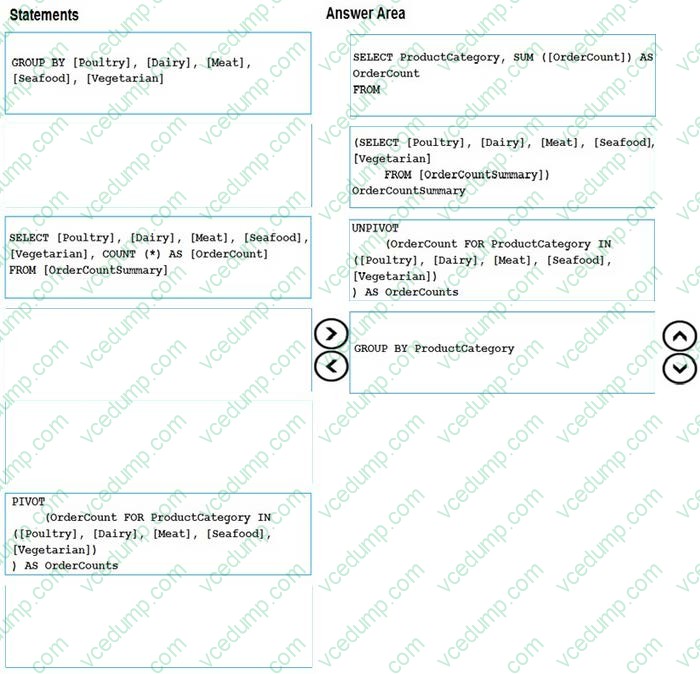
DRAG DROP
You develop a Microsoft SQL Server database for an order processing system that contains a table named OrderCountSummary, as shown in the first exhibit. (Click the Exhibit tab.)
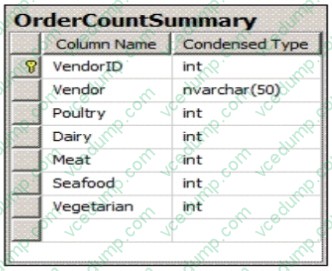
The table stores the names of vendors and the number of orders submitted by each vendor for each food category: Dairy, Meat, Poultry, Seafood, and Vegetarian. You need to generate a report that displays the total number of orders placed for each food category, as shown in the following table.
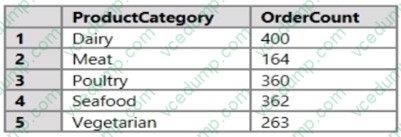
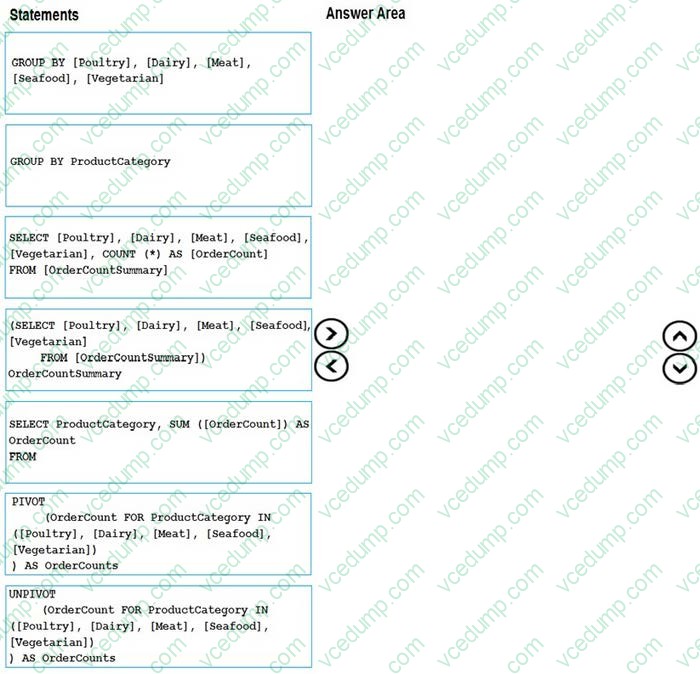
Which four Transact-SQL segments should you use to develop the solution? To answer, move the appropriate Transact-SQL segments from the list of Transact-SQL segments to the answer area and arrange them in the correct order.
Select and Place:
-
Question 265:
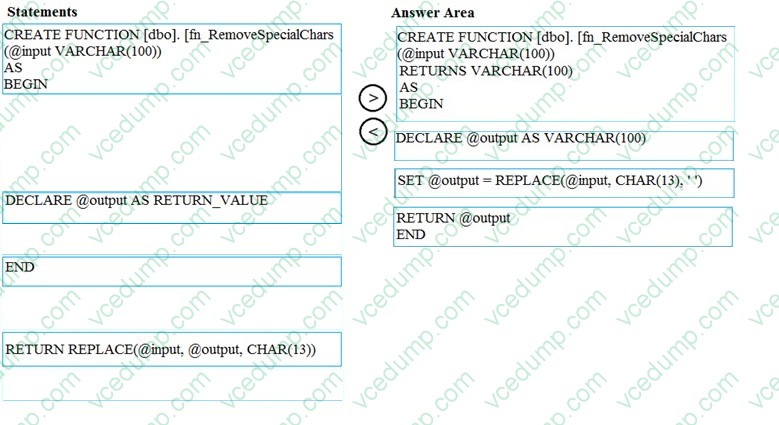
DRAG DROP
You develop a Microsoft SQL Server database that supports an e-commerce website. You create a table defined by the following Transact-SQL statement:
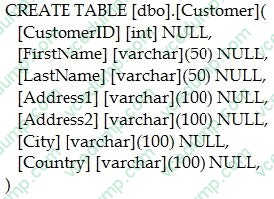
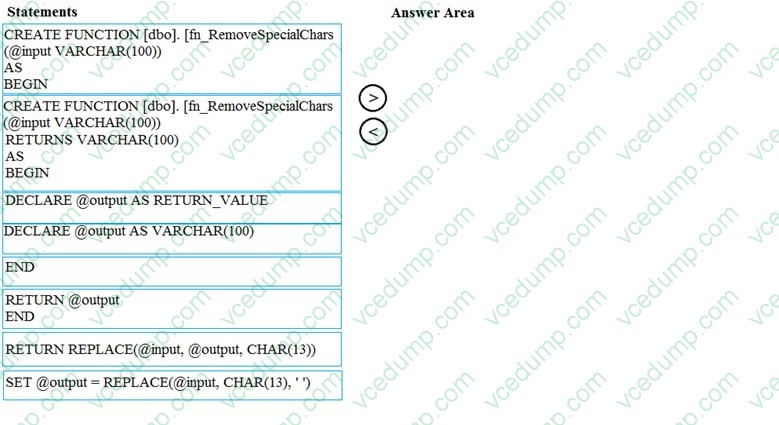
You need to create a reusable function that will remove all carriage return characters from all the text values.
Which four Transact-SQL segments should you use to develop the solution? To answer, move the appropriate Transact-SQL segments from the list of Transact-SQL segments to the answer area and arrange them in the correct order.
Select and Place:
-
Question 266:
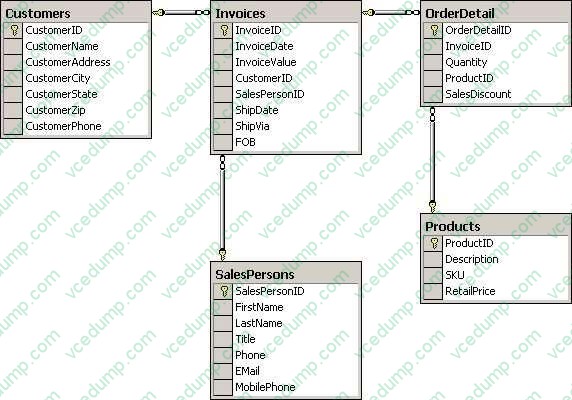
You work as a database administrator at ABC.com. ABC.com has a SQL Server 2012 database named SalesDB. The SalesDB database is shown in the following database diagram: You create a view on the SalesDB using the following Transact-SQL code:
CREATE VIEW SalesV
WITH SCHEMABINDINGS
AS
SELECT Products.ProductID, Invoices.InvoiceDate, SUM (Products.RetailPrice * OrderDetail.Quantity * OrderDetail.SalesDiscount) AS Price
FROM OrderDetail INNER JOIN Products ON
OrderDetail.ProductID = Products.ProducID
INNER JOIN Invoices ON
OrderDetail.InvoiceID = Invoices.InvoiceID GROUP BY Products.ProductID, Invoices.InvoiceDate GO
How should you alter this view to allow users to update data through the SalesV?
A. You should add a CHECK constraint to the SalesV view.
B. You should add an INSTEAD OF trigger to the SalesV view.
C. You should add a clustered index to the SalesV view.
D. You should add an AFTER UPDATE trigger to the SalesV view.
E. Create a columnstore index on all columns used in the SalesV view. -
Question 267:
You use a Microsoft SQL Server 2012 database. You want to create a table to store Microsoft Word documents. You need to ensure that the documents must only be accessible via Transact-SQL queries. Which Transact-SQL statement should you use?
A. CREATE TABLE DocumentStore ( [Id] INT NOT NULL PRIMARY KEY, [Document] VARBINARY(MAX) NULL ) GO
B. CREATE TABLE DocumentStore ( [Id] hierarchyid, [Document] NVARCHAR NOT NULL ) GO
C. CREATE TABLE DocumentStore AS FileTable
D. CREATE TABLE DocumentStore ( [Id] [uniqueidentifier] ROWGUIDCOL NOT NULL UNIQUE, [Document] VARBINARY(MAX) FILESTREAM NULL ) GO -
Question 268:
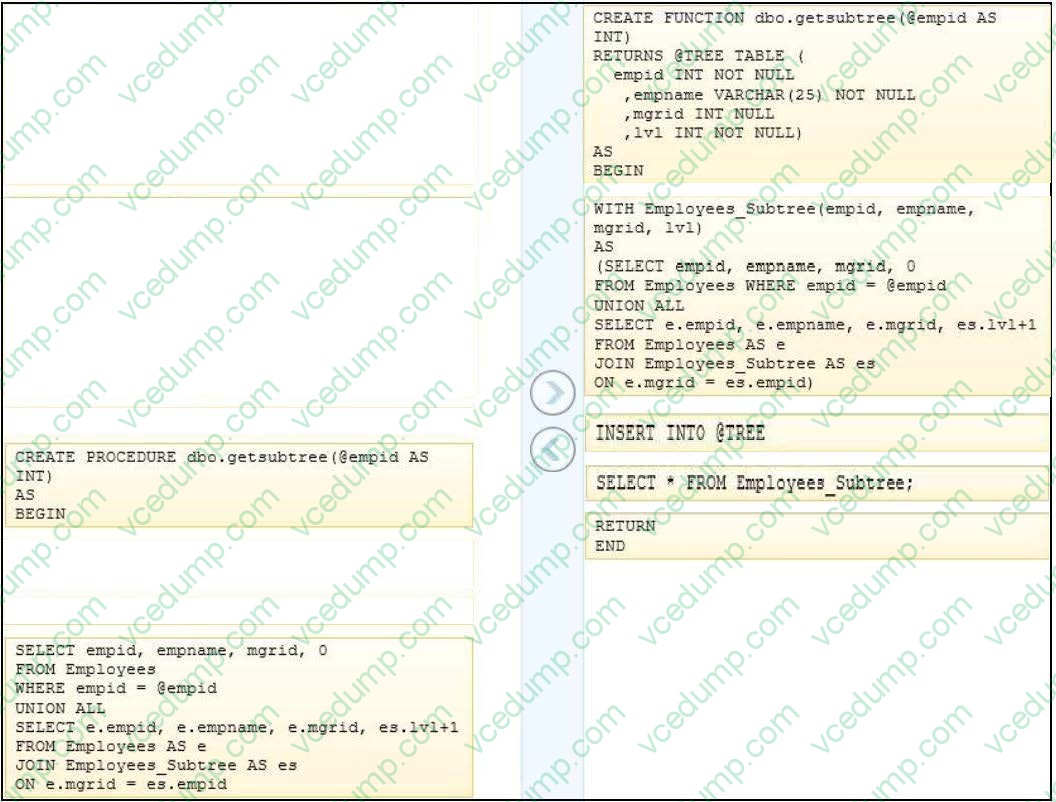
You use Microsoft SQL Server 2012 to develop a database application. You create two tables by using the following table definitions.
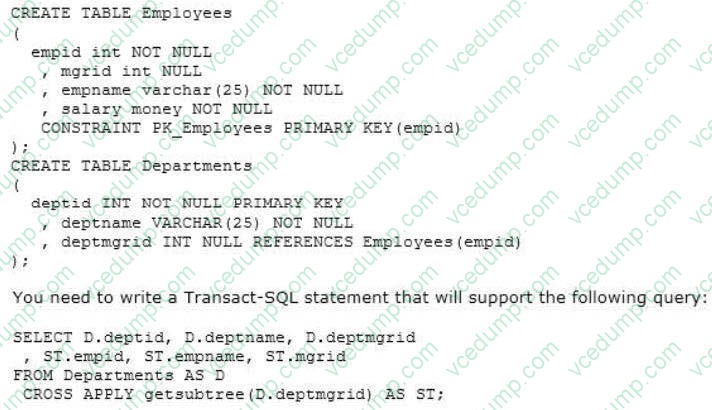
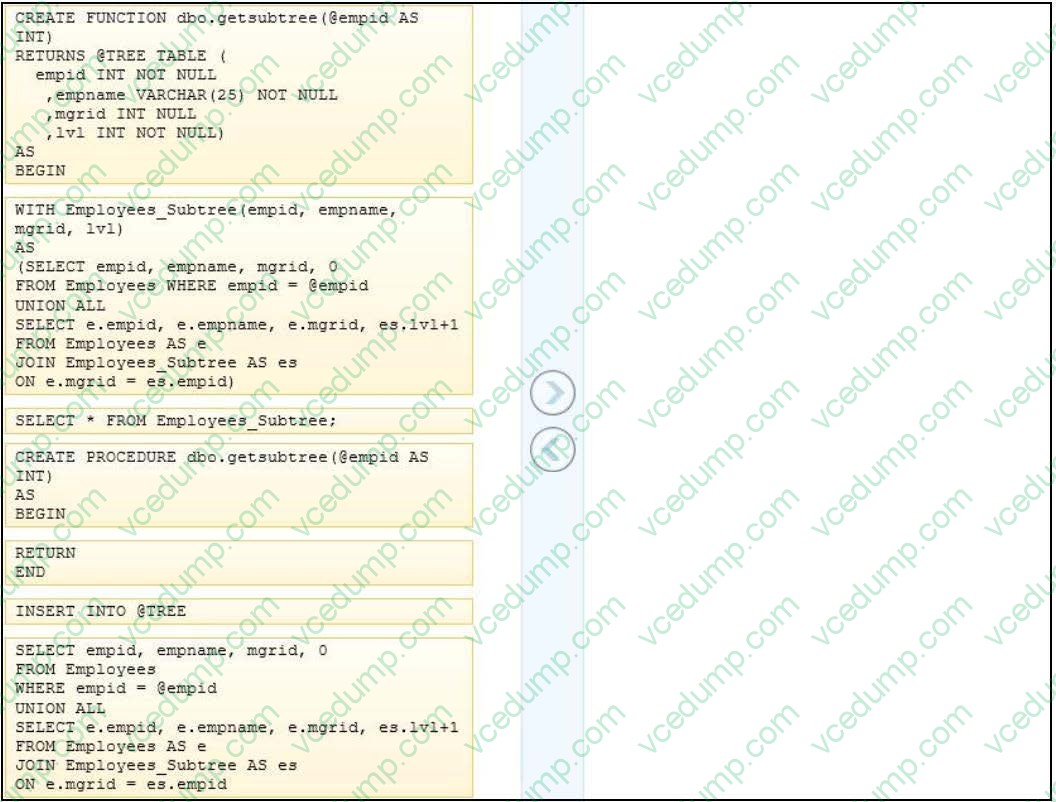
Which six Transact-SQL statements should you use? (To answer, move the appropriate SQL statements from the list of statements to the answer area and arrange them in the correct order.)
Select and Place:
-
Question 269:
A table named Profits stores the total profit made each year within a territory. The Profits table has columns named Territory, Year, and Profit.
You need to create a report that displays the profits made by each territory for each year and its previous year. Which Transact-SQL query should you use?
A. SELECT Territory, Year, Profit, LAG(Profit, 1, 0) OVER(PARTITION BY Year ORDER BY Territory) AS NextProfit FROM Profits
B. SELECT Territory, Year, Profit, LAG(Profit, 1, 0) OVER(PARTITION BY Territory ORDER BY Year) AS NextProfit FROM Profits
C. SELECT Territory, Year, Profit, LEAD(Profit, 1, 0) OVER (PARTITION BY Territory ORDER BY Year) AS NextProfit FROM Profits
D. SELECT Territory, Year, Profit, LEAD(Profit, 1, 0) OVER (PARTITION BY Year ORDER BY Territory) AS NextProfit FROM Profits -
Question 270:
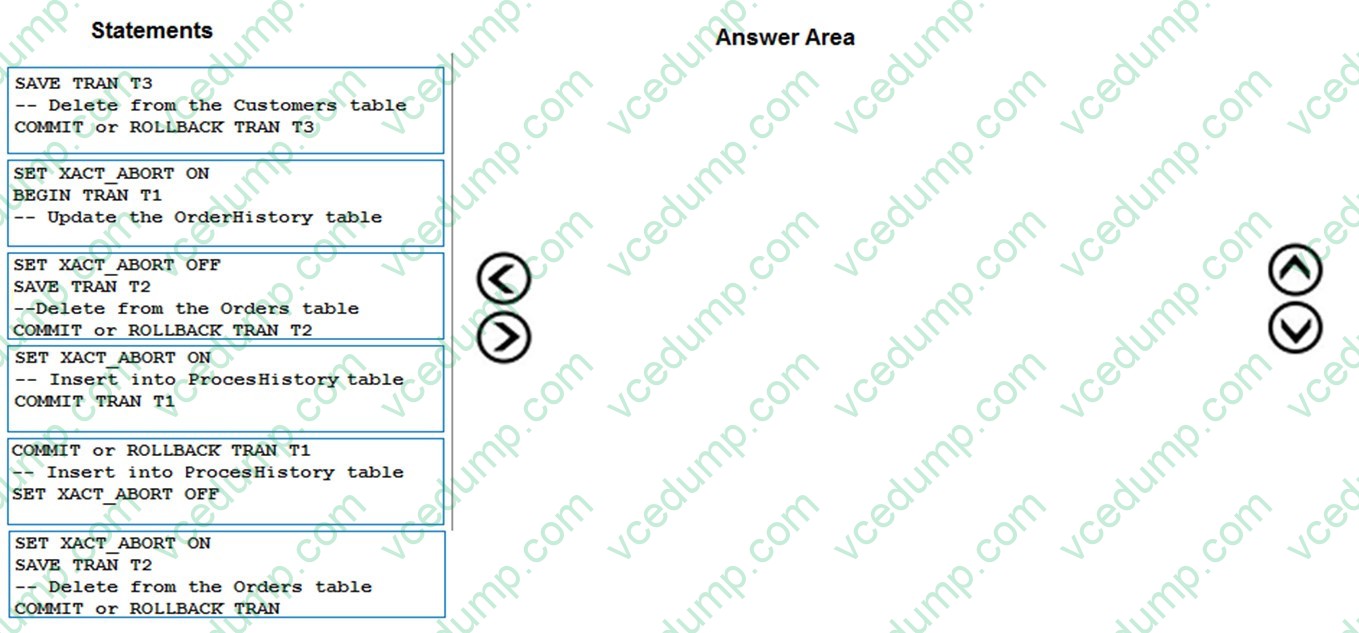
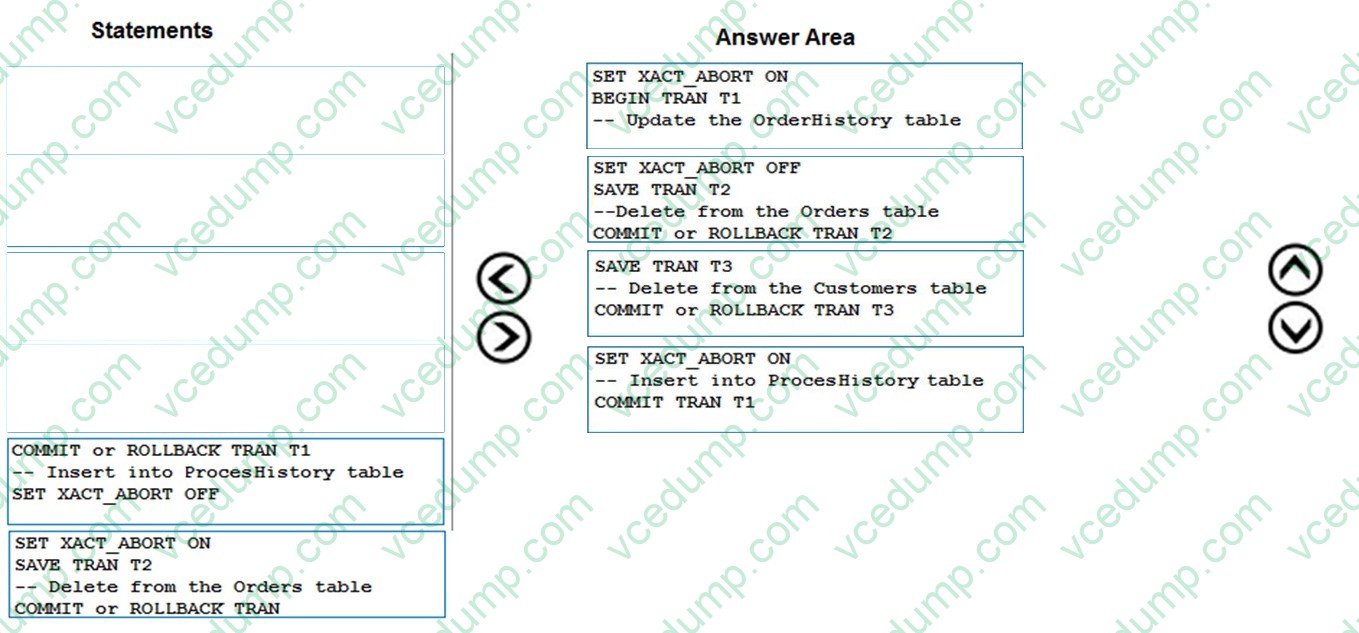
DRAG DROP
You are developer for a Microsoft Azure SQL Database instance.
You are creating a new stored procedure. The procedure must perform the following tasks in this order:
1. Update a table named OrderHistory.
2. Delete rows from a table named Orders.
3. Delete rows from a table named Customers.
4. Insert rows into a table named ProcessHistory.
You need to ensure that the procedure meets the following requirements:
If either DELETE operation fails, the rest of operation must continue.
If either the UPDATE operation or the INSERT operation fails, the whole procedure should fail and no changes should be retained.
Which four Transact-SQL segments should you use to develop the solution? To answer, move the appropriate Transact-SQL segments from the list of Transact-SQL segments to the answer area and arrange them in the correct order.
Select and Place:
Related Exams:
-
62-193
Technology Literacy for Educators -
70-243
Administering and Deploying System Center 2012 Configuration Manager -
70-355
Universal Windows Platform – App Data, Services, and Coding Patterns -
77-420
Excel 2013 -
77-427
Excel 2013 Expert Part One -
77-725
Word 2016 Core Document Creation, Collaboration and Communication -
77-726
Word 2016 Expert Creating Documents for Effective Communication -
77-727
Excel 2016 Core Data Analysis, Manipulation, and Presentation -
77-728
Excel 2016 Expert: Interpreting Data for Insights -
77-731
Outlook 2016 Core Communication, Collaboration and Email Skills
Tips on How to Prepare for the Exams
Nowadays, the certification exams become more and more important and required by more and more enterprises when applying for a job. But how to prepare for the exam effectively? How to prepare for the exam in a short time with less efforts? How to get a ideal result and how to find the most reliable resources? Here on Vcedump.com, you will find all the answers. Vcedump.com provide not only Microsoft exam questions, answers and explanations but also complete assistance on your exam preparation and certification application. If you are confused on your 70-461 exam preparations and Microsoft certification application, do not hesitate to visit our Vcedump.com to find your solutions here.